





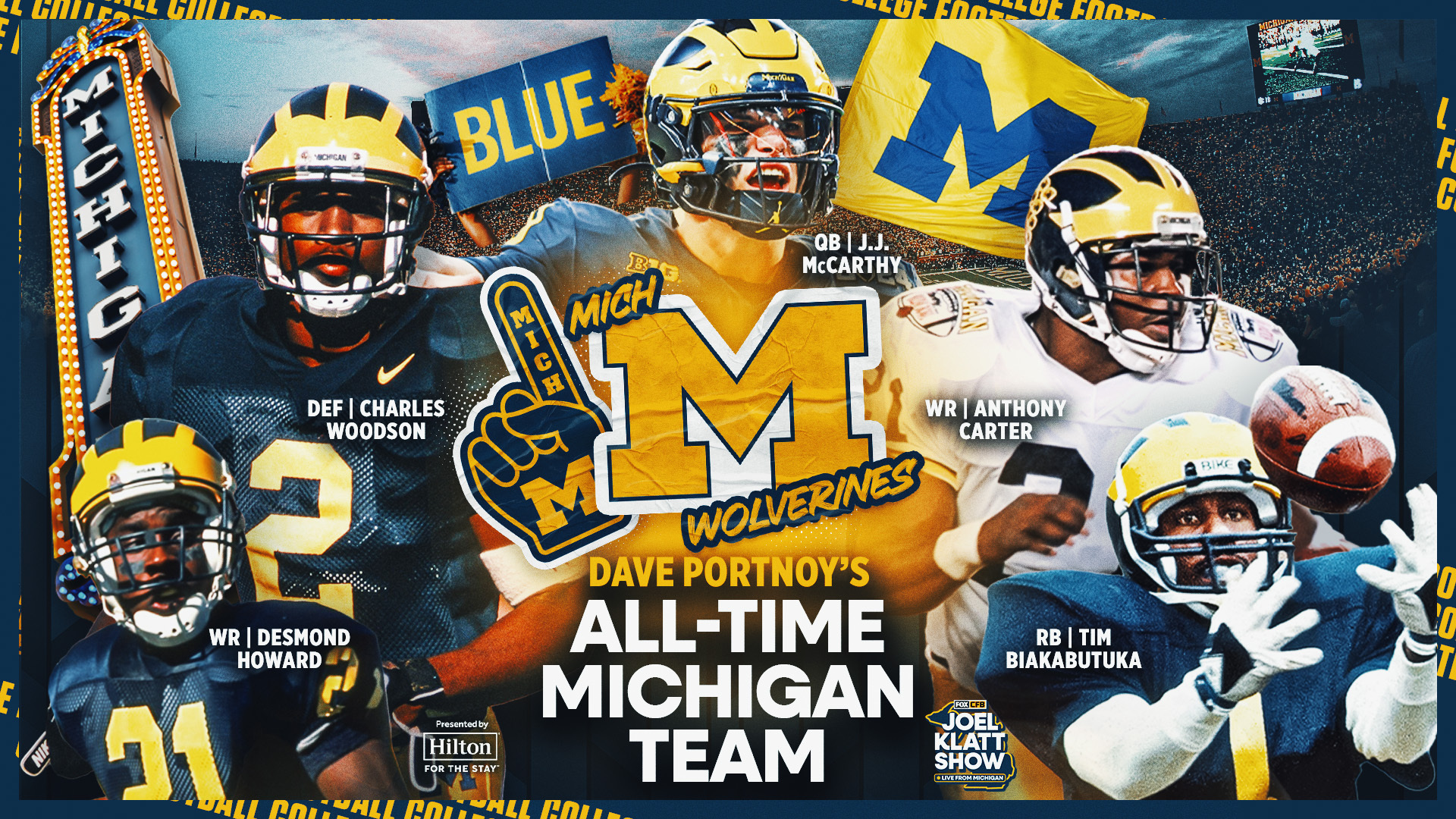
If you invite a die-hard Michigan fan to a live show and give him the chance to build his all-time Wolverines football team, you better be ready for some debate. But for Dave Portnoy, it wasn’t just a debate—it was a declaration. The scene was set in Ann Arbor, the heart of Michigan football, where “The Joel Klatt Show” had set up for a special live episode ahead of a massive Saturday showdown between Michigan and Oklahoma, kicking off at noon ET on FOX. The buzz in the room was electric, the kind of energy that only a college town can generate on a game week. Klatt, a former college quarterback and one of the sharpest football minds in sports media, introduced Portnoy as one of the most passionate and outspoken Michigan fans in existence. Then he issued the challenge: pick the ultimate Michigan team—one quarterback, one running back, two wide receivers, and one defensive player. For most people, that would be a fun hypothetical. For Portnoy, it was a test of emotional memory. The Barstool Sports founder has lived and died with this team through every heartbreak and every triumph. He has watched Michigan lose to Ohio State in ways that seemed cruel, and he has watched Michigan climb back to the top of college football. So when he opened his mouth to answer, the audience knew they weren’t going to hear a safe, politically correct, stat-obsessed list. They were going to hear the truth, straight from a fan’s soul.
The quarterback decision was always going to be the most contentious one. Michigan has produced legends at the position, including Tom Brady, arguably the greatest NFL quarterback of all time, and Jim Harbaugh, the current coach and a former All-American signal-caller. But Portnoy didn’t say Brady. He didn’t say Harbaugh. He said J.J. McCarthy, and he said it with the confidence of someone who had just been asked his own name. “To me, it’s a no-brainer. It’s not even close,” Portnoy said. He acknowledged that if you were building an NFL team, Brady would be the pick. But this wasn’t about the NFL. It was about what McCarthy meant to Michigan. McCarthy’s career numbers are excellent: he completed 482 of 713 passes for 6,226 yards, 49 touchdowns, and just 11 interceptions. He also ran for 632 yards and 10 scores. But the stat that matters most to Portnoy is the one that doesn’t show up in a standard scouting report: McCarthy’s record as a starter was 27-1. That is not a collection of nice games; that is a revolution. Before McCarthy arrived, Michigan was in a dark place. Ohio State was a recurring nightmare, and the Wolverines were getting “drummed” every year, as Portnoy put it. There were serious questions about whether Harbaugh could fix the program, and Portnoy admitted that he was among those who wanted him gone. Then McCarthy took the field, and everything changed. He beat Ohio State. He won the Big Ten. He led Michigan to a national championship. For Portnoy, that makes McCarthy the defining quarterback of Michigan’s modern era. You can argue that Brady is the greatest player to ever come through the program, but Portnoy’s question is different. It’s about impact. And no one had more impact than McCarthy.
At running back, Portnoy chose a name that might have made some younger fans raise their eyebrows: Tim Biakabutuka. This wasn’t a random pick from a highlight reel. It was personal. Biakabutuka played for Michigan from 1993 to 1995, and his career totals are impressive: 434 carries for 2,624 yards and 24 touchdowns. But no one remembers him for the accumulation. They remember him for one afternoon in 1995, a game that should be studied by anyone who wants to understand what makes sports special. Michigan faced Ohio State, and the Buckeyes were undefeated and ranked No. 2 in the country. They had one of the most ferocious defenses in the nation. And then Biakabutuka happened. He ran for 313 yards. That is not a typo. He shredded a supposedly elite defense as if it were made of paper, and he did it in the biggest game of the year. “He made them look bad,” Portnoy said, and you could hear the joy still bubbling in his voice. It wasn’t just that Michigan won. It was that a Michigan running back took the most important game of the season and turned it into a personal museum exhibit. Portnoy was not shy about his affection. “I loved Biakabutuka. I had a crush on Biakabutuka,” he said, and the audience laughed because they understood exactly what he meant. This wasn’t a rational analysis of yards per carry. It was the memory of a fan who watched a player do the impossible. Michigan has had many great running backs, including Blake Corum, who helped win a national title. But Portnoy didn’t pick Corum. He didn’t pick Mike Hart or Tyrone Wheatley. He picked the player who delivered the most jaw-dropping single-game performance against Michigan’s biggest rival. That’s how you build an all-time team when you’re not just looking at a spreadsheet. You pick the guy who made you believe.
At wide receiver, Portnoy had no desire to overthink anything. He picked Desmond Howard and Anthony Carter, two names that belong in the first sentence of any conversation about Michigan football. Howard, who played from 1988 to 1991, was a Heisman Trophy winner and the kind of receiver who made defensive coordinators change their entire game plan. He finished his career with 134 receptions for 2,146 yards and 32 touchdowns. But his résumé also includes electric special teams production: 45 kickoff returns for 1,211 yards and two scores, plus 26 punt returns for 337 yards and another touchdown. His most famous moment, a punt return touchdown against Ohio State where he struck the Heisman pose in the end zone, is one of the most iconic plays in the history of the rivalry. Anthony Carter, meanwhile, came from an earlier generation, playing from 1979 to 1982. He was just as explosive, if not more so. Carter caught 161 passes for 3,076 yards and 37 touchdowns, averaging an absurd 19.1 yards per reception. He also contributed on special teams, totaling 907 punt return yards and 1,606 kickoff return yards, with multiple return scores. All told, he scored 40 touchdowns for the Wolverines. Carter was a pioneer, a player who proved that a receiver could be the centerpiece of an offense long before the modern spread era made that idea fashionable. Portnoy’s explanation for selecting both was gloriously simple: “I want Desmond and Anthony Carter. I’m down with that.” No long justification, no careful deliberation. Just pure instinct. Howard and Carter represent two different eras, but they share a common thread: they were game-changers. They made ordinary plays look like art, and they made every snap feel like a potential six points.
The defensive choice was the only one that made Portnoy pause. He knew that Aidan Hutchinson had a legitimate argument. Hutchinson, the 2021 star who terrorized Ohio State, was a pure pass rusher with a relentless motor. Portnoy even brought up the now-famous clip of Hutchinson throwing an Ohio State offensive lineman into another time zone. “There’s that clip of him just taking the Ohio State lineman and just throwing him into the fourth row,” Portnoy said. It was a violent, beautiful moment that perfectly captured the anger and frustration Michigan fans had felt for years, channeled through one man’s raw power. But as much as Portnoy loved Hutchinson, he could not ignore the aura of Charles Woodson. Woodson, who patrolled the secondary from 1995 to 1997, was not just a great cornerback. He was a force that altered the structure of the game. He intercepted 16 passes, but he was also an offensive weapon, catching 21 passes for 370 yards and three touchdowns while adding 167 rushing yards and two scores. He returned punts with an almost balletic fearlessness. And in 1997, he became the first primarily defensive player to win the Heisman Trophy. That alone would have made him a legend, but he also ended that season as a national champion. For Portnoy, Woodson is the ultimate example of how one player can dominate an entire sport without touching the ball on every possession. He was a cornerback who made quarterbacks look away. He was a returner who made punt teams fear him. He was an offensive threat who could flip field position in a single play. “It’s gotta be Woodson,” Portnoy concluded. No disrespect to Hutchinson, who will always have that clip and a special place in Michigan lore. But Woodson didn’t just win games. He changed the conversation. He made it possible to imagine a defender as the face of a national championship team.
When it was over, Portnoy’s all-time Michigan team looked less like a fantasy roster and more like a timeline of modern Michigan football history. At quarterback, J.J. McCarthy, the player who broke the Ohio State curse and guided the Wolverines to a national title. At running back, Tim Biakabutuka, the man who turned one game against Ohio State into a permanent legend. At wide receiver, Desmond Howard and Anthony Carter, two names that define explosive playmaking. On defense, Charles Woodson, the two-way star who made history and ensured that no one would ever forget 1997. It is not the most statistically dominant team in every category. It is not a team that would necessarily dominate in a computer simulation. But it is a team that tells a story, and that is what makes sports so powerful. Portnoy didn’t pick these players just because of their numbers. He picked them because of what they meant to him and to every other fan who lived through those eras. He picked McCarthy because he represented redemption. He picked Biakabutuka because he represented the ability to shock the world. He picked Howard and Carter because they represented joy. He picked Woodson because he represented perfection. The choices will be debated, and that is exactly the point. Someone will make the case for Brady. Someone will make the case for Corum. Someone will argue that another receiver deserves a spot. That is the beauty of sports fandom. There is no official answer, only the stories we carry with us. As Michigan prepares to face Oklahoma, with FOX cameras rolling and Joel Klatt broadcasting from the heart of Wolverines country, Portnoy’s team will stand as a reminder of why we love this game. It is not about being right. It’s about feeling something. And anyone who listened to Portnoy on that Thursday in Ann Arbor could hear exactly what Michigan football feels like in his bones. It’s loud. It’s messy. It’s loyal. And it never, ever looks away.