


Here is a humanized and deeply expanded summary of Cal Raleigh’s breakout performance, written to capture the emotional weight and narrative drama of what transpired.
Paragraph 1: The Heavy Weight of a Forgotten Star
The late-summer Seattle air, thick with marine moisture and the briny scent of Puget Sound, hung over T-Mobile Park like a held breath on that Monday night. For the majority of the 40,000 fans filing into their seats, the primary storyline was the health of the Mariners’ playoff hopes, but for the man crouching behind the plate in the home dugout, the narrative was far more personal and suffocating. Cal Raleigh, the hulking switch-hitting catcher who had become a folk hero in the Pacific Northwest, had been carrying a burden that seemed to grow heavier with every passing day. The scoreboard flashing his batting average—a ghastly .159, a figure that looked more like a typographical error than a statistic for a former Most Valuable Player runner-up—felt like a scarlet letter sewn into the back of his jersey. The whispers had started weeks ago, creeping from the sports talk radio shows into the clubhouse: What’s wrong with Cal? Is the pressure too much? Has he lost it for good? A year ago, he was the titan of the sport, the man who had smashed 60 home runs and driven in 125, a juggernaut who carried the franchise on his massive shoulders. Now, every at-bat was a public struggle, a mental gauntlet where the ghosts of his past successes mocked his current failures. He had tried everything—changing his stance, watching film until his eyes burned, meditating in the quiet of the batting cage—yet the ball refused to find green grass. In the first inning, that tension was palpable. Across from him stood Zack Wheeler, a flailing ace in his own right, a pitcher whose recent struggles had made him vulnerable. The Mariners had managed to scratch together a couple of baserunners against him, and the electric hum of the crowd signaled a potential breakthrough. Raleigh stepped into the batter’s box, his heart hammering against his chest wall, the voices of doubt screaming in his ears. He looked out at the mound, saw Wheeler’s eyes darting toward the catcher, and tried to remember the simplicity of the game he had loved since childhood: see the ball, hit the ball.
Paragraph 2: The Dam Breaks in the First Inning
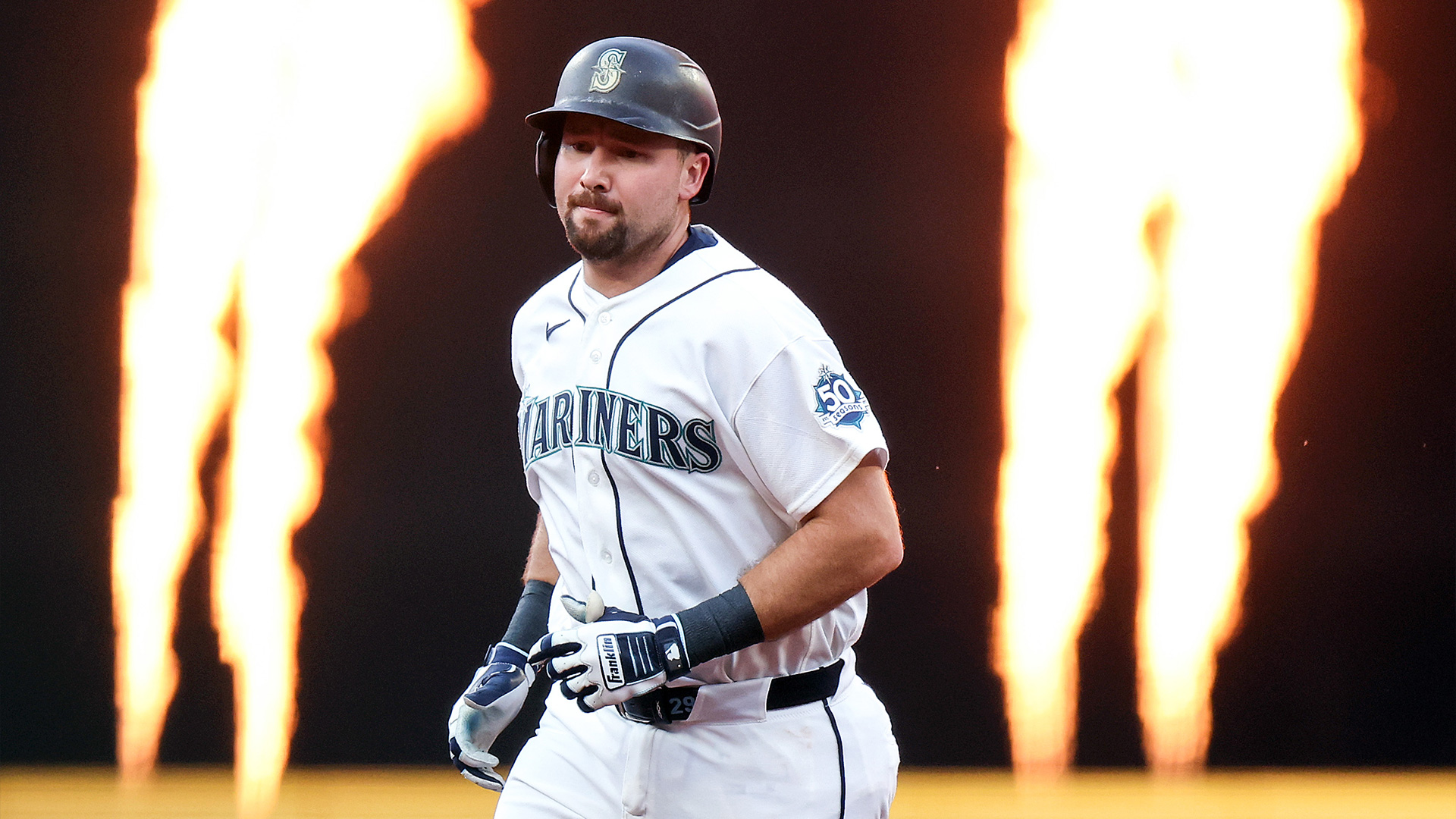
What happened next was not just a baseball play; it was an emotional exorcism. With the bases full of Mariners—a walk, a single, and a field error giving him the chance to not just contribute, but to break the game open—Raleigh dug his back foot into the dirt and waited. The pressure of the inning was immense, but the pressure of his season loomed even larger. Wheeler, desperately searching for a pitch to escape the jam, reached back for a fastball. It was a pitch he normally commands with precision, but tonight, it leaked over the heart of the plate, a meaty mistake with a hint of indecision. Raleigh’s massive frame uncoiled with a violent, balletic fury. The sound that followed—the crack of the ash meeting the ball—was not the weak, sickly pop of a groundout that had haunted him all season, but a sharp, clean thunderclap that snaps the head of every fan in the stadium toward the flight of the ball. The ball screamed off the bat, a laser beam that skipped into the right-field seats, landing with a thump that seemed to shake the foundation of the ballpark. It was the culmination of the five-run inning, the exclamation point on a rally that gave the Mariners a commanding lead, but for Raleigh, it was something far more profound. It was a release valve, a white-hot surge of adrenaline that washed away fourteen weeks of grinding frustration. As he rounded first base, his usually stoic face betrayed a flicker of raw relief—his eyes wide, his jaw unclenching. The dugout erupted. Teammates leapt over the railing, their shouts drowned out by the roar of a crowd that desperately wanted to believe their hero was back. He wasn’t just a scoring a run; he was reclaiming his identity. For Wheeler, it was a demoralizing blow, the final nail in a brutal night, but for Raleigh, it was the first full breath he had taken in months. The monkey, the weight, the demon—whatever you wanted to call it—was still on his back, but for the first time, it felt like a backpack he could actually shed.
Paragraph 3: The Savoring of a Multihomer Masterclass
The fifth inning arrived with the Mariners cruising on a comfortable cushion, but the game’s tension had shifted from the scoreboard to a singular, quiet quest that was brewing in the heart of the lineup. Raleigh stepped to the plate to lead off the inning. Wheeler, still on the mound despite the earlier beating, was doing the grim math of a pitcher fighting for survival. He challenged Raleigh again, this time with a slider that hung just fractionally higher than intended. Raleigh, seeing the pitch with sudden, surreal clarity, launched his second long ball of the night. This one sailed even further, a towering, majestic shot into the second deck, leaving no doubt as it left the yard. The crowd, which had been buzzing about the first homer, now rose to a fever pitch. The realization started to wash over the stadium: this could be a special night. The third act came in the seventh inning. Wheeler had been rendered ineffective, pulled from the game after a long, arduous evening. In his place came the hard-throwing reliever Chase Shugart, a man tasked with the thankless job of silencing a hitter who had already tasted blood. Shugart, perhaps overthinking the moment, fell behind in the count. He had to throw a strike, and he did—a fastball that, while not poorly located, was exactly where Raleigh wanted it. In a sequence that felt predestined, Raleigh turned on it and sent a scorching, line-drive screamer into the bleachers for his third home run of the game—his first career three-homer masterpiece. The ballpark became a cacophony of pure, unadulterated joy. The “Raleigh! Ral-eigh! Ral-eigh!” chants were deafening. Teammates lined up at the top step of the dugout, slapping his helmet, hugging him so hard it lifted him off his feet. He wasn’t just a hitter having a good night; he was a man who had been trapped in a dark cave, finally seeing the light, and his joy was infectious, raw, and deeply human.
Paragraph 4: The Statistical Poetry of Redemption
When the dust settled and the bottom of the seventh inning frame came to a close, the stat lines told a story of magnificent arithmetic shifting slowly back into reality. Raleigh finished the night a perfect 3-for-3, with a walk added to his ledger, a near-flawless day at the dish. The three home runs pushed his season total to 17, a respectable number for a slugger, but one that had felt so distant given his abysmal average. The more staggering math, however, was the leap on the scoreboard: from .159 to .167. A minuscule change of eight points, an array of decimals that means nothing to the casual fan but means the world to a player buried in the depths of a slump. It is a peculiar irony that a hitter can blast three balls over the fence and only raise his average a handful of points, but it perfectly encapsulates the feast-or-famine nature of his season. When he connected, he connected with authority—the young catcher was on pace for 40 homers again if extrapolated—but the consistent singles, the bloops, the seeing-eye grounders that form the foundation of a batting average, were painfully absent. This night, however, was about the swing path. It was about the mechanical adjustments that had been paying off in secret batting practice sessions. The walk he took in another at-bat was arguably just as important as the home runs; it demonstrated a blossoming plate discipline, a willingness to let the ball pass, a sign that the anxiety was melting away and his brain was finally catching up with his athletic body. The .167 average is a reminder of the hole he dug, but the sheer power display is a testament to the fact that he was never broken; he was simply waiting for the storm to pass. Every great hitter goes through this crucible, and tonight, the statistics ceased to be a verdict on his career and instead became a launching pad for the second half of the season.
Paragraph 5: The Shadow of the MVP and the Pressure of Greatness
To truly understand the magnitude of this particular Monday night, one must rewind the tape to the previous autumn. A calendar year ago, Raleigh was not just a good catcher; he was the most talked-about offensive force in the league. He was the runner-up for the American League Most Valuable Player award, a monumental achievement that placed him in the pantheon of elite talents. He led all of Major League Baseball with 60 home runs and 125 runs batted in, numbers so eye-popping they seem fictional. That season created a golden cage for him. It set a standard so impossibly high that any regression would be viewed not as a normal fluctuation, but as a catastrophic failure. The pressure of that monster season bled into the winter, the spring, and the summer. Every at-bat in 2024 was framed against the ghost of 2023. The opposing pitchers attacked him differently, treating him with the respect reserved for a perennial All-Star, but a hittable fastball in the zone became a temptation he just couldn’t resist, leading to an expansion of his strike zone and a barrage of outs. The media scrutiny was relentless. Sports analysts dissected his swing on a nightly basis, questioning if the league had figured him out, if his years of catching had worn him down. He was living through the loneliness of the king, isolated by his own previous brilliance. And yet, through the misery of the .159 average, he continued to show up. He continued to handle the demanding duties of a catcher, calling games, blocking balls in the dirt, throwing out baserunners, providing value even when his bat failed. This performance against Wheeler was not luck; it was a breaking of a psychological barrier. It was the defiant declaration that the MVP runner-up was still inside this struggling shell, and that the law of averages, combined with sheer talent, had finally coalesced to remind the baseball world that Cal Raleigh is a transcendent star who refuses to be defined by a bad stretch.
Paragraph 6: The Aftermath and the Long Road Ahead
The final out of the 9-2 victory was recorded, but the story of the night lingered in the electric air of the clubhouse. Water bottles were dumped, music blared, and for the first time in a long time, the laughter that echoed off the walls of the home clubhouse was genuine and unforced. The win itself was a crucial boost in a razor-thin division race, but the individual triumph was the true centerpiece. Raleigh sat at his locker, a sheen of sweat still on his brow, eyes glistening not with tears but with the quiet satisfaction of a man who had just wrestled his own worst enemy to the ground. He didn’t speak of the 60 home runs from the past season, nor did he promise a return to MVP form. He spoke of process, of