




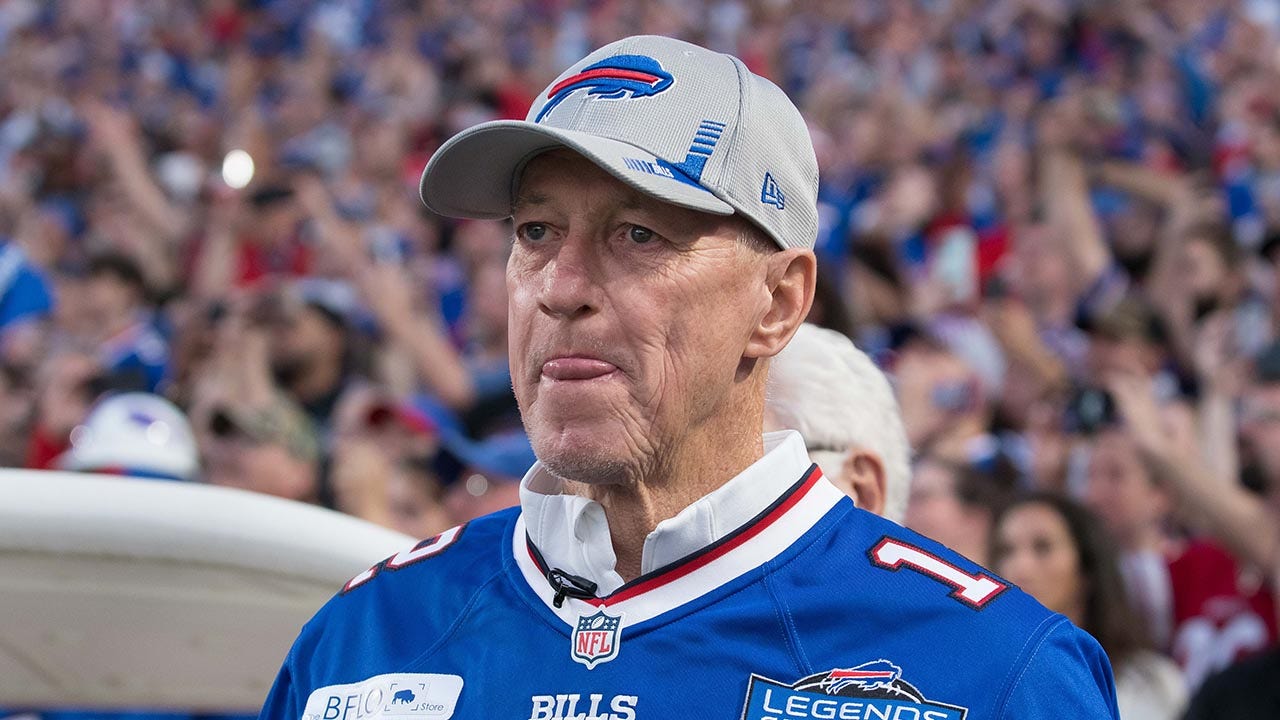
On a bright, ceremonial afternoon in Orchard Park, New York, the air was thick with the scent of fresh-cut grass, new concrete, and the overwhelming promise of a bright new era. Dignitaries, team executives, and community leaders had gathered for the highly anticipated ribbon-cutting ceremony of the brand-new, state-of-the-art Highmark Stadium—a magnificent architectural marvel designed to carry the Buffalo Bills and their fiercely loyal fan base into the future. It was supposed to be a day defined entirely by celebration, ribbon cuttings, and forward-looking optimism. However, the narrative of the day took a deeply touching and unexpected turn when the franchise’s most cherished living legend, former Hall of Fame quarterback Jim Kelly, stepped up to the microphone. Standing before a crowd of familiar faces, the 66-year-old icon did not just speak of luxury suites, modern engineering, or gridiron strategies; instead, he shared a deeply personal and sobering update that caught everyone off guard. Kelly revealed that just a month and a half prior, he had suffered an unexpected stroke that required a taxing, multi-day hospitalization. For a region that has long viewed Kelly as the physical embodiment of their own rugged resilience, the news was a sudden, jarring reminder of human vulnerability amidst a backdrop of brand-new, sterile perfection. Yet, characteristically, Kelly delivered the news not with a plea for sympathy, but with the pragmatic, dry wit that has endeared him to millions for decades. Acknowledging that his eyesight is currently failing him and joking that his hearing “still sucks” as a natural byproduct of a life lived loud and hard, he declared that he feels remarkably good, instantly transforming a moment of collective worry into an inspiring testament to the enduring human spirit.
To understand the gravity of Kelly’s latest health scare is to appreciate the staggering gauntlet of medical adversity he has already traversed throughout his post-football life, cementing his status as a living symbol of survival. Long before this recent stroke, Kelly’s body had become a quiet, sacred battlefield, bearing the physical scars and spiritual lessons of multiple grueling encounters with terminal illness. His harrowing journey with squamous cell carcinoma began with an initial diagnosis and extensive surgery to his upper jawbone in 2013, a blow that was swiftly followed by a terrifying recurrence in 2014 that demanded aggressive, exhausting rounds of chemotherapy and radiation targeting his maxillary sinus. The ultimate test of his physical and emotional endurance arrived in 2018, when he underwent a massive, highly complex reconstructive surgery to rebuild his upper jaw using bone from his leg after the oral cancer returned with a vengeance. Each of these chapters was fraught with immense pain, functional disruptions to his speech and swallowing, and the terrifying prospect of mortality, yet Kelly consistently met each crisis with an unyielding resolve and a raw, public openness about his reliance on Christian faith and family to pull him through the darkest corridors of human suffering. To the profound relief of a collective community that holds its breath with geographical proximity to his pain, Kelly was quick to follow the news of his stroke with the triumphant declaration that his most recent cancer screenings have returned entirely clear, proving that his long-running war with oncological demons remains a spectacular story of victory. His ability to stand tall, share his physical limitations without shame, and smile in the face of cumulative bodily trauma humanizes him far more than any pristine highlight reel ever could, demonstrating a deep, everyday heroism that far outshines the glory of his youthful athletic prime.
Indeed, that athletic prime remains the stuff of football scripture, particularly within the boundaries of Western New York, where Jim Kelly’s legacy is woven tightly into the very fabric of municipal identity. From 1986 to 1996, Kelly served as the commander-in-chief of a historic Buffalo Bills era, pioneering the legendary, lightning-fast “K-Gun” no-huddle offense that completely revolutionized how modern professional football is designed and executed. Under his fierce, vocal leadership, the Bills achieved a historic feat that has never been replicated in NFL history: securing four consecutive AFC Championship titles and marching to four straight Super Bowl appearances from 1991 to 1994. While cynical national sportswriters often dwell on the agonizing heartbreak of those four consecutive championship defeats, the real legacy of that era lies in the profound masterclass of resilience it taught an entire generation of Buffalonians. Rather than letting those devastating, high-profile losses divide them, the city and its quarterback forged an unbreakable, deeply empathetic bond in the fires of shared disappointment, realizing that their mutual struggles made them stronger together. It was a relationship built on the blue-collar understanding that life, much like football, is not defined by how many times you are knocked to the turf, but by the stubbornness with which you stand back up and face the next play. Today, when Bills fans look at Jim Kelly, they do not see a tragic figure of near-misses; instead, they see a champion of perseverance who mirrors their own working-class values, a beloved father figure who taught them that true loyalty is forged in the brutal storms of winter, not the fleeting sunshine of easy victories.
This historical hunger for a championship and a deep sense of unfinished business continues to fuel the modern era of Buffalo football, bringing a heavy emotional weight to the current team led by superstar quarterback Josh Allen. Since he was drafted in 2018, Allen has carried the hopes of an entire region on his broad shoulders, drawing inevitable, deeply affectionate comparisons to Kelly himself with his high-stakes play style, physical toughness, and profound, authentic connection to the local community. Under Allen’s dynamic, passionate leadership, the contemporary Bills have successfully clawed their way back to NFL elite status, making triumphant postseason runs and marching deep into the playoffs, only to find their ultimate championship dreams repeatedly thwarted by their perennial postseason rivals, the Kansas City Chiefs. Throughout all these modern heartbreaks and nail-biting triumphs, Kelly has remained an incredibly active, comforting, and visible presence in the Western New York area, refusing to retreat into a comfortable, quiet retirement and instead choosing to act as a vital mentor, passionate cheerleader, and living bridge between the franchise’s historic past and its highly anticipated future. Rather than viewing the current team’s quest for the elusive Vince Lombardi Trophy through a lens of jealousy or territorial pride, Kelly has embraced the young roster with a paternal warmth, offering steady guidance on how to handle the immense pressure of carrying an entire city’s emotional well-being on game days. His enduring presence in the team facility and locker room serves as a constant, motivating reminder to Allen and his teammates of the rich lineage they inherit, showing them that when they finally do hoist that coveted championship trophy, they will be lifting not just a piece of silver, but the dreams of decades of hard-working people who never stopped believing.
This beautiful continuum of hope and athletic history is precisely why the official ribbon-cutting ceremony of the brand-new Highmark Stadium was such a monumentally emotional milestone, and why Jim Kelly’s presence there was so profoundly symbolic to everyone in attendance. As the Bills prepare to host the formidable Detroit Lions in their highly anticipated regular-season home opener on September 17, Kelly is looking forward to the grand debut of the state-of-the-art facility with the unbridled, infectious excitement of a young boy attending his very first football game. The new stadium possesses an intentional, highly advanced architectural design specifically engineered to trap the crowd’s raw energy, shield them from the biting lake winds, and create an acoustic pressure cooker that ensures opposing offenses will struggle to hear a single play call. Interestingly, the new venue’s seating capacity of 60,108 is actually smaller by over 10,000 seats compared to its beloved, weathered predecessor, a highly deliberate design choice aimed at bringing fans significantly closer to the field and eliminating poor sightlines, thereby creating a far more intimate, intense, and unified wall of sound. Standing amidst the sweeping, modern steel canopies of the breathtaking new construction, Kelly vividly painted an evocative picture of what opening day will feel like, speaking with a visible passion about the impending, joyful sensory overload that awaits. He noted with a wide smile that the inaugural game is going to be incredibly special, not just for the modern athletes running out of the tunnel under the blinding lights, but for the multigenerational families of fans who have stood by this team through bone-chilling blizzards and decades of heartbreak. For Kelly, this stadium represents a physical manifestation of a community’s pride—a modern-day Colosseum where he fully expects to witness a level of deafening roar that will shake the very foundations of Orchard Park, establishing a culture of victory right from the very first whistle.
Ultimately, what makes the grand opening of this magnificent new stadium so profoundly compelling is that its true soul will never be found in the premium corporate luxury suites or the cutting-edge digital displays, but in the untamed, beautifully chaotic spirit of the fan base that will fill it to the brim—the legendary “Bills Mafia.” Nationally celebrated and feared for their unrivaled eccentricity, unconditional passion, and fierce, family-like loyalty, these blue-collar supporters have elevated pregame tailgating into a legendary, ritualistic art form that defies clean corporate logic and warms the coldest, snowiest winter days. Whether they are recklessly leaping off the tops of recreational vehicles through folding plastic tables, ingeniously baking pizzas inside filing cabinets, or joyfully watching the iconic super-fan “Pinto Ron” get systematically doused in cascades of ketchup and mustard, Bills fans bring a raw, authentic, and deeply human spirit to professional sports that is increasingly rare in today’s quiet, commercialized arenas. This wild, unconditional love is the exact same raw energy that has sustained Jim Kelly through his darkest personal and physical trials over the decades, creating a beautiful, deeply symbiotic relationship where the legendary quarterback’s physical survival mirrors the fans’ own chaotic, resilient, and utterly defiant lifestyle. The thunderous, room-shaking chant of “Let’s Go Buffalo!” that has rattled stadium rafters for generations is poised to carry over seamlessly into this new architectural masterpiece, proving that while the brick and mortar may change, the unbreakable, fighting soul of Western New York remains entirely untouched by time. As the gates of the new Highmark Stadium swing wide to welcome a new generation, it stands as a brilliant monument to absolute survival—showing the world that in Buffalo, true victory is not merely defined by the presence of a shiny championship trophy, but by the relentless, beautiful courage to keep showing up, table-jump after table-jump, battle after battle, and season after season, with an open heart and a voice ready to shake the heavens.