


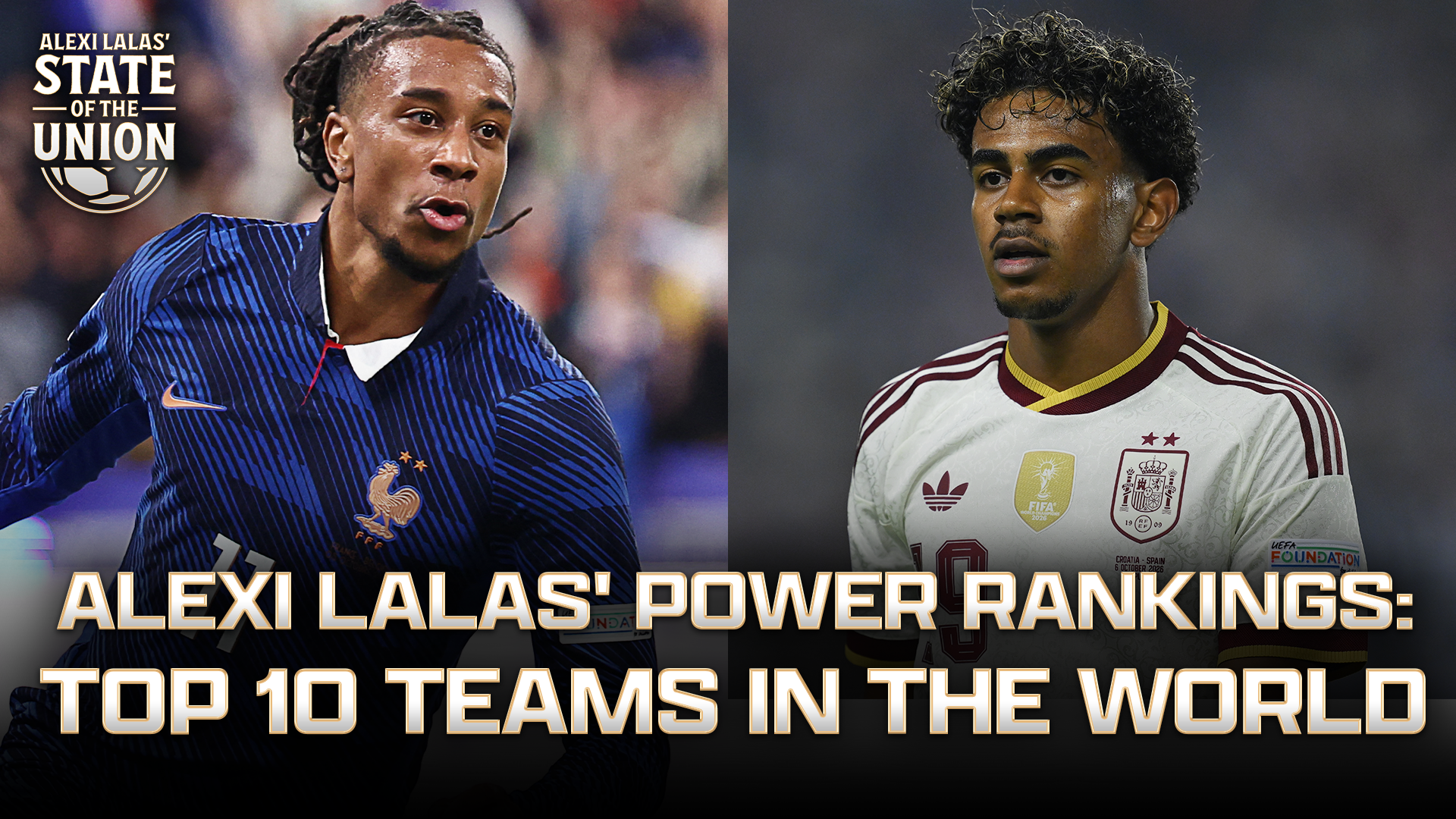
Alexi Lalas has never been one to hide behind spreadsheets. FIFA released its official rankings on Oct. 7, and the organization no doubt spent a lot of time, money, and technological firepower on the formula. Lalas, on the other hand, prefers something more visceral: gut feel. That is the spirit behind his first post-World Cup power rankings, a set of opinions designed to provoke, amuse, and maybe even annoy. “I love power rankings and I especially love counter rankings,” he says. “If you don’t like mine, then get your own.” The rankings arrive after a 2026 World Cup that gave us a new champion, a changing of the old guard, and plenty of questions about what comes next. With the dust settled, Lalas has looked at the global pecking order with fresh eyes. Some of his choices line up with FIFA’s official list; others are deliberate statements. But all of them are rooted in what he saw on the pitch, how teams have looked since, and the narratives that will define the next cycle. From a South American heavyweight adjusting to life after Messi to a European superpower finally unburdened from its greatest star, this list is as much about vibes as it is about victories. So let’s dive in, starting with the teams on the outside looking in.
At No. 10, Colombia find themselves one spot below FIFA’s ranking of 11th, though Lalas makes it clear he isn’t exactly following the script. The Colombians arrived at the World Cup as one of the trendy dark-horse picks, a team with enough attacking spark and defensive grit to make a deep run. Luis Díaz, who has shined as an attacker for Liverpool and now Bayern Munich, gave them a genuine game-breaker on the wing, and the team’s balance made them dangerous. But a round-of-16 loss to a similarly stout Switzerland side ended the dream earlier than many expected. Since then, Colombia have had a relatively uneventful window: a win over Peru, a loss to Paraguay, and a draw with Mexico, who FIFA has at No. 10. That last result especially seems to bother Lalas. “FIFA has Mexico at this spot, but I just think that’s ridiculous,” he says. Colombia could make an argument for being South America’s toughest side, even if their results haven’t been spectacular. Their next opponents are still TBD, but the pieces are clearly there. Just above them, at No. 9, are Morocco. The Atlas Lions made history in 2022 as the first African nation to reach a men’s World Cup semifinal, and they have kept that momentum rolling into 2026, where they lost to France in the quarterfinals—a painful echo of their 2022 semifinal loss to the same opponent. Their young core and success at youth tournament levels suggest this is not a one-off. Morocco cruised to two wins in AFCON qualifying in September, though the biggest story off the pitch is a court ruling that will decide whether Morocco or Senegal is named AFCON champions after the controversial 2025 final. Lalas sees a team that has answered the big question about whether they were just a golden generation or a genuine movement. “I think Morocco and this generation of players have proved they are here to stay,” he says.
At No. 8, the Netherlands remain one of international soccer’s great nearly-men. They have reached the World Cup final three times and never won it, and their 2026 run ended in the round of 32 against Morocco—another heartbreak for a side with a passionate fanbase and genuine talent. Cody Gakpo and Brian Brobbey were lively in attack, while the ageless Virgil van Dijk anchored the defense and remained the heart and soul of the team. There is a new chapter now: Xavi Hernandez, the Barcelona legend and 2010 World Cup winner with Spain, was surprisingly appointed as the Netherlands’ new manager. His tenure started with two wins over Serbia and draws against Germany and Greece in Nations League play, a steady if unspectacular beginning. Lalas is willing to give them the benefit of the doubt. “The Dutch have still ultimately never won the World Cup, but they are still a good solid team,” he says. “I can be convinced otherwise, but I’m going to give them the benefit of the doubt.” Up next, they face Greece on Nov. 13 and Germany on Nov. 16. At No. 7, Belgium are in a similar spot—solid, experienced, and capable of hurting anyone on their day. Their so-called Golden Generation of Romelu Lukaku, Kevin De Bruyne, and Thibaut Courtois looked as though it might be running on fumes, but the Red Devils proved people wrong at the World Cup, hammering the U.S. men’s national team 4-1 in the round of 16 before falling to Spain in the quarterfinals. Their recent Nations League results included two losses to a more talented France team, but those were tempered by wins over Italy and Türkiye. The old guard is slowly passing the torch to players like winger Jérémy Doku, and the team is still dangerous. As Lalas puts it, “The U.S. found out in the worst possible way and at the worst possible time how good this team can be.” Belgium face Türkiye on Nov. 12 and Italy on Nov. 15.
At No. 6, Brazil remain one of the biggest draws in world football, but that is not the same as being the best team. Led by star winger Vinícius Jr., they never quite lived up to the mythical yellow jerseys, and they bowed out to Norway in the round of 16. It has now been 24 years since Brazil last won a World Cup, and the weight of that history is becoming harder to ignore. Carlo Ancelotti, one of Europe’s greatest club managers at places like Real Madrid and AC Milan, is in charge, but three friendly wins over Australia and India haven’t answered the big questions about their defense or their next generation of stars. Vinícius has had some struggles at Real Madrid, and the team’s overall direction remains unclear. Lalas was high on Brazil and says they did nothing to change that during the World Cup, but the phrase “still Brazil” carries an element of living on past glory—like Germany, they are constantly hanging on to the fact that they used to be the world’s dominant force. At No. 5, Argentina are the most emotional entry on this list. Lionel Messi’s Last Dance almost ended with a fairy-tale repeat, as La Albiceleste reached the final before falling 1-0 to Spain. Messi, at 39, was the focal point and the inspirational guiding light, scoring eight goals and finishing second to Kylian Mbappé in the Golden Boot race. Since then, Messi has officially retired from international soccer, honored in an emotional send-off against Benin in Buenos Aires on Oct. 6. The era changes, but Argentina still has young talents like Julian Alvarez, Enzo Fernández, and Nico Paz. Lalas explains why he keeps Argentina below the top two despite back-to-back World Cup finals and a 2022 title: “They rode Messi, and he carried them in many ways. They did it willingly and were a wonderful team to watch. Now we don’t know what this team is going to look like going forward without Messi. There’s nobody who could ever replace him.” It is not a knock on Argentina’s talent; it is an acknowledgment that some players are simply irreplaceable.
At No. 4, Portugal are Lalas’ most intriguing counter-argument to Argentina. The 2026 World Cup was mostly a disappointment for Cristiano Ronaldo and company—outside of a 5-0 romp over debutants Uzbekistan, they never quite clicked, and they lost to eventual champions Spain in the round of 16. Then things got messy off the field. Ronaldo, who had already announced that 2026 would be his last World Cup, had a falling out with manager Jorge Jesus and abruptly left the team in September over disagreements about playing. Portugal didn’t miss him, at least not on the scoreboard: they won all four Nations League games, including two victories over Erling Haaland’s Norway, and looked crisper without their iconic captain. Lalas calls this “the new Portugal” and believes a burden has been lifted. “Nobody’s denying all the talent they have, but this incredible weight is now gone,” he says. “I am bullish on them going forward without Cristiano Ronaldo, just maybe not so bullish when it comes to Argentina without Messi.” It is a fascinating contrast: one legend’s exit feels like liberation, while another’s feels like loss. Portugal face Czechia on Nov. 14 and England on Nov. 17. At No. 3, England are the team Lalas admits he doesn’t enjoy praising. The Three Lions had their best World Cup finish since 1990, reaching the semifinals before losing to Argentina and then falling to France in the bronze match. “Wonderwall” provided the soundtrack, and for a moment it felt as though football might finally come home. Harry Kane scored six times, but Jude Bellingham was the breakout star, especially after a round-of-16 win over Mexico at the Estadio Azteca that etched his name into Three Lions lore. With Thomas Tuchel in charge, expectations remain huge, and a Nations League loss to Spain in September isn’t enough to shake Lalas’ respect. “It hurts me to say England, but they are just a good team,” he says. “They are as good—and maybe better—than many other teams, even ones in the past that won the World Cup.” England face Croatia on Nov. 12 and Spain on Nov. 15.
At No. 2, France have the kind of squad that most countries can only dream about. Kylian Mbappé, Ousmane Dembélé, and Michael Olise formed a terrifying forward line, and Mbappé scored ten goals at the World Cup, winning the Golden Boot and setting a new all-time World Cup scoring record with 22 career goals. France were stopped in the semifinals by Spain—a brick wall Lalas says made even this loaded team look average—but they rebounded to finish third with a high-scoring win over England in the consolation match. With Didier Deschamps stepping down as manager, Zinedine Zidane has taken over, which should keep France right at the top. They won all four Nations League matches in the latest window, even without an injured Mbappé for part of it. France face Italy on Nov. 12 and Türkiye on Nov. 15, and there is no reason to think they will slow down. But the No. 1 spot belongs to Spain, and there is very little debate. La Roja won their second men’s World Cup title with an improbable run in which they conceded just one goal in eight games. Lamine Yamal arrived injured and wasn’t even needed at his best, because Rodri ran the midfield and won the Golden Ball, while Unai Simón took home the award for best goalkeeper. Since lifting the trophy, Spain have extended their unbeaten streak to 40 games, winning four more Nations League matches—including a thrilling 3-2 victory over England at Wembley. They face Czechia on Nov. 12 and England on Nov. 15, and until someone proves otherwise, they are the team to beat. Lalas’ first post-World Cup power rankings are not a math problem; they are a feeling. They are meant to spark arguments and capture the shifting tides of world football. And as he would say, if you don’t like them, feel free to make your own.