





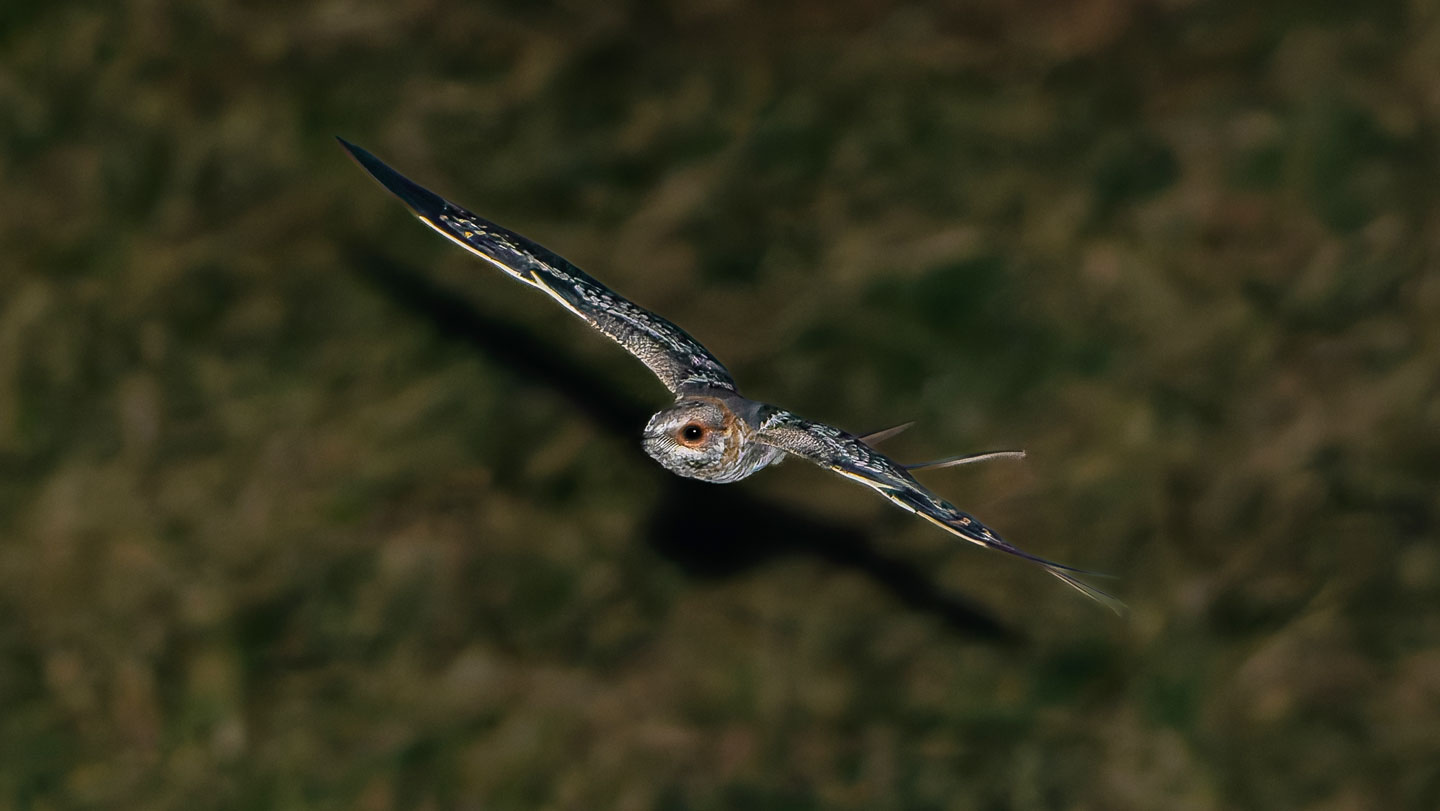
To wander through the densely forested Andean foothills of South America after sunset is to step into a world governed by a delicate, velvety silence. Under the canopy of the Argentine night, the darkness is typically absolute, punctuated only by the gentle rustle of leaves or the occasional, stealthy movement of nocturnal creatures. Yet, every now and then, this tranquil darkness is suddenly and violently shattered by a succession of sharp, explosive cracks that echo through the trees like the snapping of dry branches or the distant firing of a pistol. For years, travelers and locals alike might have assumed these abrupt, whip-like sounds were the work of larger forest animals stepping on dry twigs or perhaps humans moving through the underbrush. In reality, the authors of this dramatic acoustic display are far smaller, wingspan-bearing inhabitants of the canopy: the male scissor-tailed nightjars (Hydropsalis torquata). According to an eye-opening study published in the Journal of Avian Biology, these peculiar, insect-eating birds are not singing their midnight serenades; rather, they are physically colliding their own skeletal structures to produce an aggressive, high-energy percussion that serves as a vital signal in the dark.
For a long time, the exact mechanism behind this nocturnal racket remained a frustrating mystery to ornithologists and evolutionary naturalists. Nightjars, which belong to an ancient lineage closely related to fast-flying swifts and hovering hummingbirds, are generally celebrated for their stealth. Most nocturnal predators and insectivores, such as owls, have evolved to be incredibly quiet, relying on silent flight to ambush their prey and avoid detection. Dr. Juan Ignacio Areta, an evolutionary naturalist at the Instituto de Bio y Geociencias del Noroeste Argentino in Salta, Argentina, found himself deeply captivated by this stark evolutionary paradox: why, and how, would a nocturnal bird develop a mechanism to generate such incredibly loud, sudden noises? To answer this question, Dr. Areta joined forces with Dr. Christopher Clark, a behavioral ecologist from the University of California, Riverside. In the chilly late-autumn nights of 2022, the two researchers embarked on a covert mission along the quiet, rural forest roads of Salta. Armed with high-speed infrared cameras and incredibly sensitive audio-recording equipment, the scientists waited in the pitch black, hoping to capture the exact split-second movements of the nightjars during their explosive, nighttime performances.
The high-speed footage captured by the research duo finally pulled back the curtain on this bizarre avian behavior, revealing a highly coordinated feat of aerial acrobatics. When a male scissor-tailed nightjar decides to perform, it typically launches itself off the ground or a low branch, performing a energetic hop or short flight. While suspended in midair, the bird forcefully swings its wings backward behind its body, bringing them together with incredible velocity. The high-speed infrared cameras proved that the resulting loud “clack” is not the sound of feathers brushing or slapping together, but rather a direct physical collision of the bird’s wrist bones, situated just below the primary bend of the wing. When these small, dense bones hit each other at high speed, the impact sends intense vibrations traveling through the wings, generating a sharp, mechanical shockwave that cuts cleanly through the damp night air. This violent bone-on-bone impact is so forceful that it produces a miniature sonic snap, allowing the bird to communicate over impressive distances without ever using its vocal cords.
By utilizing their skeletal frames to produce sound, scissor-tailed nightjars have joined an exclusive and highly eccentric biological “percussion band” within the avian kingdom. While the vast majority of birds rely on elaborate vocalizations via their syrinx to attract mates and defend territories, a select few have evolved to use their bodies as instruments. The Siberian grouse (Falcipennis falcipennis), for instance, strikes its specialized wing feathers together to create a rhythmic rustling, while the male riflebird of Australia scrapes its hard bill across its stiff wing feathers like a wooden rasp to produce a harsh, scraping note. Perhaps closest in methodology to the nightjars are the manakins—vibrantly colored, tiny birds residing in the tropical forests of the Americas—who are the only other avian group known to purposely slam their wrist bones together to create a snapping sound during their complex, hyperactive courtship dances. What makes the scissor-tailed nightjar’s behavior so unique, however, is that they have adapted this high-impact, bone-jarring lifestyle to the pitch-black hours of the night, where visual signaling is highly limited and auditory clarity is absolutely paramount.
Despite successfully mapping out the physical mechanics of this bone-snapping behavior, the researchers note that there is still much to learn about the social and emotional meaning behind these acoustic performances. A male scissor-tailed nightjar is a striking sight even in the dim light, boasting exceptionally long, elegant, paired tail feathers that trail behind it like a pair of silver streamers. When these males perform their wing-snapping displays, they appear to be sending a highly versatile message to their forest neighbors. Observations show that the birds utilize these dramatic snaps in a variety of emotionally charged contexts: they snap loudly when trying to catch the attention of nearby females, they continue to snap as they approach a prospective mate, and they even produce the sounds during the physical act of mating. However, the snaps are not solely reserved for romance. When an intruding male encroaches upon a established territory, the resident male will aggressively snap his wings while chasing the trespasser through the dark canopy, transforming a love song into a stern, percussive warning.
Ultimately, the discovery of the nightjar’s wrist-snapping ability highlights the beautiful, often unpredictable pathways that evolution can take. In a biological niche where quietness is usually a prerequisite for survival, the scissor-tailed nightjar has carved out a spectacular, loud space for itself, demonstrating that the drive to communicate, attract mates, and defend resources can overcome even the most deep-seated evolutionary pressures for silence. For scientists like Dr. Areta and Dr. Clark, standing on a pitch-black Argentine road listening to the sharp cracks of bird wings is a humbling reminder of how many secrets are still tucked away in the natural world, waiting to be illuminated by patience, curiosity, and a bit of infrared light. As Dr. Areta warmly notes, these birds simply seem “really fond of these sounds”—a simple human sentiment that beautifully bridges the gap between scientific observation and the raw, joyful eccentricities of wild nature.