



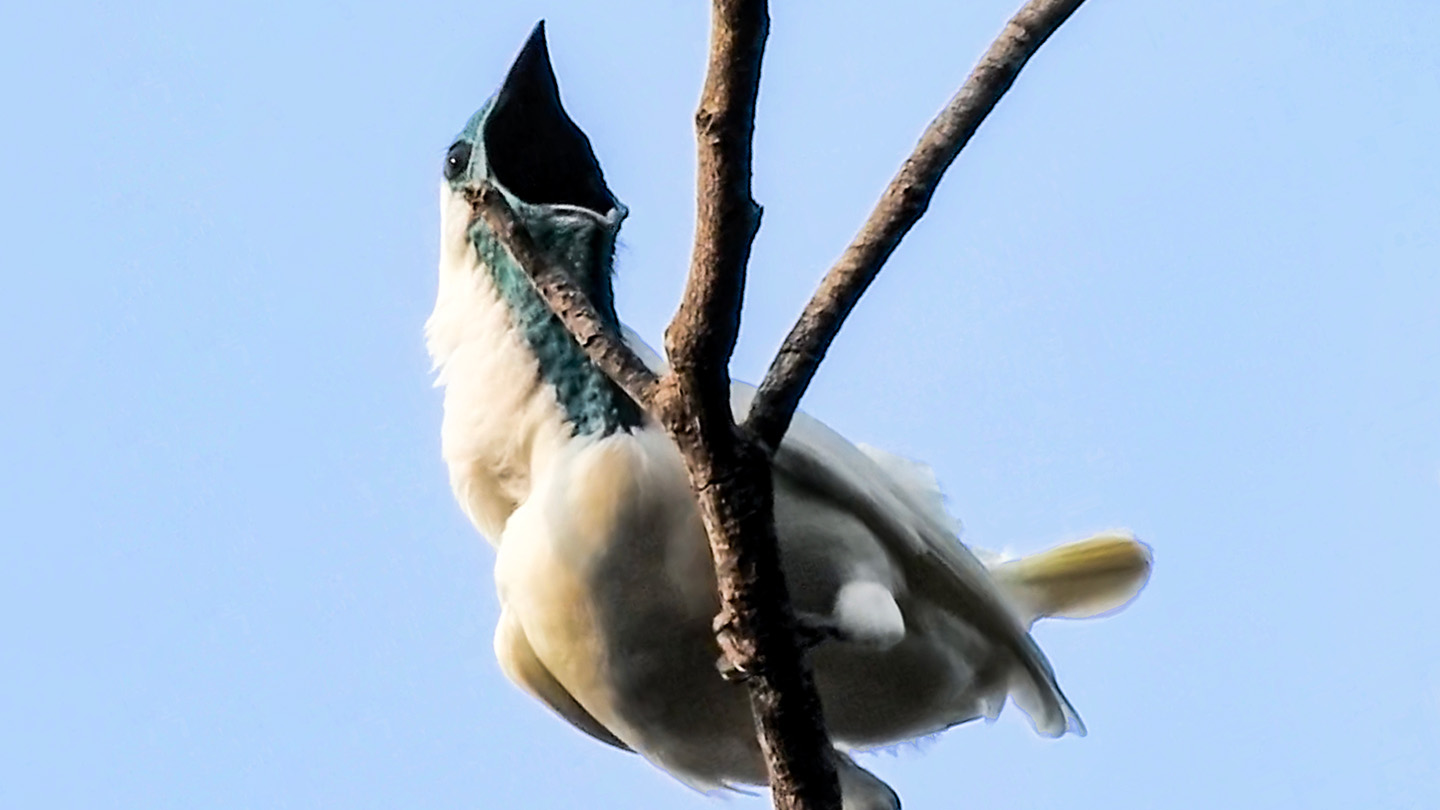
Imagine standing in a misty South American forest when the air around you is suddenly split by a sound so piercing and metallic that it feels less like a bird song and more like a fire alarm going off right beside your ear. That is the reality of encountering the bare-throated bellbird, a snow-white bird with a stout body, a broad bill, and a striking blue-green patch on its throat. Its explosive mating call can reach volumes above 130 decibels, a level that outdoes a jackhammer hammering concrete and rivals the ear-splitting experience of sitting in the front row at a loud rock concert. For comparison, a typical conversation sits around 60 decibels, and prolonged exposure to sounds above 85 decibels can cause hearing damage. So this bird is not just singing to attract a mate; it is unleashing a biological force of nature. The bellbird’s call is one of the loudest sounds produced by any animal on the planet. It has made this creature a serious contender for the title of world’s loudest bird, and it has also presented scientists with a fascinating puzzle: how does such a relatively small animal generate such an astonishingly powerful sound, and why would evolution ever favor something so extreme?
For years, ornithologists have carefully studied the timing, pitch, and rhythm of bird songs, hoping to decode the messages hidden in their melodies. They have mapped the way birds use songs to defend territory, attract partners, and recognize one another. But one aspect of bird vocalization has remained surprisingly ignored: sheer loudness. Why do some birds boom while others merely whisper? The Canada goose, for example, can produce a honk that reaches around 100 decibels, a sound comparable to a chainsaw or a motorcycle engine. A starling, on the other hand, rarely gets much above 70 decibels, roughly the level of a dishwasher running in the next room. That is a massive difference in acoustic power between two familiar birds, yet scientists have had very little understanding of what causes it. The bare-throated bellbird, with its record-breaking call, forced the question into the open. Once researchers began asking why some birds are so extraordinarily loud, they quickly realized that the answer would require looking at bird anatomy, evolution, and ecology in a completely new way. Finding the answer would mean tramping through forests, swamps, and grasslands with sensitive sound-measuring equipment, recording every bird they could find, and comparing not just the songs themselves but the bodies that produce them.
The quest to understand these sonic extremes began in earnest in 2019, when Jeff Podos, a behavioral ecologist at the University of Massachusetts Amherst, and a colleague crowned the white bellbird as a record-setting vocal powerhouse. That bird, an Amazonian cousin of the bare-throated bellbird, was measured at 125 decibels, the loudest bird call ever documented at the time. The finding was startling, but it also raised an even bigger question: what was going on inside these birds that allowed them to reach such ear-shattering levels? To find out, Podos and his research team knew they needed to study more than just the champions. They needed to understand the full range of bird vocal volume. So Podos packed a high-grade sound meter, the kind used to monitor noise levels in industrial workplaces, and a laser rangefinder to measure exactly how far away the birds were when they sang. Then he went out into the woods, swamps, and open fields around his home in western Massachusetts, pointing his equipment at every bird he could find. Warblers, sparrows, robins, and many more were all recorded and measured. It was painstaking fieldwork, but it was only the beginning. Soon after, Podos enlisted João Menezes, a graduate student from Brazil who had just joined his lab, to help turn this collection of sound levels into a much larger evolutionary study.
Menezes took on the challenge with enthusiasm, traveling across his home country of Brazil to capture bird vocalizations in a staggering variety of habitats. He measured birds from the Atlantic Forest near São Paulo to the mountains surrounding Rio de Janeiro and beyond, from lush tropical lowlands to dry, open grasslands. Along the way, he recorded everything from the soft, whisper-like chirps of the dusky-throated hermit hummingbird to the loud, piercing yelps of the red-legged seriema, a shaggy bird that stalks the grasslands and sounds like something between a dog and a screaming human. Every measurement required patience and precision, because accurately measuring the volume of a wild bird call means knowing exactly how far away the bird is, how the sound travels through the environment, and how to avoid startling the bird into silence. When all the data was finally compiled, Menezes and Podos had gathered vocal volume information on 123 different bird species, creating what they believe is the largest dataset of its kind ever assembled. This gave them the statistical power to look for patterns that had never been examined before. They could now ask, with real evidence, what makes some birds naturally louder than others, and whether those differences could be traced back to something in the birds’ physical design.
The answer, it turned out, was written in the birds’ bodies. The heftier the bird, the louder its call tended to be, and the same was true for birds with wider beaks. These two traits worked together to create the perfect acoustic instrument. A larger body has more muscle and more lung capacity, which means it can generate greater respiratory pressures and push more air through the vocal organ with force. A wider beak, meanwhile, acts like the bell of a trumpet, helping to radiate sound outward more efficiently instead of letting it scatter in all directions. Gabriel Mindlin, a biophysicist at the University of Buenos Aires who studies birdsong but was not involved in the study, found the connection between anatomy and acoustic performance both sensible and plausible. Larger birds, he notes, simply have the potential to produce more powerful airflow, while the shape and size of the beak directly influence how well that acoustic energy escapes into the surrounding world. It is a bit like the difference between blowing air through a narrow straw and blowing through a large horn: the same pair of lungs can produce vastly different results depending on the shape of the opening. The bare-throated bellbird, with its stout body and wide-gaped bill, has essentially evolved into a living megaphone. Its anatomy is perfectly suited to turning breath into a blast of sound that can travel through dense forest foliage and reach potential mates across great distances.
Yet the anatomical explanation only solves part of the mystery. Knowing how the bellbird makes such a loud sound does not explain why evolution pushed some birds to such extremes in the first place. The researchers expected to find a single overarching reason, perhaps linked to mating behavior, habitat type, or the way birds fly. They tested all of these possibilities. Did birds that gather in dense groups need to shout over one another? Did birds that live in thick forests need louder calls to penetrate the vegetation? Did birds that rely on long-distance communication need more volume to cover greater distances? The results were frustratingly inconclusive. None of those explanations held up consistently across the 123 species they studied. “We weren’t able to find an overarching pattern that applies to birds in general,” Menezes admitted. Instead, the evolution of loudness appears to be a deeply complex story, one that likely varies from species to species depending on a unique mix of ecological pressures, social structures, and environmental conditions. Perhaps for some birds, extreme volume is driven by intense competition for mates, while for others it is shaped by the acoustics of their particular habitat. Perhaps some birds are loud because they can be, and their bodies have simply evolved to exploit that possibility. The study opens a door to a new field of research, one that takes volume as seriously as pitch and timing. It reminds us that the natural world is full of extremes that seem almost impossible until we look closely, and that even the most familiar aspects of nature can still hold remarkable secrets. The bare-throated bellbird’s deafening call is not just a curiosity; it is a testament to the extraordinary diversity of life, and a reminder that the more we listen, the more we realize how much we still have to learn.