






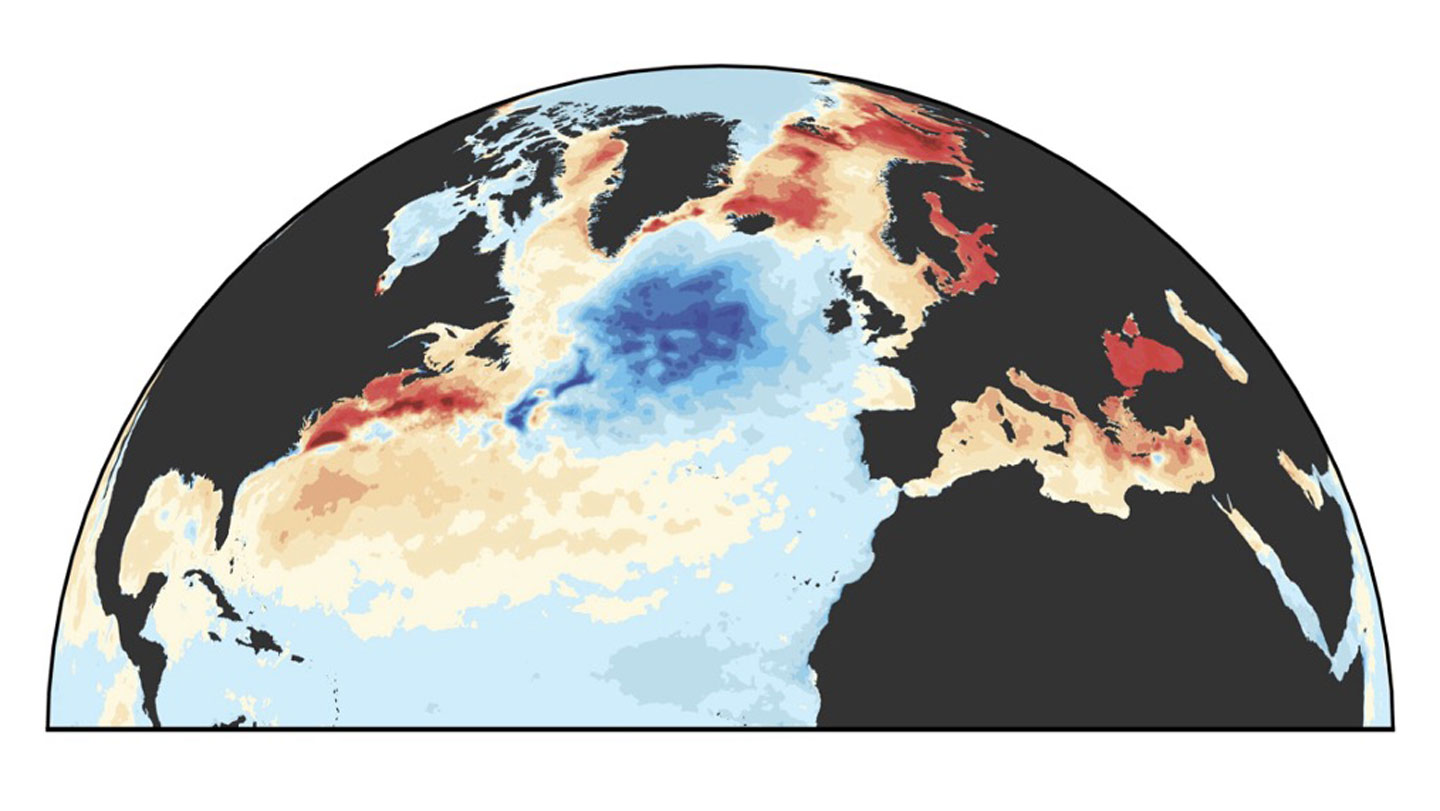
While our planet’s oceans are warming at an alarming rate, absorbing the vast majority of the excess heat trapped by human-induced greenhouse gases, a remarkable and puzzling anomaly has been festering in the North Atlantic. Amidst this rising global fever, a stubborn patch of ocean water located just south of Greenland and Iceland has actively cooled by about one degree Celsius since the late nineteenth century. Colloquially termed the “cold blob” or the subpolar warming hole, this sapphire-blue expanse of freezing water has stood for decades as a baffling contradiction on global climate maps. To a casual observer, a localized cold spot might sound like a refreshing reprieve or perhaps a harmless quirk of nature, but to the global scientific community, it represents a deep and troubling scar indicating that Earth’s ancient climate machinery is suffering a profound systemic failure. For years, researchers argued over what was triggering this anomalous chill: was the area simply losing an immense amount of heat directly into a turbulent, changing atmosphere, or was it being starved of the warm currents it historically relied upon? Human curiosity and scientific determination have finally cracked this grand mystery, revealing that the cold blob is not an isolated weather phenomenon, but rather a visible symptom of a vital planetary artery beginning to stall.
To truly comprehend the gravity of this cold spot, one must understand the colossal underwater engine that sustains the temperate climates of the Northern Hemisphere: the Atlantic Meridional Overturning Circulation, or AMOC. Often described by oceanographic scientists as a planetary conveyor belt, the AMOC acts much like a beating heart for the global climate, distributing thermal energy across immense distances. Under normal geological conditions, this massive system transport warm, salty surface waters from the sun-drenched tropical regions northward toward Europe and the Arctic. As this warm water journeys north, it releases its heat into the atmosphere, generating gentle, tempering winds that keep Western Europe significantly warmer, milder, and more agriculturally productive than other global regions at similar high latitudes. Once this water surrenders its thermal energy in the far north, it becomes cold, dense, and heavy, causing it to sink deep into the abyss of the ocean, where it begins a slow, silent return trip southward along the seafloor to complete its endless loop. Decades ago, climate scientists began to suspect that the mysterious cold blob was the direct result of this magnificent conveyor belt losing its momentum, which would inevitably starve the North Atlantic of its expected tropical warmth. Yet, without definitive proof, some held onto the alternative theory that localized atmospheric shifts were merely sucking heat away from the surface, keeping the deeper oceanic currents blameless.
Determined to settle this crucial debate and uncover the truth behind our changing seas, physical oceanographer Stefan Rahmstorf and a dedicated team of researchers at the Potsdam Institute for Climate Impact Research in Germany embarked on a painstaking detective journey. Published in the prestigious journal Geophysical Research Letters, their study sought to reconstruct a comprehensive, high-definition history of North Atlantic temperatures and ocean-to-atmosphere heat exchange. The scientific team went to extraordinary lengths to gather their clues, reanalyzing historical marine logbooks and temperature records that date as far back as 1870, and seamlessly blending them with ultra-precise satellite observations that have hovered over our oceans since 1993. The logic of their scientific inquiry was elegant but unyielding: if the ocean’s circulation was working perfectly and the cold blob was merely caused by the atmosphere drawing heat away from the water, then historical datasets should show a steady, undeniable increase in the amount of heat escaping from the ocean’s surface into the air over the last several decades. Conversely, if the ocean’s plumbing system was backing up, they would see a decline in the amount of heat escaping, proving that there was simply no warmth left in the water to escape in the first place.
When the final data was compiled and analyzed, the results were both clear and deeply unsettling, dismantling any lingering hopes of a harmless explanation. Instead of finding a rising tide of heat radiating from the ocean into the air, Rahmstorf’s team discovered a pronounced, decades-long decrease in the amount of heat escaping the North Atlantic surface into the atmosphere, a decline that has become incredibly stark and pronounced since 1993. Even more telling was where this heat loss was occurring; the most significant drop in thermal energy was concentrated within the top 1,000 meters of the ocean’s water column, which aligns perfectly with the exact depth where the warm, northward-bound waters of the AMOC typically flow. By proving that the upper ocean has physically lost its core source of thermal energy, the study provided definitive, empirical evidence that the AMOC’s heat supply to this vulnerable region has been steadily drying up over the last half-century. This discovery confirms that the cold blob is not a superficial weather pattern, but rather an active, real-time deceleration of the Atlantic’s conveyor belt—a physical slowing of the global ocean currents that has far-reaching consequences for the future of humanity.
The realization that the AMOC is progressively slowing down has transformed what was once a comfortable academic debate into an existential crisis of unprecedented proportions. For nearly thirty years, leading oceanographers and climate scientists viewed the complete collapse of this current system as a “high-impact but low-probability” threat—a distant, theoretical nightmare scenario suited for science fiction novels rather than active policy planning. However, this breakthrough study, combined with a growing mountain of modern empirical evidence, has forced a dramatic paradigm shift, causing researchers like Stefan Rahmstorf to publicly declare that their view of the risk has fundamentally changed. If the AMOC continues to weaken and ultimately crosses its irreversible tipping point, it will unleash a chaotic cascade of climate disruption that would reshape life on Earth. Europe, already struggling with extreme weather events, would find itself plunged into unprecedented temperature extremes, dealing with winters of paralyzing cold and summers of volatile, destructive heat that would devastate continental agriculture. Furthermore, as the current stalls, tropical rainfall belts would shift dramatically, threatening the monsoons that billions of people across Asia and North Africa rely on to water their crops, feed their families, and sustain their livelihoods.
Ultimately, the chilling mystery of the North Atlantic’s cold blob serves as a powerful, poetic reminder of our profound economic and physical dependence on the delicate, silent systems of the natural world. This discovery highlights the critical necessity of independent, robust science journalism and active scientific literacy in a world where key decisions about our collective future must be guided by objective physical truth rather than political convenience. Confronting an issue as vast and intimidating as the slowing of our oceans requires a global awakening, a shared understanding that the invisible systems keeping our planet habitable are under severe strain from human activities. We can no longer afford to treat the quiet warnings of our physical oceanographers as remote problems for future generations to navigate. By supporting scientific research, investing in deep climate literacy, and making the courageous choices necessary to transition away from fossil fuels, we can still act to stabilize our planet’s vital systems, ensuring that the incredible, life-giving conveyor belt of our oceans continues to beat for generations to come.