






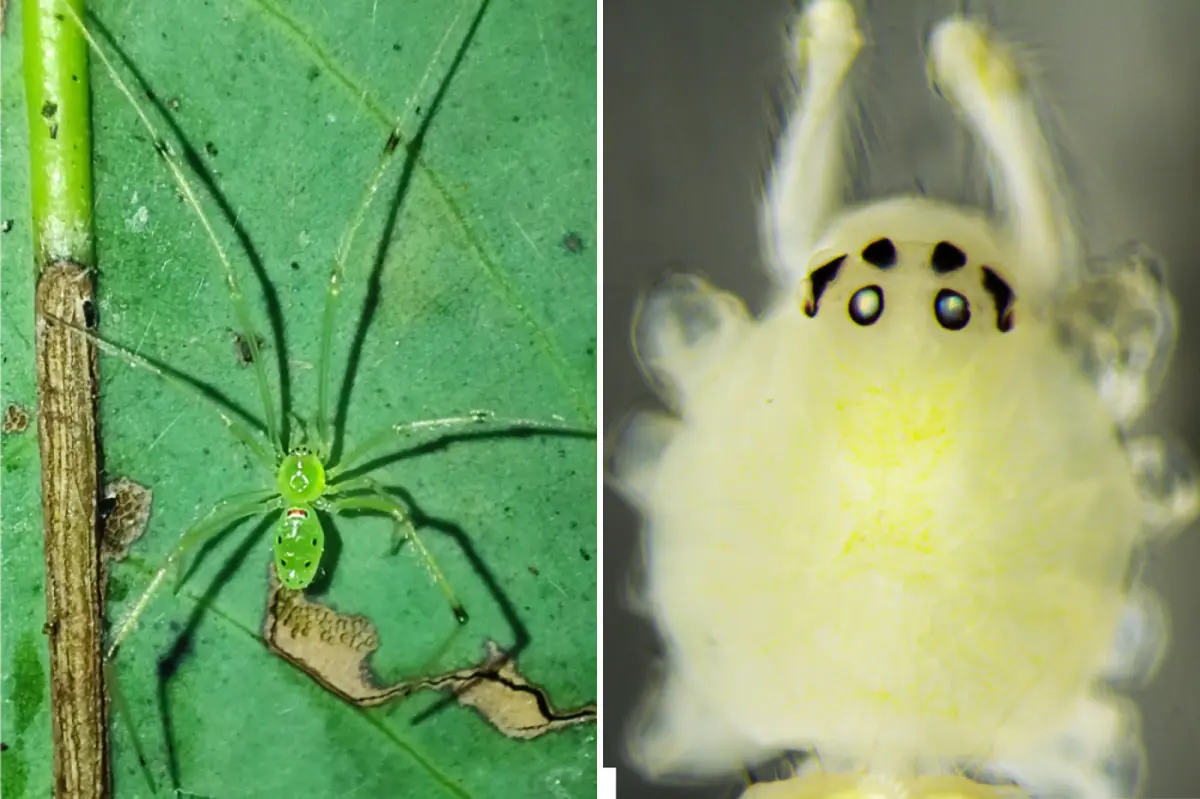
Deep within the rugged, mist-shrouded peaks of the Western Himalayas, where the air is thin and the earth is perpetually damp, nature has recently unveiled one of its most whimsical and enchanting secrets. Scientists trekking through this formidable, high-altitude terrain have discovered a brand-new species of arachnid that challenges our deepest, most primal fears of creepy-crawlies by sporting a literal smiley face on its back. Officially named Theridion Himalayana, this tiny creature has quickly captured the imaginations of researchers and nature lovers alike, earning the affectionate moniker of the “happy-face spider.” For generations, spiders have been cast as the ultimate villains of the miniature world—associated with dusty corners, venomous bites, and the eerie, unseen webs of horror movies. Yet, this newly identified Himalayan resident turns that stereotype completely on its head, reminding us that the natural world is not just a theater of survival, but also a canvas of astonishing artistry, humor, and surprise. The discovery of Theridion Himalayana serves as a delightful reminder of how much of our planet remains unexplored, waiting in the quiet, damp corners of the earth to surprise us with a smile. By bridge-building between scientific classification and human emotion, this tiny spider invites us to look closer at the undergrowth and reconsider our relationship with the often-misunderstood creatures that share our planet, proving that even in the harshest environments, life finds a way to express itself with a touch of cosmic joy.
To truly appreciate the significance of this discovery, one must look back over a century to the lush, tropical rainforests of the Hawaiian Islands, where the very first happy-face spider (Theridion grallator) was documented by intrepid naturalists in the year 1900. For over a hundred years, these charismatic Hawaiian spiders were celebrated as unique evolutionary anomalies, isolated on their Pacific volcanic islands and beloved as symbols of island biodiversity. The discovery of a close relative thousands of miles away, nestled in the freezing, towering altitudes of the Indian Himalayas, has sent shockwaves through the global scientific community. Theridion Himalayana belongs to the incredibly diverse spider family known as Theridiidae, commonly referred to as cobweb spiders or tangle-web spiders. This massive biological family boasts over 577 distinct species, making it one of the most evolutionarily successful and diverse groups of arachnids on Earth. The Theridiidae are famous for their three-dimensional, tangled webs, which they use to capture prey with remarkable efficiency, but it is their physical diversity that truly sets them apart. Finding a happy-face variant in the Himalayas highlights the incredible adaptive capabilities of this family, showing how a single evolutionary branch can bridge the gap between tropical Pacific beaches and cold, high-altitude mountain ranges, adapting to wildly different climates while retaining that signature, charming aesthetic.
The breakthrough occurred when a dedicated team of field biologists embarked on a rigorous expedition through the Western Himalayas, eventually capturing and meticulously examining 61 individual spiders. Under the magnifying lenses of their mobile laboratories, the scientists witnessed an extraordinary display of polymorphism—a biological phenomenon where a single species exhibits multiple distinct physical forms, colors, or patterns. In both male and female specimens of Theridion Himalayana, the researchers observed a breathtaking kaleidoscope of colors, with vivid reds, deep blacks, and stark whites arranging themselves in a multitude of ways across the spiders’ abdomens. Remarkably, scientists documented up to 32 different color and pattern variations within this single species, ranging from abstract, paint-splattered designs to the iconic, unmistakable caricature of a smiling human face. Some spiders looked as though they were grinning broadly, others appeared to be winking, and some carried patterns that resembled ancient, stylized masks. This intense level of physical variety within a single population is incredibly rare and suggests a complex genetic playground where different traits are constantly shuffling, ensuring that no two happy-face spiders are guaranteed to look exactly alike as they navigate their mountain homes.
To understand the mechanics behind this vibrant diversity, researchers conducted deep genetic sequencing on the collected specimens, uncovering a fascinating secret hidden within the spiders’ DNA. The analysis, subsequently published in the prestigious scientific journal Evolutionary Systematics, revealed that Theridion Himalayana possesses a genetic variation of approximately 8.5% compared to its closest known evolutionary relatives. In the realm of genetics and taxonomy, an 8.5% divergence is a massive gulf, serving as definitive, undeniable proof of a separate and entirely new evolutionary lineage. This genetic distance indicates that the Himalayan happy-face spider did not simply drift over from other regions recently; rather, it has been carving out its own distinct evolutionary path in the isolation of the mountains for millions of years. High-altitude environments, with their extreme weather and geographic barriers like deep valleys and towering ridges, often act as “evolutionary islands.” Over countless generations, the ancestors of Theridion Himalayana became genetically isolated from their low-altitude cousins, allowing natural selection to work its magic in creative and unexpected ways, eventually resulting in the unique, genetically distinct, and wonderfully smiling species we see today.
Despite these groundbreaking genetic insights, scientists remain deeply puzzled by the most obvious question: why does a tiny spider living in the remote Himalayas need a smiley face on its back? Evolution rarely does anything without a purpose, yet experts are currently locked in debate over what specific evolutionary advantage these striking, face-like markings provide. One leading theory suggests the patterns are a form of aposematism, or warning coloration, designed to trick predators like birds and wasps into thinking the spider is toxic or dangerous to eat. Another school of thought proposes that the highly varied patterns serve as a sophisticated camouflage, breaking up the spider’s silhouette against the speckled leaves, moss, and dew-drenched foliage of their damp habitats, making them virtually invisible to predators looking for a standard “spider-shaped” meal. Alternatively, the markings might play a role in mate selection, or perhaps they are simply a harmless, neutral byproduct of other, more critical genetic adaptations occurring beneath the surface. For humans, looking at these spiders triggers a psychological phenomenon known as pareidolia—our deeply ingrained tendency to recognize human faces in random patterns—which immediately makes these creatures feel familiar, approachable, and endearing, bridging a psychological gap between humans and arachnids that rarely exists.
Ultimately, the discovery of Theridion Himalayana is about far more than just a cute face; it is a vital piece of the puzzle in our ongoing effort to map and understand the Earth’s rapidly changing biodiversity. By studying how these spiders evolved such incredibly diverse physical forms in response to their high-altitude, damp environments, scientists can gain invaluable insights into how climate change and habitat fragmentation might impact fragile mountain ecosystems in the future. The Himalayas are currently on the front lines of global climate shifts, with rising temperatures and altering moisture patterns threatening countless delicate species that rely on these unique microclimates to survive. Theridion Himalayana stands as a vibrant symbol of ecological resilience and natural wonder, urging us to protect these pristine, wild spaces before their secrets are lost to us forever. Every time we discover a new species, we are reminded of how little we actually know about the web of life that sustains us, and how vital it is to approach the natural world with a sense of humility, curiosity, and awe. In a world often dominated by bleak environmental headlines, the happy-face spider of the Himalayas offers a bright, smiling beacon of hope, reminding us that nature still has plenty of magic left to share if we are simply willing to look closely enough to find it.