






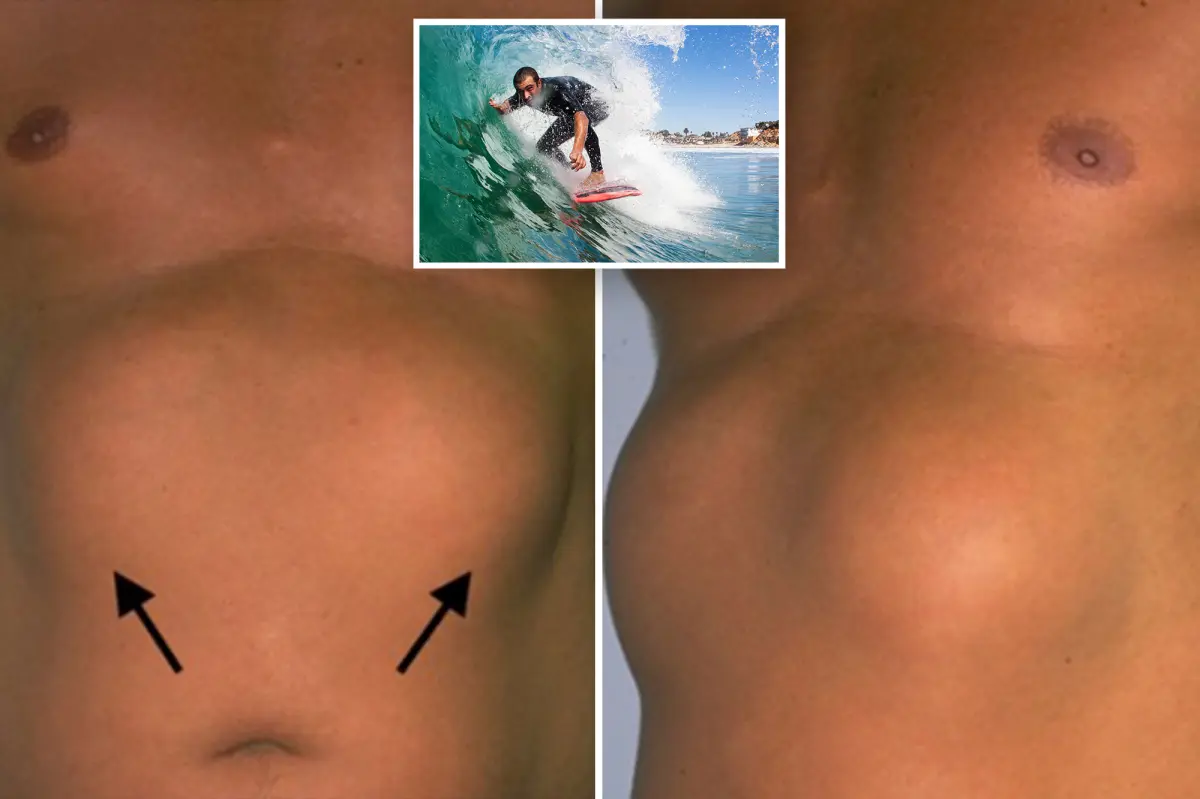
Every surfer knows the ocean leaves marks. A lifetime spent paddling out can etch a body with physical memories: the faded scars from reef encounters, the bony knobs that longboarders develop on knees and feet, the calcium deposits in the ear canal that old-timers call “surfer’s ear.” But there is another souvenir that is only now getting the attention it deserves, and it comes as a surprise to many wave-riders who look down one day and notice soft, rounded lumps bulging from their chests. Doctors have given them a name that is equal parts medical and playful: liposurfomas. These fatty growths, researchers say, are not actually tumors, but they can look alarmingly like one. The condition is turning up in longtime surfers, especially those who have spent decades lying chest-down on hard boards, grinding their torsos into the fiberglass and resin as they paddle against the current. Instead of being cancer, they are essentially scar-like masses of fatty tissue, molded by years of low-grade pressure and friction. For aging surfers, the discovery can be unsettling. A lump on the chest is the kind of thing that makes anyone think of the worst. But researchers are trying to spread a simple message: these strange bumps are common, they are generally harmless, and they are the direct result of an unusual relationship between human bodies and surfboards.
The peculiar condition has caught renewed attention in Southern California after researchers at the University of California, Irvine took a closer look at seven surfers with the distinctive growths. Dr. Jeffrey Klein, a dermatology professor at UC Irvine and one of the researchers behind the study, said the growths can be mistaken for cancer, potentially sending otherwise healthy surfers down a nerve-racking path of testing and treatment. In a write-up of the findings, the researchers described the lesions as “rather common in surfers” and noted that most surfers probably know at least one person with the telltale soft, symmetrical chest bumps. The worry is understandable. When you feel a lump, your mind jumps to worst-case scenarios. You start imagining doctor visits, scans, biopsies, and the possibility of something life-changing. But according to the researchers, these particular masses are benign fatty growths, not malignancies. They are a physical reminder of the sport itself, formed quietly and slowly under the skin. The fact that they look so dramatic is perhaps why they have been overlooked for so long. Surfers might have noticed them for years, but it took a dedicated medical study to give them a name and reassure the surfing community that a bizarre set of chest lumps is not necessarily a reason to panic.
What causes a liposurfoma? The researchers believe these growths result from “incessant low-intensity traumatic compression of subcutaneous tissue,” squeezed between the costal margin — the edge of the rib cage — and the hard deck of a surfboard while paddling in the prone position. In plain language, years of lying flat on a board and paddling repeatedly grinds and presses the soft tissue just under the skin, causing it to respond by forming fatty scar-like masses. The human body is remarkably adaptive, but it is also a creature of habit. Do the same motion over and over for decades, and the tissue will eventually change. The condition is different from the better-known “surfer’s knots,” which are hard, callus-like masses typically found on knees, feet, and shins of longboarders who kneel or paddle with their legs rubbing against the board. Liposurfomas are softer, fatty, and live on the chest, usually near where the ribs press into the board during the most basic act of surfing: getting to the lineup. Both types of growths are reportedly benign, but the chest version tends to be more alarming because it looks so much like a tumor. The fact that it grows slowly over years and changes size with surf season can make it even more confusing to a physician who is not familiar with surf culture.
Perhaps no one has handled the news with more humor than Corky Carroll, the legendary surfer who went public about his bulging torso in a 2010 column and referred to himself as “the man with four breasts.” Carroll’s self-deprecating description captured the experience of any older surfer who has looked in the mirror and realized their chest looks a little different than it once did. The growths tend to swell during peak surf seasons, when surfers are in the water every day, and shrink slightly when surfers take extended time on dry land. That pattern — bigger during heavy surfing, smaller during a layoff — is a clue that the masses are not the kind of hard, unchanged lumps that cancer typically behaves like. But the emotional impact is still real. It is one thing to have a few scars or achy joints; it is another to see your body change in a way that feels foreign and frightening. By talking about it openly, Carroll and the researchers have helped frame these growths not as a hidden disease but as a badge of decades in the water, one that may require a second look but not necessarily urgent surgery.
For surfers who are keen to ditch the extra set of pecs, there are options. Treatments range from adding extra padding to wetsuits to surgical removal and liposuction. The simplest approach is prevention: put something soft between the body and the board, change the way pressure falls on the chest, and give the tissue a chance to recover. Some surfers find that wearing a thicker wetsuit during colder months helps, or that a surfboard with a softer deck pad makes a difference. Others may choose to alter their paddling position, though that is easier said than done for anyone who has been doing it the same way for decades. The most direct fix is to have the growths surgically removed or liposuctioned, and doctors can do that safely. But there is an important caveat that every dedicated surfer needs to hear: if riders keep hitting the surf with the same body-to-board pressure, the lumps can come right back. Removing the tissue does not remove the conditions that created it. The underlying cause is still there, waiting patiently beneath the surface. So a decision to treat liposurfomas is not a one-time fix; it is a commitment to changing a relationship with the sport or accepting the possibility of regrowth.
The bigger message from this research is not that surfing is dangerous in the way people usually fear. Surfers have long braved shark bites, reef scrapes, and the dreaded surfer’s ear, but those are dramatic, visible risks that come with the territory. Liposurfomas are different. They are quiet, slow, and almost mundane. They are the cumulative result of thousands of hours spent doing one of the most joyful things a person can do: lying on a board, waiting for a wave, feeling the ocean rock underneath. There is something strange about the idea that a lifetime of surfing could end up changing the shape of your chest, but there is also something almost poetic about it. The body remembers what you love, even in ways you might not expect. For anyone who notices a suspicious bump, the sensible advice is still to see a dermatologist and get it checked out, because some growths are not harmless and it is always better to be sure. But if the diagnosis is liposurfoma, the treatment might simply be reassurance. You can keep surfing. You can keep paddling out. You just might want to invest in a little extra padding, and maybe give the board a softer place to rest against your ribs. The ocean will still be there, and so will the waves. And if those strange lumps return later, they will serve as a reminder that a life spent in the water leaves its own distinctive signature — one that doctors are only beginning to understand.