





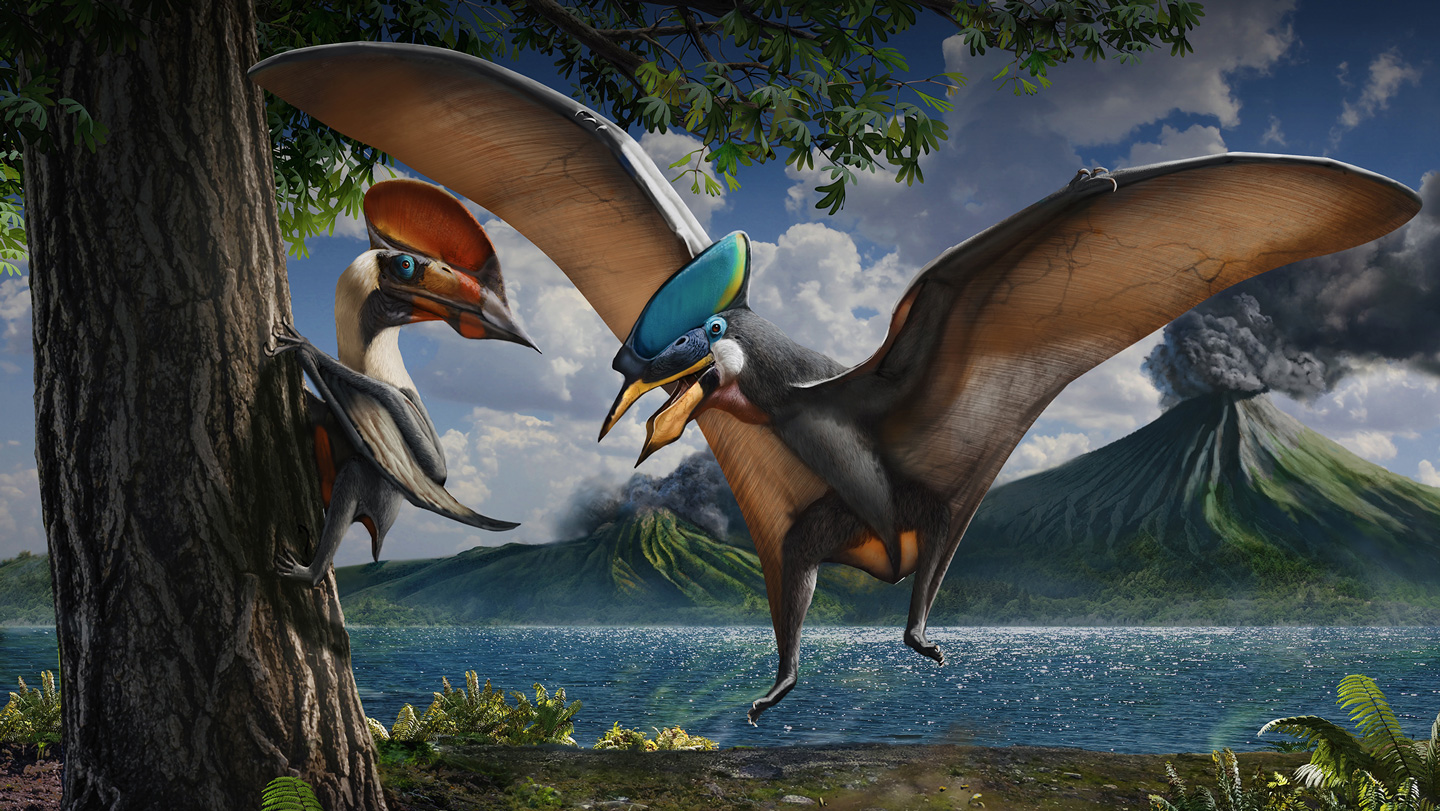
For generations, our collective imagination has painted pterosaurs—the world’s first flying vertebrates—in hues of ash gray, charcoal, and muddy brown, depicting them as leathery, dark beasts gliding silently over primordial swamps like ominous, prehistoric hang-gliders. This monochromatic fantasy has now been permanently shattered by a stunning discovery that changes how we view these ancient masters of the sky. A team of scientists, publishing their breakthrough in a preprint at bioRxiv.org, has revealed that at least one species of pterosaur did not soar in dull, utilitarian tones, but instead shimmered in a dazzling, kaleidoscopic array of iridescent greens and magentas. This discovery does far more than just update the color palette used by paleoartists; it fundamentally upends our understanding of how these creature lived, breathed, flew, and socialized. For the first time, we are forced to imagine these fearsome reptiles not merely as cold-blooded, mechanical predators of the Mesozoic era, but as brilliant, flashy performers of the ancient skies. The scientific community has reacted with profound excitement, with paleontologist Steve Brusatte of the University of Edinburgh—who was not involved with the study—declaring it to be one of the most intriguing and surprising fossil discoveries of recent years. It serves as a beautiful reminder that the deep past was not a silent, gray-scale museum exhibition, but a world vibrating with the same visual brilliance and sensory richness that we witness in nature today, linking our modern landscape directly to a vibrant world that existed millions of years ago.
The centerpiece of this evolutionary revelation is an exceptionally well-preserved fossilized specimen of Sinopterus dongi, a relatively compact pterosaur species whose impressive wingspan could stretch up to nearly two meters wide. Unearthed from the famous, fossil-rich geological formations in northeastern China, this creature spent more than 120 million years locked inside ancient stone, waiting for the right moment and the modern technology necessary to reveal its long-hidden secrets. What makes this particular find a true miracle of paleontology is the exquisite preservation of its soft tissues. While the fossil record is famously biased toward hard bones and teeth, soft tissues like skin, hair, and muscles are incredibly delicate, almost always decaying away long before fossilization can occur. David Martill, a prominent paleontologist at the University of Portsmouth who was not part of the research team, noted that soft tissue preservation at this high level of fidelity is unimaginably rare and precious. This preservation allowed researchers to look past the bare skeletal structure and study the physical coat of the pterosaur, which was densely blanketed in tiny, hair-like filaments known as pycnofibers. These structures, similar in many ways to the protofeathers found on some dinosaurs, provided the perfect canvas for the ancient colors, acting as a direct physical link between the evolutionary ancestors of modern birds and the magnificent flying reptiles of the Cretaceous period.
To truly understand how these stunning colors were created, we have to look past simple chemical pigments and examine the microscopic physics of light. While standard biological colors are created by pigments that absorb certain wavelengths of light and reflect others, iridescence is an entirely different phenomenon known as structural coloration. This optical magic occurs when light waves bounce off highly organized, microscopic physical structures, scattering and interfering with one another to produce a shifting metallic shimmer that changes color depending on the viewer’s angle—much like a soap bubble, a compact disc, or a peacock feather. By using advanced scientific tools like scanning electron microscopy, the researchers carefully examined the fossilized pycnofibers of Sinopterus dongi. What they found under the microscope was a stunningly organized architecture: the pycnofibers contained highly ordered, layered arrays of melanosomes, which are the tiny, pigment-carrying envelopes inside animal cells. Rather than being scattered randomly throughout the tissue, these melanosomes were stacked in neat, precise, repeating patterns that are practically identical to the light-scattering structures that create the metallic sheen seen in modern birds. Through computer simulations of how light behaves when striking these patterns, the team confirmed that these ancient structures would have produced deep, rich greens and magentas—the exact color scheme that we associate today with the iridescent plumage of common starlings and wild pigeons.
This microscopic color map is far more than a superficial cosmetic upgrade; it provides scientists with a vital window into the internal biology, metabolism, and thermal regulation of these extinct creatures. Melanosomes do not exist purely for show, and their diverse physical characteristics tell us a great deal about an animal’s core physiology. When the researchers analyzed the physical variety of the melanosomes embedded within the Sinopterus pycnofibers, they discovered a level of structural diversity that is only seen in modern warm-blooded organisms like mammals and birds, rather than the simple, uniform structures found in cold-blooded reptiles. According to Steve Brusatte, this diversity strongly suggests that pterosaurs possessed highly active, high-octane metabolisms and sophisticated internal mechanisms to regulate their own body temperature. Flying is arguably the most physically demanding activity an animal can perform, requiring immense energy reserves and a highly efficient internal furnace. The discovery of these advanced, insulating pycnofibers signals that pterosaurs were not lethargic, cold-blooded gliders waiting passively on cliff edges for a warm thermal wind to lift them up, but were energetic, hot-blooded aviators capable of sustained, powerful, and active flight through the ancient skies. The shimmering pycnofibers likely played a crucial dual role: acting as a warm winter coat to preserve metabolic heat, while simultaneously serving as a high-visibility billboard to communicate with the rest of the world.
By establishing that pterosaurs flew around in shimmering, metallic coats of green and magenta, the study invites us to imagine their daily lives, behaviors, and social interactions with a newly humanized perspective. In our modern natural world, iridescent feathers are almost universally associated with the dramatic, high-stakes theater of courtship, mate selection, and territory defense. Birds of paradise, hummingbirds, and peacocks use their structural colors as a complex physical language, performing intricate, rhythmic dances and tilting their bodies at precise angles to catch the afternoon sunlight and dazzle watching females. The presence of these identical light-catching structures in Sinopterus dongi suggests that the Cretaceous forests and coastlines were home to similar evolutionary beauty pageants. We can now visualize a prehistoric scene where these flying reptiles did not just hunt in silence, but gathered in groups on sunlit branches or rocky shorelines to show off. A male Sinopterus might have strutted, spread its wings, and turned its head in highly stylized patterns, transforming its iridescent coat into a flashing, shifting neon sign designed to attract partners and intimidate rivals. This reimagining humanizes these long-dead creatures, transforming them from terrifying, monstrous lizards of a bygone age into highly expressive, social, and visually communicative animals that navigated the very same evolutionary dances of attraction and competition that define modern wildlife today.
Ultimately, this pioneering study forces the scientific community to re-evaluate some of the most basic, long-held theories regarding the very origin and evolution of feathers. For several decades, the dominant scientific consensus declared that simple, hair-like protofeathers first evolved in dinosaurs and their relatives as a purely practical survival mechanism—specifically, as a layer of thick insulation to help warm-blooded animals keep their body heat from escaping into the environment, much like fur did for early mammals. Only much later in the evolutionary timeline, scientists believed, did these feathers adapt to become colorful, complex structures used for flight and visual display. However, the presence of highly organized, iridescent melanosomes in the primitive pycnofibers of pterosaurs suggests a thrilling alternative: the genetic and biological drive to be seen, to communicate, and to attract mates may have been the primary evolutionary spark that created feathers in the first place, with practical insulation and flight developing later as happy evolutionary accidents. As David Martill points out, this revelation is a massive call to action for paleontologists worldwide, who must now go back through existing collections and re-analyze other precious fossils of soft tissues, skin, and early feathers to see what other hidden arrays of color have been overlooked. It is a breathtaking testament to the power of modern science that a microscopic pattern preserved in a piece of Chinese stone for 120 million years can completely rewrite our understanding of evolutionary history, reminding us that the deep past was an endlessly colorful, shining world, and that we are only just beginning to develop the eyes to see it.