






For decades, humanity has stood on the precipice of a computational revolution, captivated by the promise of quantum computers that could simulate molecular bonds to design life-saving medicines, optimize global supply chains to combat climate change, and unlock clean energy secrets currently hidden from classical supercomputers. Yet, the path to this dazzling future has been relentlessly blocked by an incredibly stubborn, microscopic foe: quantum noise. Today’s quantum processors are incredibly delicate machines; the slightest fluctuation in temperature, a stray whisper of electromagnetic radiation, or even the subtle magnetic pull of the Earth can cause their quantum bits, or qubits, to “decohere.” When decoherence strikes, the fragile states of superposition and entanglement—which allow quantum computers to evaluate millions of possibilities simultaneously—abruptly collapse, introducing catastrophic errors into calculations. To combat this fragility, the majority of the tech industry has chosen a brute-force approach, attemptedly binding thousands of physical qubits together to build a single, error-corrected “logical” qubit. Microsoft, however, chose a radically different and far more audacious path. Rather than building massive, power-hungry machines designed to clean up errors after they occur, Microsoft’s research team decided to bypass the noise problem entirely by rewriting the fundamental physics of the qubit itself. By placing their bet on the beautiful, abstract branch of mathematics known as topology, Microsoft set out to manufacture qubits that possess built-in, hardware-level immunity to external disruptions, carving a unique trail toward a quieter, fundamentally stable quantum era.
To fully appreciate the sheer brilliance of this approach, one must step away from traditional silicon transistors and delve into the mind-bending intersection of mathematics and particle physics. In the realm of mathematics, topology is the study of geometric properties that remain completely unchanged when an object is bent, stretched, or twisted, as long as it is not torn, cut, or glued back together. A classic analogy is a doughnut and a ceramic coffee mug: to a topologist, these two objects are structurally identical because both possess a single, central hole, meaning one can be seamlessly reshaped into the other without breaking its fundamental integrity. Microsoft’s visionary idea was to apply this mathematical principle to the subatomic world, realizing that if quantum information could be woven across a physical system using topological structures, it would be incredibly resilient against local disturbances. The vehicle for this mathematical wizardry is the Majorana zero mode, a highly exotic, theoretical quasiparticle first predicted by the Italian physicist Ettore Majorana in 1937, which possesses the unique quality of being its own antiparticle. By splitting a single electron’s quantum information across two physically separated Majorana zero modes on opposite ends of a nanostructure, researchers can create a qubit that is structurally shielded from its environment. Because the information is stored non-locally across both halves of the split particle, a passing wave of environmental noise cannot corrupt the data unless it strikes both halves at the exact same fraction of a second—a physical impossibility in a controlled laboratory setting.
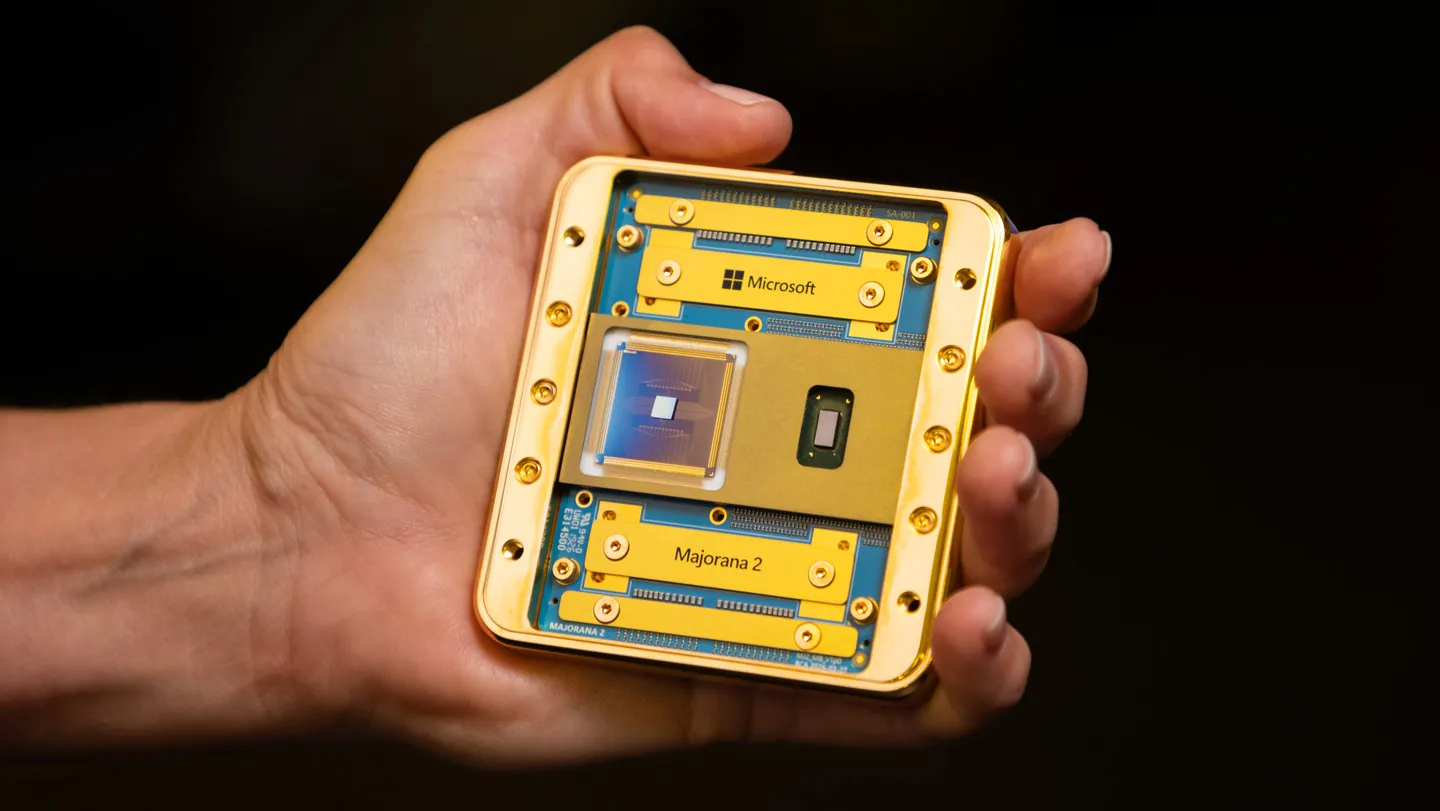
Despite the breathtaking beauty of this mathematical theory, translating these concepts into actual physical hardware has proved to be one of the most grueling scientific marathons of modern times. For years, Microsoft’s quantum division faced intense skepticism from the broader academic community, with some critics questioning whether these elusive Majorana zero modes could ever be reliably created, let alone manipulated, in a fabricated microchip. The difficulty lies in the fact that Majorana quasiparticles do not exist naturally in the wild; they must be painstakingly coaxed into existence by forcing a semiconductor, such as indium arsenide, to interface with a superconductor, such as aluminum, under extreme conditions just a fraction of a degree above absolute zero. In early experiments, Microsoft’s researchers discovered that their greatest enemy was not the theory itself, but the chaotic reality of materials at the atomic level. Even the tiniest imperfection—a single misplaced atom at the boundary where the superconductor met the semiconductor, or an invisible layer of continental chemical contamination—would create artificial “traps” that mimicked the signature of Majorana particles, leading to false positives and dragging down the coherence of the qubits. Recognizing that they had reached the physical limits of their initial designs, Microsoft’s engineering team returned to the drawing board to focus their immense computational resources and material science expertise on developing a successor platform: the Majorana 2 chip.
The breakthrough that has injected fresh enthusiasm into Microsoft’s quantum timeline is a masterclass in materials chemistry and atomic-scale engineering. On the newly developed Majorana 2 chip, researchers made the strategic decision to execute a wholesale “material swap,” systematically replacing the traditional chemical combinations at the critical interfaces of their nanowires with highly advanced, crystalline alternatives. To achieve the perfect, atomic-level smoothness required for these interfaces, the team pioneered ultra-clean molecular beam epitaxy, a process that allows them to grow the superconducting layer directly on top of the semiconductor nanowire, atom by single atom, with virtually zero structural mismatch. This material swap addressed a fundamental bottleneck by eliminating the microscopic “noise” and unwanted electron scattering that had previously choked the emergence of the delicate quantum states. It acted like paving a pristine, glassy highway for the electrons moving through the device, allowing the superconducting and semiconducting layers to interact in perfect quantum harmony. As a direct result of this material refinement, the delicate collective electronic behavior required to produce the elusive Majorana zero modes could finally emerge clearly, cleanly, and with a level of control that had previously existed only on paper.
This material triumph on the Majorana 2 chip has yielded dramatic, quantifiable improvements in the effectiveness of these topological qubits, shifting the technology out of the realm of abstract physics and onto a concrete engineering roadmap. The most significant consequence of the material swap was a massive boost in what physicists refer to as the “topological gap”—the critical energy barrier that protects a topological state from being disrupted or collapsed by external heat. With a wider, more robust topological gap, the qubits on the Majorana 2 chip proved to be incredibly resilient, demonstrating that the fragile quantum states could be maintained with unprecedented stability and paving the way for more reliable information storage. Furthermore, this success has validated Microsoft’s rigorous “Device Signature” protocol, a strict verification methodology designed to mathematically prove that the observed quantum phenomena are indeed authentic Majorana states rather than masquerading material defects. With a highly reliable, clean material foundation now firmly established, Microsoft’s research teams can confidently pivot to the next monumental milestone on their roadmap: “braiding.” Braiding is the process of physically moving these Majorana zero modes around one another in space and time, weaving their quantum pathways into complex topological knots that perform logical operations, a process that will form the basis of inherently error-immune quantum computation.
Looking beyond the complex equations and high-tech cleanrooms, Microsoft’s achievement with the Majorana 2 chip is a deeply human story of scientific perseverance, intellectual humility, and long-term vision. It is a powerful reminder that the road to world-changing innovation is rarely a straight line; it is paved with public setbacks, rigorous academic debate, and the quiet, relentless pursuit of truth at the atomic scale. While other technology giants chose easier, more immediate routes by building larger, noisier quantum processors that require massive overhead to correct errors, Microsoft’s scientists chose the harder, more intellectually demanding path, believing that solving the fundamental physics of the qubit first was the only true way to scale quantum computing to a level where it can truly benefit society. As this technology matures over the coming decades, it holds the key to solving humanity’s most complex challenges, from discovering ecological carbon-capturing materials to curing chronic diseases. Ultimately, the Majorana 2 chip is more than just an engineering upgrade; it is a step toward a future where our greatest global challenges are met not with computational brute force, but with the quiet, elegant mathematics of nature itself.