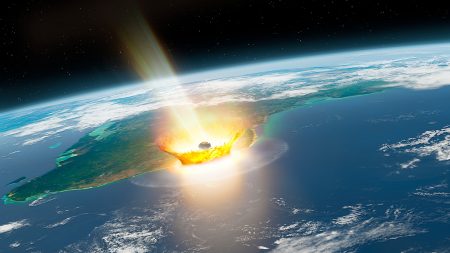







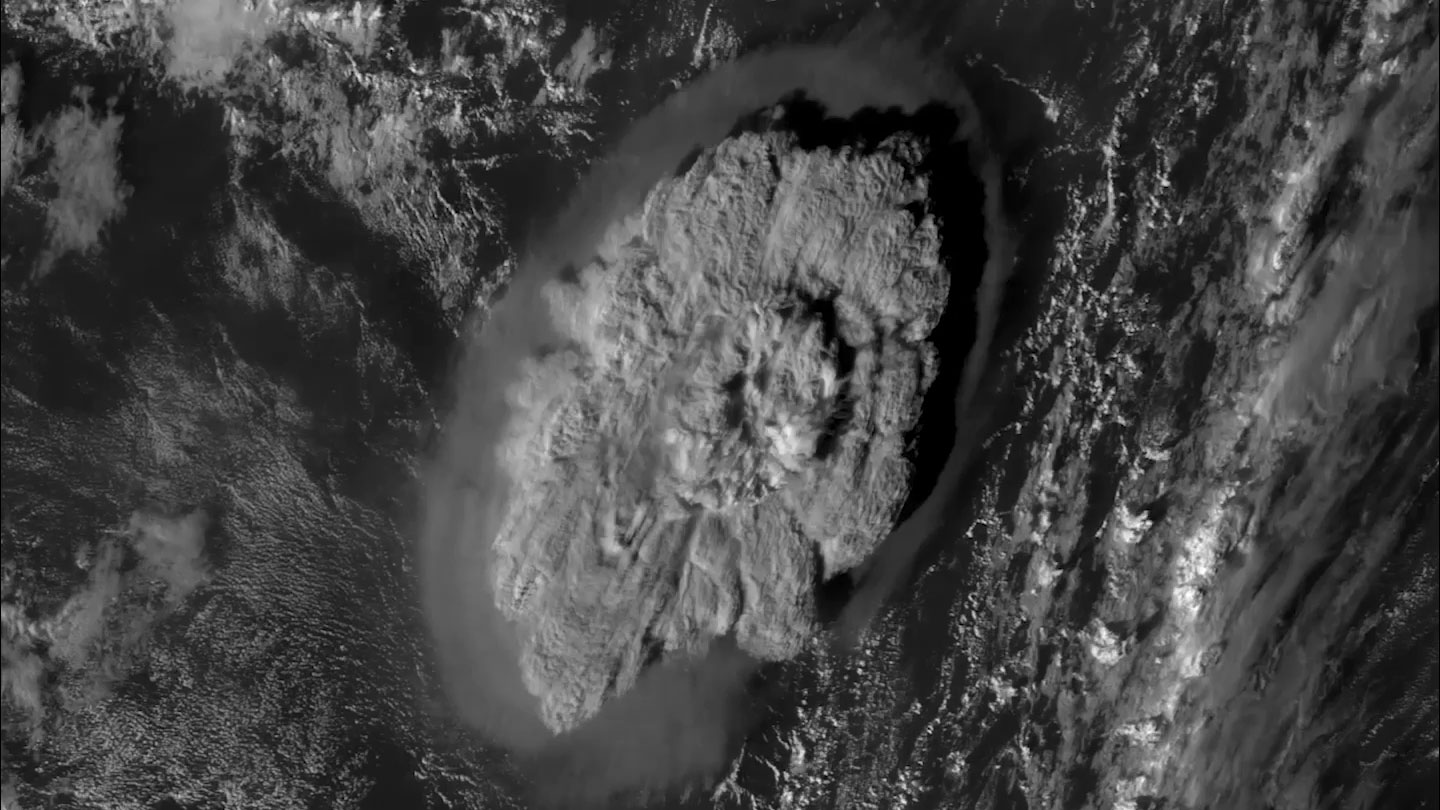
In the early weeks of January 2022, the peaceful waters of the South Pacific Ocean were shattered by an event of apocalyptic proportions. The submarine volcano Hunga Tonga–Hunga Ha’apai, resting quietly beneath the waves, erupted with a ferocious energy equivalent to several atomic bombs. This historic geological convulsion did not merely ripple through the ocean; it violently punched a hole through the sky, launching a colossal column of superheated ash, sulfurous gases, and vaporized seawater an astonishing 55 kilometers into the atmosphere, penetrating deep into the mesosphere. The explosion sent shockwaves whispering through the global atmosphere, vibrating windows thousands of kilometers away in Alaska and New Zealand, while leaving human observers in utter awe of our planet’s raw power. As satellites watched from orbit, this massive, dark umbrella of ash and gas spread across the globe, throwing a shadow that scientists immediately recognized as both a potential climate threat and an unprecedented scientific opportunity. Amidst the chaos of this natural disaster, researchers realized they were witnessing a planet-scale chemistry experiment unfold in real-time. According to a landmark study published in the journal Nature Communications, this cataclysmic plume contained a surprising secret: it initiated a series of chemical reactions that actively dismantled some of its own atmospheric pollutants. Most notably, the plume served as a highly efficient destroyer of methane, one of the most potent greenhouse gases plaguing our modern world. By tracking the migration and dissipation of this volcanic cloud through satellite data, researchers have gained a vital, unexpected window into the atmospheric dynamics of greenhouse gas destruction. This discovery marks a profound turning point in climate science, offering empirical, real-world data that could help us evaluate the validity of controversial, artificial cooling tactics designed to pull our warming planet back from the edge of ecological collapse.
To appreciate why this accidental volcanic experiment is so significant, one must first look at the atmospheric menace that is methane. While carbon dioxide remains the primary antagonist in our global warming narrative, methane is a silent, hyper-efficient accomplice, responsible for roughly one-third of the global temperature increases observed since the dawn of the industrial age. Molecule for molecule, methane is vastly more effective at trapping thermal radiation than carbon dioxide during its initial years in the sky, acting like a thick, heavy blanket wrapped around the earth. Fortunately, it possesses a glaring vulnerability: unlike carbon dioxide, which can stubbornly linger in the atmosphere for centuries or even millennia, methane is chemically fragile and breaks down in about ten short years. This relatively brief atmospheric lifespan makes methane the premier target for geoengineering advocates—ambitious scientists and thinkers who propose active, technological interventions in the Earth’s climate system to rapidly halt rising temperatures. However, as climate anxiety worsens and the clock ticks down, the prospect of playing God with our atmosphere becomes more alluring, yet dangerously unmapped. Before humanity can safely embark on any grand experiments to scrub methane from the atmosphere, we must possess a reliable, incredibly precise method to measure whether these interventions are actually working. As Maarten van Herpen, an insightful physicist with the Dutch consulting firm Acacia Impact Innovation, points out, we cannot manage what we cannot measure. For van Herpen and his global team of colleagues, the catastrophic Tonga eruption offered a once-in-a-lifetime test case to see if modern satellite technology could accurately detect and quantify methane degradation from the edge of space, providing a crucial dry run for future, human-engineered climate solutions.
The primary driver behind this natural methane-scrubbing phenomenon is a highly reactive chemical agent: atomic chlorine. In the everyday chemistry of our atmosphere, chlorine atoms act like chemical scalpels, slicing through methane molecules and initiating their destruction. Van Herpen and his team had spent years investigating how these reactive chlorine atoms form in nature, previously discovering a fascinating pathway where iron-rich mineral dust, swept up from the vast sands of the Sahara Desert, mingles with salt-rich ocean spray over the Atlantic. Under the warm glow of sunlight, the iron and saltwater undergo a photo-chemical dance that liberates chlorine in its highly reactive atomic state. When the Hunga Tonga–Hunga Ha’apai volcano erupted, it fundamentally mimicked and amplified this exact desert-and-ocean phenomenon on a staggering scale. Because the volcano’s caldera lay 150 meters beneath the ocean’s surface, the explosive heat did not just shatter rock; it instantly vaporized and lofted more than a hundred million metric tons of salty seawater directly into the stratosphere, alongside millions of tons of mineral-rich volcanic ash. This violent mixture created an ideal high-altitude laboratory where intense sunlight, volcanic minerals, and sea salts combined to unleash an unprecedented torrent of reactive chlorine atoms, which immediately began seeking out and dismantling nearby methane molecules in a frantic, unyielding chain reaction that surprised even the most seasoned atmospheric scientists.
Proving that this complex chemistry was actually happening tens of kilometers above the Earth required a feat of sophisticated space-age tracking. The researchers turned their gaze to the Tropospheric Monitoring Instrument (TROPOMI), a cutting-edge sensor aboard the European Space Agency’s Sentinel-5P satellite that maps air quality and greenhouse gases around the globe. Measuring methane directly over the open ocean is an atmospheric scientist’s nightmare because seawater absorbs and reflects sunlight at wavelengths that easily confuse satellite sensors, effectively blinding traditional orbital instruments. To bypass this frustrating obstacle, the scientific detectives looked for a chemical informant: formaldehyde. Formaldehyde is a secondary compound that is not directly thrown into the sky by volcanic eruptions, but is instead born as a transient intermediate product when methane molecules are ripped apart by chlorine. Because formaldehyde is extremely sensitive to sunlight and typically breaks down within hours, finding it persistently hovering inside the volcanic plume days after the eruption was the smoking gun the team needed. Its ongoing presence proved that methane was being continuously and vigorously destroyed inside the cloud. Folkert Boersma, an esteemed atmospheric scientist at Wageningen University & Research who observed the study from afar, expressed genuine surprise at these findings, noting that the detection of such high formaldehyde levels reveals a highly active chemical factory in the stratosphere that had never been documented in this manner before, opening up new pathways of scientific inquiry.
Despite the excitement surrounding this natural display of methane destruction, the study has simultaneously raised massive red flags among atmospheric chemists who worry about the dangerous lessons humanity might draw from it. In the immediate aftermath of the eruption, the intensified chlorine chemistry destroyed an estimated 900 tons of methane per day—a drop in the bucket compared to the 300,000 tons of methane released by the overall eruption, but a powerful proof of concept nonetheless. Yet, the thought of actively replicating this process by deliberately spraying chlorine into the stratosphere fills environmental experts with immense dread. Pete Edwards, an atmospheric chemist at the University of York, delivers a warning against even considering such an intervention, reminding us of the dark, cautionary tale of chlorofluorocarbons (CFCs) from the late 20th century, which depleted the ozone layer and created the infamous Antarctic ozone hole that took decades of international treaties to begin healing. In the cold, fragile environment of the stratosphere, chlorine is an incredibly indiscriminate agent; rather than hunting down the relatively scarce methane molecules, it preferentially attacks ozone, the vital gas shielding the Earth from deadly ultraviolet radiation. In fact, under stratospheric conditions, chlorine atoms react with ozone roughly 380 times faster than they do with methane, meaning any attempt to chemically cool the planet using chlorine would almost certainly sacrifice our planet’s protective UV shield, trading one existential climate crisis for another catastrophic disaster.
Ultimately, the valuable scientific lesson learned from the high-altitude chemistry of the Tonga eruption serves to redirect our collective focus back to the fundamental truths of our climate struggle. While exploring the outer limits of atmospheric chemistry expands our understanding of how our planet regulates itself during titanic volcanic crises, it also highlights the profound limits and dangers of relying on desperate geoengineering bypasses. Scientists like Folkert Boersma emphasize that the ultimate solution to global warming is not found in complex stratospheric manipulation, nor is it in spraying defensive chemicals into our blue skies. Instead, the true path forward is much simpler to understand, yet far more demanding of our societal willpower: we must stop emitting greenhouse gases at the source. Rather than dreaming of grand orbital mechanisms to clean up our industrial waste, humanity’s immediate global priority must remain the aggressive, systematic reduction of our carbon and methane output through sustainable energy transitions, plugging of natural gas leaks, and ecological restoration. This volcano showcased that the Earth can occasionally initiate its own emergency clean-up protocols, but it also left us with a clear warning that our atmosphere is a highly delicate web of balances that we tinker with at our own structural peril, reminding us that there is no shortcut to preserving our fragile home.