





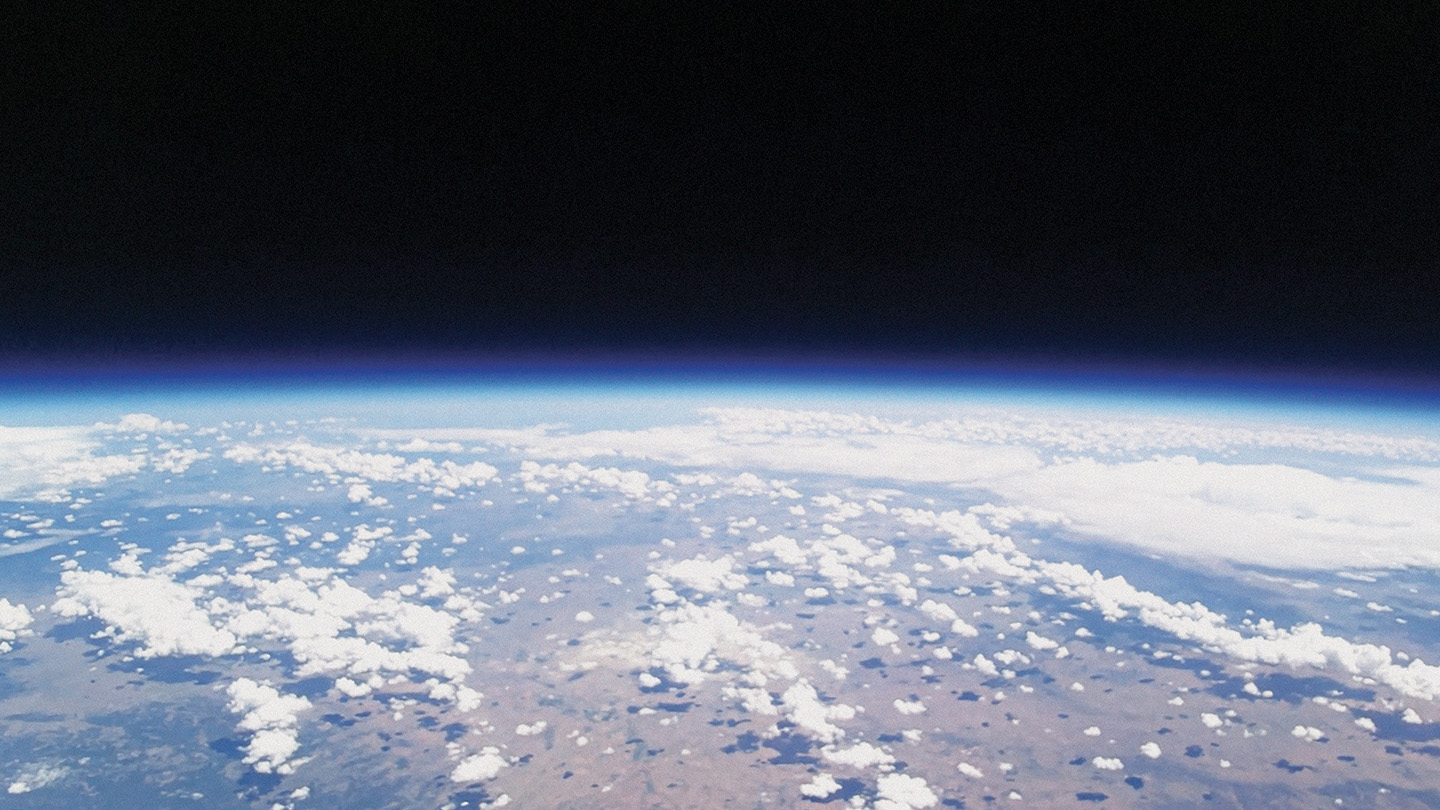
Hover thirty kilometers above the soil of our planet, and you will find yourself suspended in a gorgeous yet terrifying purgatory. Far below, the gentle, unmistakable curve of the Earth reveals itself, wrapped in a thin, glowing envelope of sapphire light—the fragile gas shield that cradles all known life. Above this delicate blue line, the sky darkens into the pitch-black void of deep space, a cold reminder of the universe’s vast indifference. For a human being, this is a realm of swift and violent death; with air pressure hovering at a mere one percent of sea level, the lack of oxygen would cause your blood to boil inside your veins, turning your skin into a gruesome network of welted blisters. Yet, as scientists have recently discovered, this atmospheric wasteland is far from barren. It is the domain of microscopic voyagers—single-celled organisms that successfully navigate temperatures as low as minus sixty degrees Celsius, extreme dehydration, and a relentless bombardment of DNA-destroying ultraviolet radiation. When microbiologist Brent Christner and his graduate student Noelle Bryan first began launching sampling balloons into this hostile high-altitude environment over a decade ago, their goal was to locate the absolute boundary of Earth’s habitable zone, hoping to understand if life could likewise endure the similarly brutal, radiation-soaked surface of Mars. Instead of finding a barren ceiling where life could no longer cling, however, they discovered that no matter how high they climbed, the sky was alive.
To appreciate the gravity of this discovery, one must look back at a century of human efforts to probe the biological secrets of our upper atmosphere, a quest that was long hindered by the limitations of early scientific technology. In 1935, the U.S. Army Air Corps launched the historic Explorer II helium balloon, carrying two brave pilots in a pressurized metal gondola twenty-two kilometers above South Dakota to study cosmic rays and drop a rudimentary, sterile microbe trap on its descent. While scientists successfully cultured ten strains of bacteria and fungi from those high-altitude samples, the limitations of pre-DNA-era biology meant they could do little more than guess at the organisms’ identities based on cellular shape. Decades later, during the height of the Cold War in 1974, Soviet researchers fired rockets equipped with sticky collection plates directly into the mesosphere—up to seventy-seven kilometers high—and returned with live cells, though their findings were perpetually shadowed by fears of terrestrial contamination. By the early 2000s, NASA entered the arena, using its high-flying ER-2 research spy planes to catch drifting microbes along with cosmic dust. These aircraft, cruising at twenty-one kilometers, required pilots to wear full spacesuits just to survive the freezing, low-pressure flight. Yet, even as scientists began applying basic genetic barcoding to these samples, they remained plagued by a fundamental bottleneck: over ninety-nine percent of the planet’s microbes refuse to grow in a laboratory petri dish. As a result, early researchers could never accurately count the total density of stratospheric life, prove how these organisms survived the solar radiation, or determine where they had originally come from on the surface of the Earth.
This historical fog began to clear in the late 2000s when Noelle Bryan, operating on a shoestring academic budget, set out to design a new class of ultra-clean microbe collectors. Utilizing simple blocks of Styrofoam and balsa wood purchased from local hardware and craft stores, Bryan built a series of lightweight, balloon-borne contraptions designed to minimize contamination using tightly sealed control chambers that never opened during flight. By 2013, having partnered with engineer T. Gregory Guzik to build rugged, arc-resistant circuitry that could survive the electrical demands of the thin upper air, Bryan traveled to the remote desert town of Fort Sumner, New Mexico—a place famous as the final resting place of Billy the Kid, but prized by atmospheric scientists for its incredibly stable winds and wide, flat terrain. On a quiet August morning, Bryan and her team released a towering, elephant-sized helium balloon into the New Mexico sky, watching as a downward-facing camera captured the desert floor shrinking into a miniature mosaic of brown and green. Slicing through violent high-altitude winds, the payload reached the stratosphere, opening its sterile hatches at eighteen kilometers to trap drifting biological particles before sealing itself shut at twenty-three kilometers and parachuting back to Earth. After chasing the GPS coordinates for miles across the arid scrubland, Bryan recovered the device nestled quietly between a yucca plant and a prickly pear cactus. Returning to her makeshift lab at the airport hangar, she ran a sensitive chemical test for adenosine triphosphate—the universal energy currency of living cells—fully expecting a negative result. Instead, the assays repeatedly glowed with chemical energy, forcing a sudden, exhilarating realization that the stratosphere was teeming with active, viable organisms.
When Bryan returned to her university laboratory to analyze the genetic identities of her sky-faring captures, she encountered a second, even more profound surprise that would turn conventional biological wisdom on its head. She had assumed that any microbe capable of surviving at the edge of space would be an exotic “extremophile”—perhaps a radiation-hardy bacterium like Deinococcus or an ultra-tough spore-former like Bacillus, organisms typically found in boiling hot springs, deep subterranean rifts, or pools of industrial acid. Instead, the genetic sequences revealed that her most resilient capture, a vibrant, orange-pigmented strain she named L6-1, belonged to the genus Curtobacterium, a common, everyday group of bacteria that spent their lives growing on agricultural crops and in garden soils. Over the next decade, Christner’s team painstakingly sequenced the microbe’s entire genome, naming it Curtobacterium aetherium and discovering that it was actually a fully functional plant pathogen capable of causing bean and millet crops to yellow, wilt, and die. For plant pathologists like Robert Harveson, who had spent decades believing these crop-destroying diseases only spread through contaminated seeds traded between farmers, the news was a revelation. The research proved that the Earth possesses an invisible, high-altitude biological highway where ordinary, terrestrial crop pests can be swept up into the stratosphere, sail across entire oceans and mountain ranges in a matter of weeks, and rain down on entirely new continents, spreading disease and driving planetary evolution on a global scale.
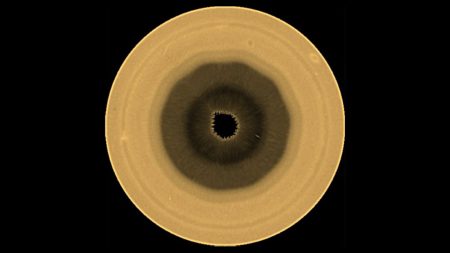
The discovery that a delicate leaf-dwelling bacterium could shrug off the lethal conditions of the upper atmosphere led researchers to investigate the elegant evolutionary survival kits these microbes carry. Because bacteria living on plant leaves are constantly exposed to cycles of extreme drying, they have naturally evolved highly efficient DNA repair mechanisms that, as it turns out, are perfectly suited for fixing the damage caused by heavy solar radiation. When graduate student Adam Ellington exposed Curtobacterium aetherium to repeat doses of lethal UV-C radiation—a high-energy wavelength of light blocked by our ozone layer but abundant in the stratosphere—he found it was just as radiation-tolerant as the world’s most famously indestructible super-microbes. Further genetic analysis revealed that this “humdrum” crop pathogen possesses a suite of highly specialized enzymes, including a rare protein called spore photoproduct lyase, which repairs DNA damage that specifically occurs when a cell is so severely dehydrated that its genetic material crystallizes into a tight, protective helix. Furthermore, these sky-dwellers utilize light-activated enzymes called photolyases that can repair cellular damage using raw sunlight, allowing them to rebuild themselves without consuming precious, scarce biological food resources. Other atmospheric researchers have discovered that some airborne bacteria can even generate their own energy by oxidizing trace gases like hydrogen and carbon monoxide, a metabolic trick that actually produces water as a chemical byproduct, effectively allowing the cells to self-hydrate and survive the desiccating freeze of the upper atmosphere.
These elegant adaptations have profound implications for how we search for life on other worlds, expanding the boundaries of where we believe living organisms can persist in the cosmos. For centuries, the scorching, acid-rain-soaked surface of Venus has been dismissed as an evolutionary dead end, but planetary scientists are now looking closely at the planet’s temperate upper clouds, forty-eight kilometers up, where pressures and temperatures mimic those of Earth. Drawing on the survival strategies of Curtobacterium, astrobiologists suggest that alien Venusian microbes could survive indefinite cycles of atmospheric sinking by drying up, hunkering down, and re-awakening only when swept back into hospitable cloud layers by updrafts. Similarly, the discovery that terrestrial microbes can survive high-altitude pressures has opened up new possibilities for Mars, where researchers have shown that methane-producing organisms can remain biologically active under thin, Martian-like atmospheric pressures, suggesting that simple life forms could easily migrate across the red planet by hitching a ride on global dust storms. Even on planets orbiting distant stars light-years away, astronomers hope to use next-generation space telescopes to scan planetary atmospheres for the distinct spectral signatures of UV-blocking pigments, similar to the orange and pink protective shields carried by the microbes captured in the New Mexico sky. Ultimately, what began as a modest project built from craft-store Styrofoam and balsa wood has forever changed our relationship with the heavens, proving that our atmosphere is not a vacant void, but a vast, living bridge to other worlds.