





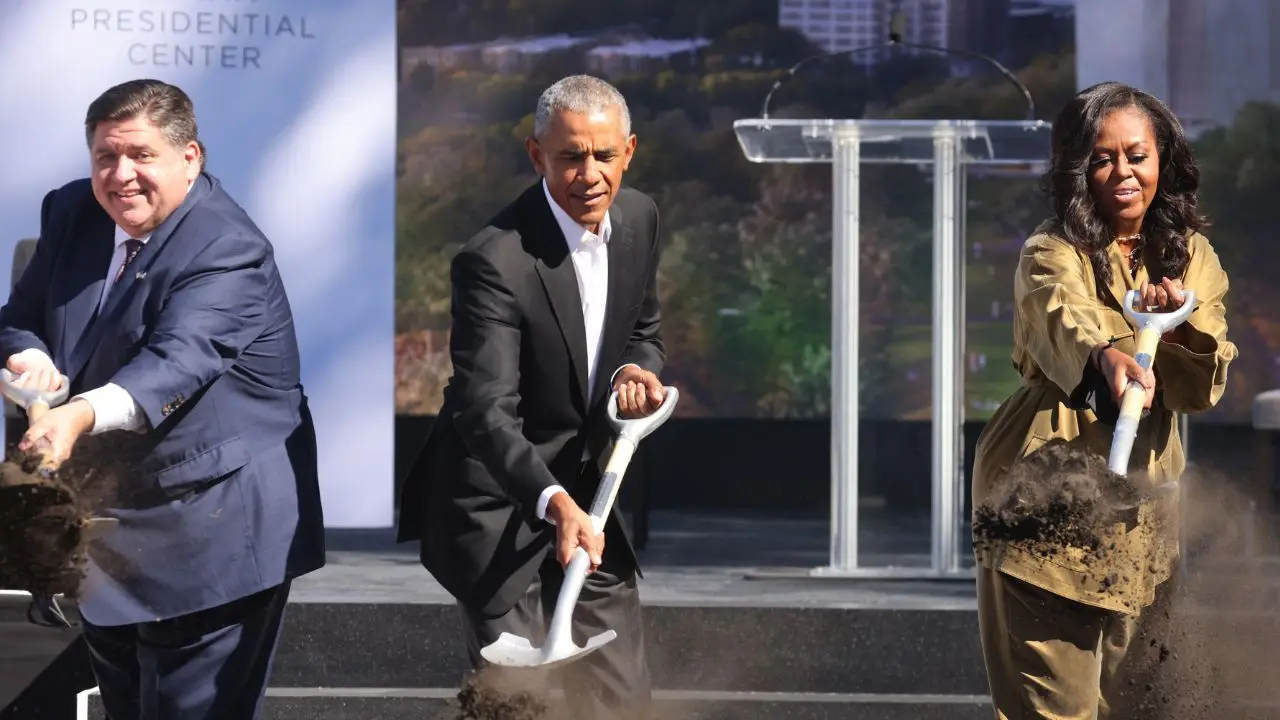
The physical structures left behind by American presidents do not merely house dusty archives or host glamorous galas; they serve as bold, tangible assertions of authority, cultural values, and historical perspective. As the long-awaited Obama Presidential Center prepared to open its doors to the public in Chicago, it became the latest battleground in a perpetual war of narratives between two vastly different eras of American leadership. Rather than standing alone as a celebration of the nation’s 44th president, the grand opening was immediately seized upon by the current White House, serving as a stark point of contrast for President Donald Trump’s own sweeping, ambitious campaign of national capital renovations. This physical tug-of-war reveals a deeper American truth: every stone laid, every dollar budgeted, and every ribbon cut is an act of intense political theater. On one side stands a progressivism that utilizes expansive, community-centered, and often highly complex public-private partnerships; on the other, a populist brand of executive power that prides itself on direct, classical aesthetics, structural fortification, and a hands-on commitment to restoration. Beneath the soaring rhetoric of both camps lies the everyday reality of the citizens who fund these grand visions, demonstrating how the pursuit of a lasting legacy is always paid for in the currency of the present.
The Obama Presidential Center, situated on Chicago’s South Side, was envisioned as a dazzling, modern hub of civic engagement and hope, designed to be a physical testament to a historic presidency. Its dedication ceremony was a masterclass in cultural influence, drawing a glittering constellation of global dignitaries, former diplomats, and Hollywood heavyweights, including former Canadian Prime Minister Justin Trudeau, media mogul Oprah Winfrey, and legendary filmmaker Steven Spielberg, alongside political powerhouses like Nancy Pelosi and Kamala Harris. Yet, behind this shield of glamour and the decade of careful planning lay a much more complicated and frustrating human reality. Critics and local taxpayers have increasingly questioned the ballooning price tag of the campus, which saw its construction costs swell from an already staggering $830 million in 2021 to well over the $1 billion mark, heavily augmented by hundreds of millions of public dollars allocated for surrounding infrastructure, utility rerouting, and transit updates. Far from the clean, triumphant narrative projected on stage, the project became a source of financial heartbreak for local construction firms and subcontractors. Multiple independent businesses reported devastating losses, with some claiming they were owed millions of dollars for their work, pushing family-owned enterprises to the brink of financial ruin—a stark reminder that the high-walled monuments of the powerful often cast long, cold shadows over the very working-class people they claim to uplift.
The Trump administration was quick to exploit these financial cracks, transforming the grand opening of the Chicago site into a political weapon to bolster the President’s own record on infrastructure and public works. White House spokesperson Davis Ingle delivered a searing critique, contrasting the perceived administrative bloat, delays, and budget overruns of the Obama era with Trump’s streamlined, aggressive approach to restoring Washington, D.C. Ingle championed Trump as a decisive executive who was actively implementing long-overdue, necessary renovations to beautify the nation’s capital and its most treasured monuments in preparation for America’s historic 250th anniversary of independence. By framing Trump as the ultimate “Builder-in-Chief”—a leader capable of delivering massive, high-quality projects on time and under budget—the White House sought to draw a sharp line between what they characterized as an errantly run, over-promising Obama administration and a pragmatic, action-oriented Trump presidency. This rhetorical offensive was designed to appeal directly to taxpayers weary of government inefficiency, presenting Trump’s hands-on oversight of Washington’s restoration not as a series of vanity projects, but as a disciplined, patriotic duty meant to honor the country’s physical heritage for generations to come.
This clash of worldviews is deeply embedded in Trump’s larger legislative and aesthetic mission, spearheaded by his executive order, “Making the District of Columbia Safe and Beautiful.” Trump’s vision for the nation’s capital is rooted in a restorationist philosophy, a desire to strip away what he diagnoses as modern neglect, crime, and urban decay in order to revive a classical, majestic sense of national pride. On his social media platform, Truth Social, Trump passionately articulated this mission, promising to rescue a capital city that he argued had fallen into squalor and filth, vow-ing to make it “truly, GREAT AGAIN!” For Trump, the physical beauty of Washington, D.C., is inextricably linked to national security, law and order, and global prestige. His focus on tangible, highly visible improvements—ranging from the meticulous maintenance of national memorials to sweeping structural upgrades—is meant to send an unequivocal message of strength and stability to both domestic citizens and foreign observers. By positioning himself as both a protector and an architect of the capital’s physical environment, Trump seeks to craft his own enduring monument, one defined by orderly landscapes, gleaming marble, and a sense of imperial grandeur that stands in direct opposition to the decentralized, community-focused hub created by his predecessor in Chicago.
Naturally, this aggressive reshaping of the White House and Washington did not escape fierce condemnation from the political opposition, who were quick to label Trump’s projects as indulgent, expensive, and profoundly out of touch with the struggles of everyday families. Barack Obama himself took direct aim at Trump’s priorities during a campaign rally, mockingly pointing to Trump’s preoccupation with paving over the iconic Rose Garden lawn with stone pavers—a change Trump’s team argued was necessary to prevent mud and accommodate modern press conferences—and his plans to build a massive, $300 million White House ballroom. Former House Speaker Nancy Pelosi echoed this frustration, calling it “shameful” that such a luxurious event space was being constructed at a time when average working families were struggling to afford basic meals. However, Trump defended the project by pulling back the curtain on its true, dual-purpose design, revealing that the future ballroom was not simply a venue for opulent state dinners, but a heavily fortified, secure facility built with state-of-the-art defense capabilities both above and deep below ground, specifically engineered to support critical presidential operations during crises. This clash perfectly encapsulates the debate: where critics saw a gilded, insulated fortress for the elite, the administration saw an essential, modern safeguard for the executive branch of government.
The battle over executive aesthetics and fiscal responsibility reached a crescendo with the announcement of a planned 250-foot gilded arch for “Memorial Circle” to celebrate America’s 250th birthday, sparking instant backlash from progressive leaders like California Governor Gavin Newsom’s office, who warned taxpayers that their hard-earned dollars were being diverted to a multi-million-dollar monument of gold-plated vanity. Yet, this ideological divide extends far beyond the architectural choices of a gilded arch in Washington or a towering concrete museum in Illinois; it touches on the very soul of how a nation chooses to remember its history and define its future. As the public wanders through the newly minted halls of the Obama Presidential Center or gazes upon the fortified structures and renovated landscapes of Trump’s Washington, they are witnessing a profound civic debate played out in brick, mortar, and steel. One vision seeks legacy through a community-driven, sprawling tribute to personal and social transformation, while the other seeks legacy through classical power, national beauty, and unyielding federal strength. Ultimately, these physical monuments are the permanent legacy markers left behind by transient leaders, leaving future generations of Americans to decide which vision of their country was truly worth the price of admission.