





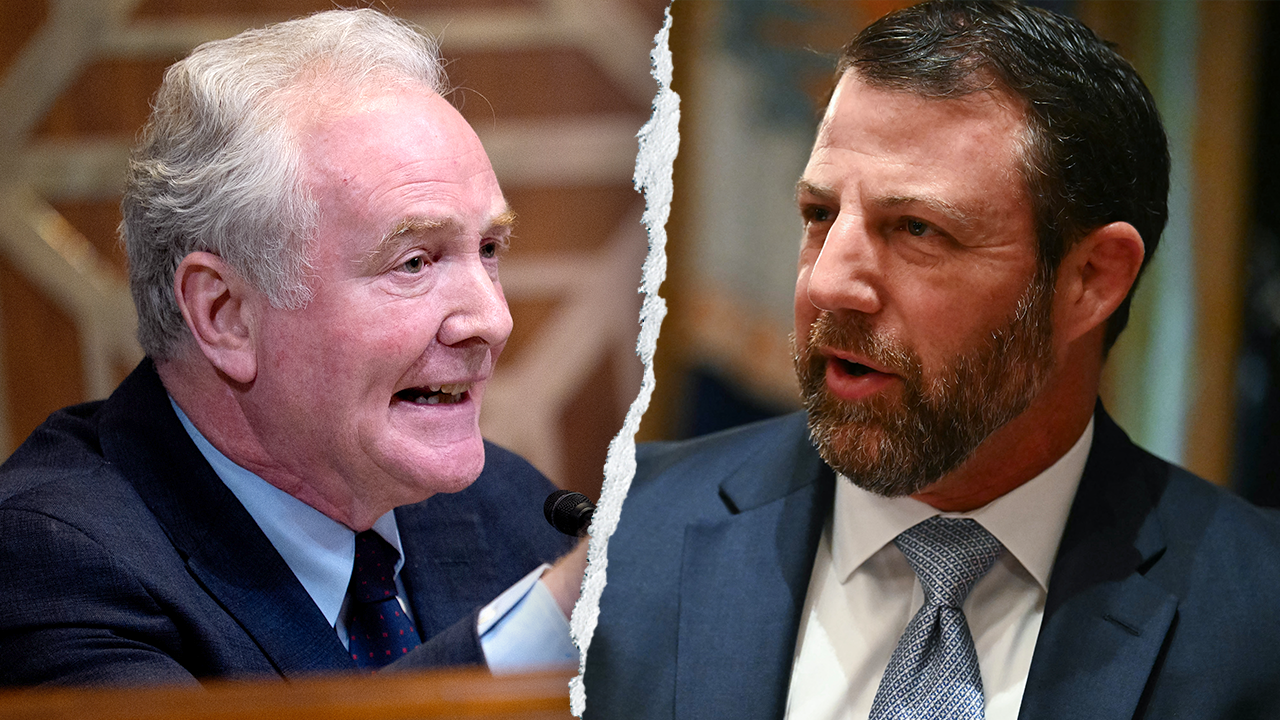
The grand, marble-lined chambers of the Senate Appropriations Committee are frequently the stage for dry, formulaic congressional hearings, but on a tense Tuesday afternoon, the sterile atmosphere of government bureaucracy evaporated completely, replaced by an arena of raw, deeply human conflict. The catalyst for this dramatic shift was a blistering emotional collision between Senator Chris Van Hollen, a veteran Maryland Democrat, and Homeland Security Secretary Markwayne Mullin, a fierce defender of his federal agency’s aggressive border enforcement tactics. Within this high-stakes setting, the debate was never merely about spreadsheets, policy allocations, or legislative procedures; instead, it cut directly to the fundamental moral direction of an American nation deeply divided over immigration, human rights, and the rule of law. What transpired was a visceral display of the psychological wear and tear that plagues modern American governance, where the human elements of frustration, anger, and ideological entrenchment took center stage. As television cameras rolled and spectators in the gallery watched in hushed silence, the deep-seated grievances of both men broke through the carefully curated veneer of congressional decorum, revealing the intense personal animosities and irreconcilable worldviews that govern the ongoing national crisis at our borders. The physical confrontation exposed the sheer exhaustion of federal lawmakers who are desperately trying to hold a gargantuan, opaque executive branch accountable to the public, juxtaposed against the defensive, beleaguered posture of an administration head who represents thousands of frontline officers and feels his agency is constantly under unfair moral and administrative siege. This was not just a routine political oversight panel; it was a deeply troubling microcosm of a government struggling to find a common language of trust, safety, and basic human dignity in a deeply fractured era.
The initial spark that ignited the hearing room centered on a fierce debate over semantic definitions, though the real-world human consequences underlying those words were profoundly grave and deeply felt. Senator Van Hollen, who has historically positioned himself as a passionate advocate for migrant communities—even while drawing intense political criticism for a controversial past journey to El Salvador to meet with Kilmar Abrego Garcia, an undocumented migrant with alleged gang ties—accused the Department of Homeland Security of harboring a systemic “pattern” of unchecked abuse in its enforcement of immigration laws. To anchor his serious charge, Van Hollen pointed directly to several high-profile, fatal encounters involving federal law enforcement officers on American soil, specifically highlighting the recent, tragic shootings of a Venezuelan national named Julio Cesar Sosa-Celis, as well as political activists Renee Good and Alex Pretti in Minnesota. For the Senator, these individual human lives were not isolated statistics but part of a larger, systemic failure of accountability that demanded immediate reckoning. However, Secretary Mullin fiercely pushed back against this bleak narrative, dismissing Van Hollen’s accusations as an unfair and politically motivated “exaggeration of words.” Mullin sought to contextualize the violence by framing it against the massive scale of a border security apparatus that manages an astronomical average of 1,900 intense, volatile physical encounters every single day. The verbal sparring heated up rapidly as Van Hollen sarcastically suggested they open up a dictionary to define what a “pattern” truly means in human terms, while Mullin adamantly argued that three isolated, tragic incidents out of hundreds of thousands of daily interactions could not logically define the honorable service of his entire federal department, highlighting a cold, statistical perspective on public safety colliding with qualitative human grief.
As the confrontation deepened, the focus of the hearing shifted from semantic definitions to the fragile, eroding concept of institutional trust, exposing the profound cynicism that now defines the relationship between the branches of the federal government. Van Hollen aggressively pressed Mullin to commit to total transparency, demanding to know if the Department of Homeland Security would fully cooperate with local Minnesota authorities by actively sharing critical evidence from the federal officer-involved shootings. When Mullin hesitated to offer an unconditional guarantee, Van Hollen blasted the administration’s defensive and tight-lipped posture, stating flatly that the highly politicized messaging coming out of the executive branch and the White House made it virtually impossible for the public, or local law enforcement, to trust the federal government to conduct an objective, independent internal review of its own behavior. This critique struck a raw nerve, prompting Mullin to launch an intense counter-offensive that targeted what he viewed as the shameless partisan double standards of his congressional interrogators. With a voice vibrating with indignation, Mullin demanded to know why Van Hollen and his colleagues willingly trusted previous administrations while maintaining a default posture of absolute skepticism and hostility toward the current leadership. Using a vivid “apples and oranges” metaphor, Mullin warned the committee against cherry-picking which administrations to believe based entirely on political convenience, showcasing the ultimate tragedy of modern Washington: an environment where the pursuit of truth regarding a loss of human life is routinely hijacked by tribal warfare, leaving grieving families caught in a devastating political crossfire.
The emotional temperature of the room remained at a boil when Senator Chris Murphy, a Connecticut Democrat known for his razor-sharp and passionate defense of civil liberties, entered the debate to challenge the broader financial and physical scale of the homeland security apparatus. Murphy redirected the focus of the intense hearing toward the massive, sprawling network of immigration detention centers cutting across the American landscape, characterizing the agency’s fiscal priorities with a devastatingly human metaphor: he accused the Department of Homeland Security of “spending taxpayer money like stone drunk sailors” to construct gargantuan, prison-like detention facilities designed to hold thousands of migrants in legal limbo. This striking imagery was not merely an abstract critique of national budget allocations; it was a powerful indictment of the human toll of mass incarceration, forcing everyone in the room to confront the reality of concrete walls, wire fences, and the quiet despair of families held indefinitely without a clear future. Murphy argued that these ballooning federal expenditures represent an out-of-control, self-perpetuating machine that prioritizes containment and punishment over constitutional restraint and basic human dignity. By framing the agency’s construction projects as an unchecked, lavish financial indulgence, Murphy sought to humanize the systemic abstractness of federal funding, transforming a dry discussion of agency appropriations into an urgent, deeply moral commentary on the rapid expansion of a surveillance and detention state operating with terrifying financial and administrative freedom.
This intense philosophical clash over executive power and institutional accountability reached its dramatic and historic zenith when Murphy demanded a simple, unambiguous commitment from Secretary Mullin regarding the fundamental American principle of judicial oversight. Citing alarming court documents wherein a federal judge identified nearly one hundred separate instances where the Department of Homeland Security had directly violated judicial orders in the state of Minnesota, Murphy pressed Mullin on whether he would unequivocally commit to obeying the future rulings of the judiciary, especially when courts deem the actions of Immigration and Customs Enforcement (ICE) to be illegal or unconstitutional. Mullin’s response, far from offering the reassuring platitudes typical of government officials, exposed a chilling and raw fracture in the very foundation of the American constitutional system. Rather than giving a straightforward, affirmative pledge of obedience to the bench, Mullin deflected, asserting that while his department would never violate the plain text of the Constitution, the courts themselves have become deeply politicized arenas where partisan judges routinely use their authority to enforce personal political opinions rather than the objective rule of law. This outright refusal to blindly defer to judicial authority sent an immediate, visceral shockwave of anxiety through the hearing room, as it went beyond a simple dispute over immigration policy and ventured into a terrifying territory where executive branch leaders reserve the right to judge the legitimacy of the judicial orders they are legally bound to follow.
The explosive hearing ultimately concluded not with any sense of mutual resolution or legislative progress, but with a lingering, heavy atmosphere of profound mutual suspicion and deep institutional anxiety that will undoubtedly reverberate far beyond the halls of Congress. Senator Murphy, visibly unsettled by the Secretary’s dismissive attitude toward the authority of the federal bench, turned directly to his congressional colleagues on both sides of the political aisle to warn them that they should be “really, really freaked out” by an executive official who openly questions the obligation of a law enforcement agency to obey court orders, highlighting how quickly the democratic guardrails can erode when raw power replaces mutual institutional trust. Mullin, entirely unapologetic and standing his ground, fired back with a warning of his own, insisting that the real cause for democratic concern lay in the highly politicized, easily overturned rulings emerging from activist courts across the nation that undermine the rule of law. For the average American citizen watching this high-stakes political drama unfold, the spectacle served as a sober and deeply humanizing reminder of the profound dysfunction currently paralyzing the federal government. It revealed a system so deeply fractured that its top leaders cannot even agree on the basic definitions of public safety, the legitimacy of the judiciary, or the necessity of operational transparency, leaving immigration policy as a perpetual, war-torn battleground where human lives, constitutional norms, and the rule of law are routinely sacrificed for political survival.