




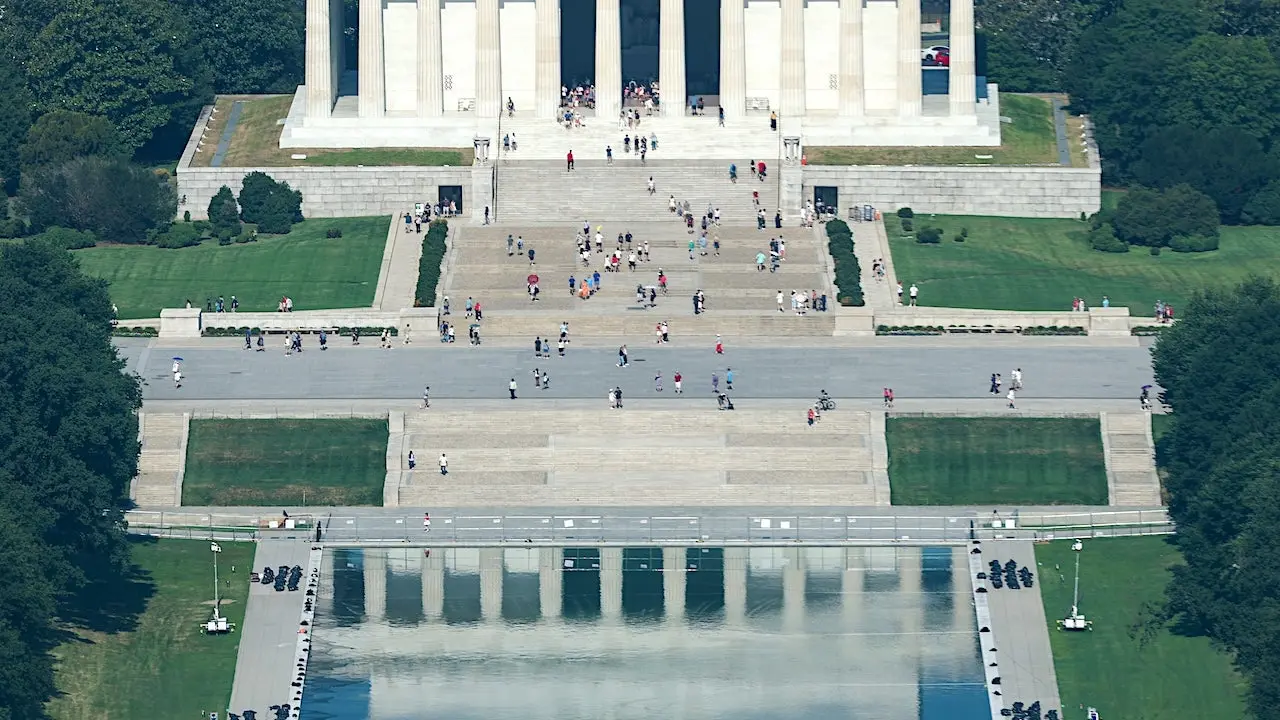
The Lincoln Memorial Reflecting Pool has long stood as an iconic sanctuary of American heritage, a tranquil mirror reflecting some of the nation’s most historic triumphs and struggles. However, during the humid Washington summer, this solemn landmark transformed into an unlikely theater of intense political warfare, legal drama, and bureaucratic finger-pointing. The controversy ignited when former Olympic kayaker David Hearn was accused of vandalizing the pool’s newly applied blue lining just as the capital prepared for a massive rush of visitors ahead of the highly anticipated America 250 celebrations. What began as a local property dispute rapidly escalated into a national flashpoint, pitting former President Donald Trump against federal prosecutors, highlighting the deep political polarization of the era, and turning a simple maintenance failure into a symbolic battlefield over patriotism, executive oversight, and civic responsibility.
The details of the confrontation, which occurred on a sweltering June afternoon, read like a tense screenplay of civic friction. According to sworn court documents shared publicly by Donald Trump, two National Park Service employees were knee-deep in the water, meticulously cleaning the interior of the pool, when they noticed Hearn walking along the edge. The witness account describes Hearn using his smartphone to document what appeared to be existing tears in the protective blue coating of the pool. Moments later, the scene escalated dramatically: the primary witness reported that Hearn knelt down, plunged both hands beneath the water’s surface, and began to “violently” rip and tug at a large section of the delicate lining. When the park employee pleaded with him to stop and warned that they would have to call the police, Hearn reportedly dismissed their concerns, retorting that the staff was “awfully sensitive about the pool” before continuing to tear at the material until National Guard soldiers arrived to intervene.
This vivid eyewitness testimony initially formed the backbone of a felony destruction of property indictment against Hearn, but the legal case collapsed almost as quickly as it had begun. U.S. Attorney Jeanine Pirro’s office had rushed to secure the indictment based on what prosecutors later described as “barebones” initial reports from the Department of the Interior. However, as the discovery process unfolded, crucial information came to light revealing that the pool’s blue protective coating was already failing catastrophically due to shoddy work by the primary contractor, Atlantic Industrial Coatings. Pressured by tight deadlines to deliver a picture-perfect monument in time for the July 4th festivities, the contractors had rushed the installation, leading to widespread peeling and bubbling independent of any human interference. Recognizing that it would be legally impossible to prove beyond a reasonable doubt that Hearn’s aggressive tugging caused the threshold of damage required for a felony conviction, prosecutors moved to dismiss the charges without prejudice, leaving the door open for future litigation but effectively defusing the immediate criminal threat against the former Olympian.
The dismissal of the charges did not sit well with Donald Trump, who launched a vigorous public campaign on his Truth Social platform to challenge the decision and keep the spotlight firmly on the incident. Trump took direct aim at U.S. Attorney Jeanine Pirro, expressing absolute disagreement with her office’s legal retreat and accusing her of “choking” under pressure. By highlighting Hearn’s history of financial donations through the Democratic fundraising platform ActBlue, Trump framed the entire episode not as a minor misunderstanding over construction quality, but as a deliberate act of politically motivated sabotage shielded by bureaucratic protective instincts. He argued that the eyewitness testimony of a career National Park Service employee—whom he described as highly credible—provided undeniable proof of intentional destruction that could not simply be explained away by contractor incompetence or administrative corner-cutting.
To bolster his narrative of a coordinated campaign against the nation’s historic spaces, Trump pointed to other bizarre and destructive incidents that plagued the grounds surrounding the Reflecting Pool during the same period. Most notably, he referenced a targeted chemical attack on the newly manicured lawns flanking the monument, where perpetrators allegedly used an “acid-like material” to burn the numbers “86 47” into the grass—a clear, politically charged reference advocating for the rejection of a potential 47th presidential term for Trump. For park rangers, groundkeepers, and daily visitors, these incidents painted a depressing picture of a deeply fractured society where even the physical grass and waters designed to foster national unity were being defaced for partisan point-scoring. In response to the wave of vandalism and technical failures, park officials scrambled to repair the turf and accelerate the installation of high-definition security cameras to ensure that every square inch of the historic plaza would remain under constant surveillance.
Despite the lingering political rhetoric, Hearn’s legal defense team—composed of high-profile attorneys Norm Eisen, Mary Dohrmann, and Steve Levin—celebrated the dismissal as a complete vindication of their client, asserting that the case was a politically motivated overreach that should never have been brought to court in the first place. They maintained that Hearn had done absolutely nothing wrong and was merely observing and interacting with a structure that was already falling apart due to systemic corporate negligence. As contractors work diligently to restore the Lincoln Memorial Reflecting Pool to its signature crystal-clear state, the physical scars of the summer may soon fade, but the deeper cultural and political divisions exposed by the conflict remain. The saga stands as a powerful, modern parable of how easily a physical space of national reflection can become a lightning rod for the fierce ideological battles defining contemporary American life.