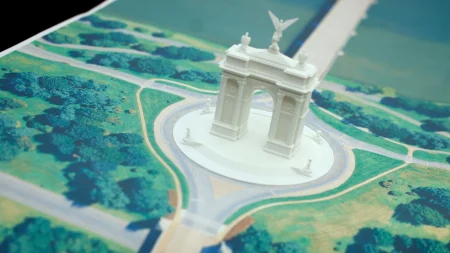






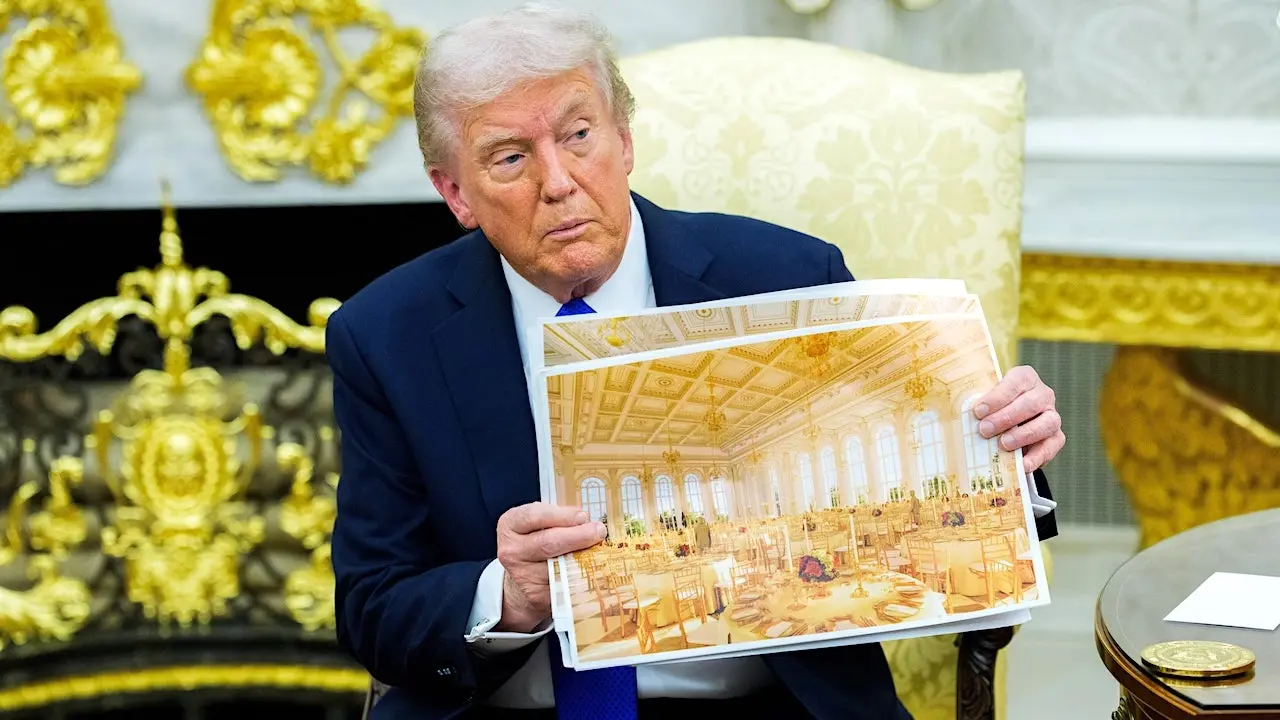
The ongoing legal battle over President Donald Trump’s ambitious plan to construct a grand ballroom at the White House has escalated from a localized zoning dispute into a high-stakes constitutional drama, highlighting the delicate balance between executive privilege, national security, and public preservation. The conflict reached a critical juncture when the D.C. Circuit Court of Appeals issued a tense 2-1 ruling that effectively halted all above-ground construction on the project, declaring that such a massive structural addition cannot proceed without explicit Congressional authorization. In response to this judicial roadblock, Trump took to social media in a characteristically fierce and public display of defiance, pledging to elevate the fight to the Supreme Court of the United States. He argued passionately that leaving the ballroom construction site unfinished not only compromises the architectural vision of the executive mansion but also poses a direct and active physical threat to the safety of future presidents who must live and work amidst an open, vulnerable construction zone. By framing the dispute as an urgent national security crisis rather than a simple bureaucratic disagreement, Trump has set the stage for a dramatic appellate showdown. For legal observers, the case is not merely about concrete, steel, and physical space; it represents a profound philosophical debate over who holds ultimate authority over the nation’s most symbolic residence, and how the physical evolution of that space should be managed in an era of deep political division.
At the very heart of the opposition to the ballroom stands the National Trust for Historic Preservation, an organization dedicated to protecting America’s architectural heritage, which has rooted its entire legal challenge in the deeply personal experience of a single local citizen. Alison Hoagland, a dedicated member of the National Trust who lives near the executive mansion, became the human face of the lawsuit by describing her routine walks through President’s Park, a ritual she performs about once a month to connect with the history and aesthetic grandeur of the nation’s capital. Hoagland argued in her testimony that the sheer scale, height, and modern design of the proposed ballroom would permanently damage her personal enjoyment of the area, casting a literal and metaphorical shadow over the historic White House and diluting its classical, timeless aesthetic. By centering their case on Hoagland’s monthly walks, the National Trust attempted to translate abstract legal statutes regarding environmental and historic preservation into a tangible, relatable human grievance. They asserted that the public has a vested, emotional, and visual ownership stake in the appearance of the White House, and that altering its iconic silhouette without public consensus constitutes a direct harm to the citizenry. This argument underscores a broader cultural anxiety about the commercialization or modernization of sacred public spaces, suggesting that some landmarks are so deeply woven into the national identity that they must remain frozen in time, protected from the temporary whims of any single administration.
However, this reliance on personal aesthetic displeasure as a basis for a federal lawsuit has drawn sharp criticism from legal scholars and dissenting jurists, who argue that such grievances do not meet the strict constitutional requirements necessary to sue the government. In her powerful and meticulous dissenting opinion, Judge Neomi Rao, a Trump appointee to the D.C. Circuit, sharply criticized the majority for prioritizing the subjective feelings of a casual pedestrian over the concrete, practical safety needs of the President of the United States. Rao argued that the district court had erred grievously by elevating the minor “aesthetic displeasure of a single passerby” above the critical government interest in establishing a secure, state-of-the-art ballroom and resolving the severe security risks associated with leaving a gaping, active construction site right outside the president’s home and office. From a legal standpoint, Rao contended that the National Trust and Hoagland utterly failed to establish “standing”—the fundamental legal principle that requires plaintiffs to prove they have suffered a concrete, particularized, and imminent injury before they can invoke the power of the federal courts. By pointing out the absurdity of halting a major executive security and infrastructure project based on the casual observations of someone walking by once a month, Rao’s dissent provided Trump with a robust, legally sound framework to appeal the decision, shifting the focus of the debate from architectural tastes to the rigid, objective rules of federal jurisdiction.
Legal experts suggest that if the Supreme Court agrees to hear the case, the justices are highly likely to bypass the messy, politically charged questions of executive power altogether and resolve the entire matter on the technical issue of standing. Abhishek Kambli, a former Justice Department attorney, and Hans von Spakovsky, a senior legal fellow at Advancing American Freedom, both agree that the current makeup of the High Court, which has historically maintained an incredibly strict and conservative interpretation of standing, presents a formidable barrier for the National Trust. Kambli pointed out that while Congress chartered the National Trust to advocate for historic preservation, the group does not actually own President’s Park or the White House East Ballroom, making it incredibly difficult to argue that they have a proprietary interest that has been damaged. Furthermore, establishing standing based purely on aesthetic harm typically requires a plaintiff to prove they actually use and occupy the specific space in question; simply passing by on a public sidewalk and feeling disappointed by the view is rarely deemed sufficient by modern federal courts. This high legal threshold was mirrored in a similar ruling earlier this summer, when an Obama-appointed district judge swiftly dismissed a lawsuit attempting to block a UFC event at the White House, ruling that the plaintiffs’ claims of aesthetic harm were far too speculative to grant them standing. Consequently, the Supreme Court could easily throw out the ballroom injunction on procedural grounds, leaving the National Trust with no legal recourse and allowing construction to resume without the Court ever having to decide if the administration had the explicit statutory authority to build the structure.
To understand the statutory debate behind the ballroom, one must examine the precise legal language governing modifications to federal property, which hinges on the everyday, real-world definitions of “alteration” and “improvement.” The Trump administration has consistently maintained that existing federal laws grant the presidency the inherent authority to make necessary physical upgrades to the White House complex, interpreting the ballroom as a functional improvement to an active, working government estate. To illustrate this concept in human terms, Kambli compared the ballroom project to a standard home renovation, noting that if an ordinary homeowner decides to build a modern extension or tear down an interior wall to create an open-concept living space, the structure does not suddenly cease to be their home; rather, it remains the same house, merely altered and improved to better suit the family’s changing needs. In the context of the White House, which must simultaneously serve as a private residence, a highly secure military command center, and a premier diplomatic venue for hosting world leaders, the administration views the addition of a secure, spacious ballroom as a vital, common-sense modernization rather than an unauthorized, brand-new construction project. By framing the ballroom as a practical real-estate improvement designed to host large-scale diplomatic events safely, the administration’s legal team seeks to demystify the project, stripping away the political theater and presenting it as a logical, necessary upgrade to a building that has constantly evolved throughout American history to meet the demands of the modern presidency.
Ultimately, the battle over the White House ballroom exposes the deep political paralysis gripping Washington, where even minor physical modifications to the executive mansion are transformed into major partisan battlegrounds. As Hans von Spakovsky observed, because the Supreme Court is likely to dismiss the lawsuit due to the plaintiffs’ lack of standing, and because Congress is far too divided along partisan lines to ever pass collective legislation either blocking or approving the project, the legal challenge represents a deteriorating avenue for civic opposition. This case forces us to grapple with a fundamental, human question: is the White House a static, sacred museum belonging entirely to the visual memory of the public, or is it a dynamic, living workspace that must adapt to the terrifying security realities and diplomatic obligations of the twenty-first century? As the physical mud and exposed steel of the unfinished construction site continue to sit in the shadow of the executive mansion, the pending Supreme Court appeal serves as a stark reminder of how our grandest national symbols are constantly caught in the crossfire of legal technicalities, political ambitions, and the quiet, daily lives of the citizens who watch them from beyond the security gates.