






The relentless passage of time spares no one, not even those who have occupied the most powerful offices in the world, where every physical movement is recorded by high-definition cameras and every momentary hesitation is analyzed for deep geopolitical meaning. For former President Joe Biden, who is now eighty-three years old and living in the more subdued chapters of his post-presidency, the transition from the absolute center of global authority to a quieter, far more vulnerable existence has been an intensely public journey. This delicate transition was on vivid display during the Maryland Democratic Party’s “Fight Back & Win Gala” held recently near Baltimore. Gathered under the warm, glaring lights of a standard political rally, supporters welcomed a leader who has spent more than half a century in the high-stakes national arena, yet the atmosphere in the room was charged with a complex, bittersweet mixture of political nostalgia, deep-seated respect, and a quiet, undeniable awareness of his physical decline. As Biden walked onto the stage, he carried the dual identity that has increasingly defined his late-career public appearances: he remains the fierce, partisan warrior determined to defend his administration’s legacy, while simultaneously showing the undeniable characteristics of an aging elder statesman dealing with the physical realities of advanced age and serious illness. To watch him speak in this highly charged environment is to witness the profound and sometimes painful friction between a mind still eager to engage in the political battles of the day and a physical body that is gradually, visibly slowing down under the weight of time. This gala was originally designed to serve as a routine platform for midterm political rallying, but it transformed into a poignant, deeply human window into the reality of a historic figure who has dedicated his entire adult life to the public theater, now navigating what may be his final chapters under an unforgiving and hyper-critical spotlight.
Despite the visible physical toll of his years, Biden’s brief ten-minute keynote address echoed with the familiar, gravelly defiance that has long characterized his political identity and rhetoric. Standing before an enthusiastic and friendly crowd of loyal Maryland Democrats, he seized the opportunity to deliver one of his most direct and unvarnished critiques of Donald Trump since officially stepping back from active reelection campaigns. With a voice that was occasionally interrupted by dry, persistent coughing spells—a physical detail that did not escape the notice of attendees—Biden vigorously defended his administration’s legislative record while launching a series of sharp verbal broadsides against what he characterized as the inherent corruption and vanity of his rivals. He pointedly mocked several of Trump’s self-styled vanity projects, including expensive aesthetic renovations to the White House complex, decorative changes at the Kennedy Center, and the long-running architectural sagas surrounding the reflecting pool on the National Mall, dryly remarking to the amused crowd, “Whoa, what a loser,” a sharp line that drew loud cheers and appreciative laughter from the political faithful. He sought to remind his audience of the enduring strength of Democratic policy while painting a stark contrast between his vision of collective, stable progress and the self-promotional governance of his long-time political opponents. The emotional climax of his address was not a traditional policy defense, but a passionate moral appeal to the Democratic base to stand firm against political adversity, urging them to “remember who in the hell we are” and asserting that nothing is beyond the nation’s capacity when acting in unison. Declaring, “So let’s get up and fight back, God darn it,” he momentarily projected a powerful surge of the old fire of his political street-fighter persona, a display of strength that temporarily pushed aside the growing public focus on his apparent frailty.
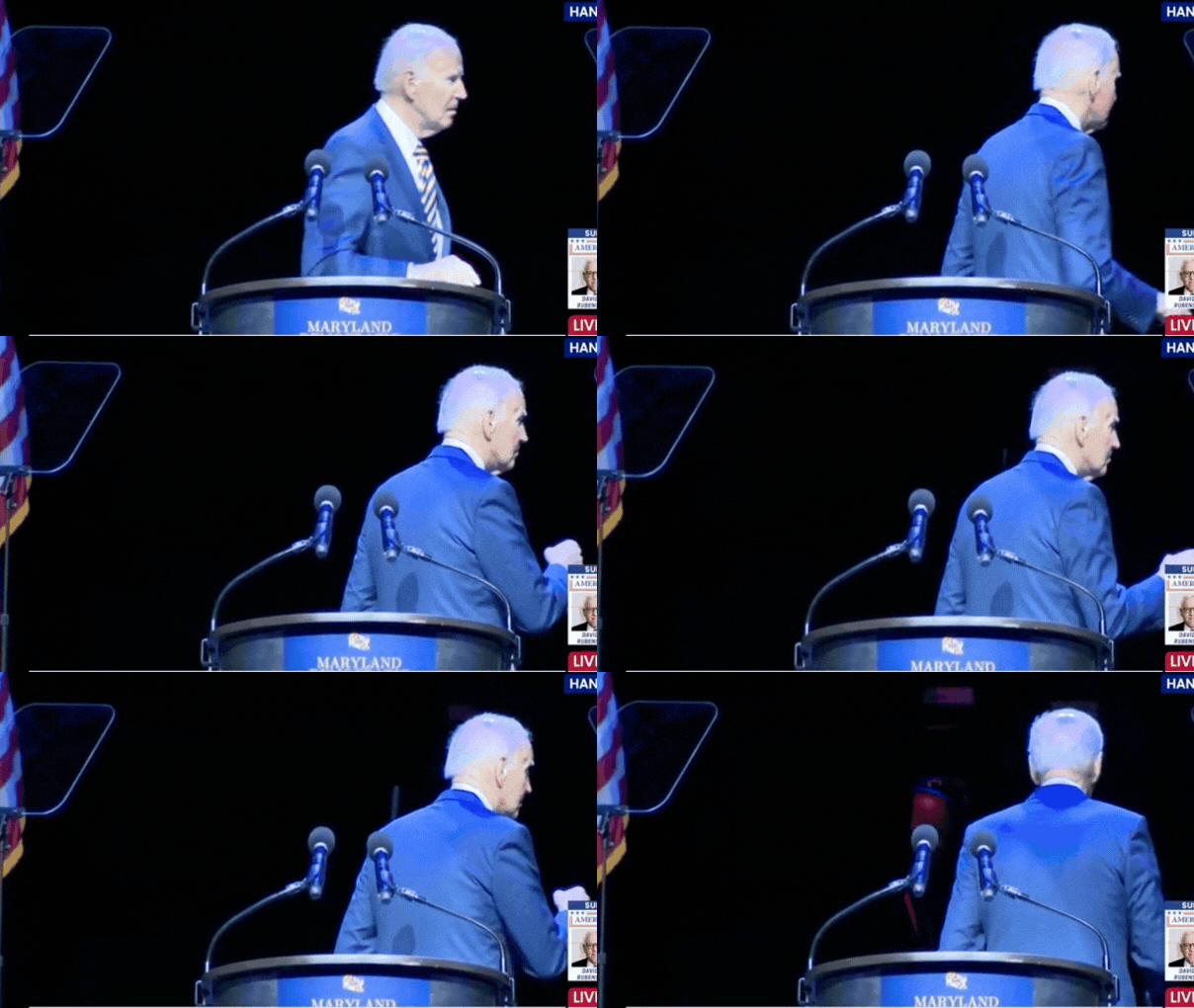
Yet, as the echoing applause began to fade into the background, the harsh realities of the present moment asserted themselves in an awkward on-stage transition that quickly captured media headlines. Upon delivering his final energetic line, Biden paused on the stage, looking momentarily disoriented as he peered toward the wings of the stage in search of a clear exit route. He pointed in two different directions, attempting to decipher the proper way off the stage while his team and stage managers offered guidance from off-camera. After a brief, hesitant pause, he turned and exited the stage in a direction completely opposite to that of the previous speakers, walking away with his back fully turned to the audience. In the modern, hyper-polarized media landscape, such small moments are instantly weaponized by political opponents as definitive proof of cognitive decline, stripped entirely of context, grace, and human empathy. However, when viewed through a more compassionate lens, this incident reflects a very common and relatable disorientation that can affect anyone, particularly an octogenarian navigating unfamiliar, brightly lit stages after giving an emotionally demanding, high-energy speech. It serves to highlight the immense, relentless pressure placed on public figures to remain flawless performers even as they navigate the inevitable physical challenges that come with advanced aging. To walk off a stage in the wrong direction is a minor human error, but when committed by a former leader of the free world, it becomes a heavily scrutinized, symbolic metaphor for the difficult, often coordinates-deprived transition out of the public eye. It reminds us that behind the grand titles and historical achievements lies a vulnerable human being who must still navigate the physical world in front of a critical audience.
This occurrence in Maryland was not an isolated event but part of a broader, deeply affecting pattern of fragile moments that have characterized Biden’s recent public appearances, including a widely discussed ceremony at the opening of the Obama Presidential Center in Chicago. That high-profile event brought together a rare assembly of political giants, including former Presidents Barack Obama, Bill Clinton, and George W. Bush, alongside former Secretary of State Hillary Clinton and current political leaders like former Vice President Kamala Harris. In the wake of the formal ceremony, as the other dignitaries began to exit the stage and mingle with the crowd, Biden remained momentarily isolated on the stage, visibly looking around in a state of quiet confusion for his family. The cameras caught a deeply human and delicate moment as he called out, “Where’s my granddaughter?” before First Lady Jill Biden quickly returned to the stage, gently took his hand, and guided him toward the safety of the wings. This moment, perhaps even more than the awkward exit in Maryland, struck a deeply resonant and emotional chord with observers across the political spectrum, serving as a reminder of our shared vulnerability. It underscored the vital, centering role of family in the lives of those who have spent decades dealing with the isolating pressures of high office, where trust is rare and the spotlight is unforgiving. It showed a husband relying on his wife’s steadying presence, transforming a public, political stage into a private, tender space of mutual support and quiet protection. Such interactions serve as a direct reminder that behind the grand titles, historic acts, and constant political battles lie vulnerable human relationships that sustain individuals through their most challenging times, proving that the need for love and guidance never fades.
The context surrounding these public moments is deeply colored by the unprecedented circumstances of Biden’s departure from active political life and his ongoing, quiet health struggles. After facing intense pressure from within his own party following a difficult debate performance and growing concerns about his viability as a candidate, Biden made the historic and painful decision to step aside from the 2024 presidential race, allowing a new generation of leadership to take the reins of the party. Since that momentous decision, he has largely retreated from the daily political grind, limiting his public appearances to significant ceremonial events, family gatherings, and rare party fundraisers. This physical withdrawal has been further complicated by his recent public disclosure that he is undergoing treatment for Stage 4 prostate cancer, a diagnosis that adds a layer of profound personal trial and mortality to his twilight years. For a man who has lived his life in the fast lane of public service, dealing with a terminal illness while under the constant, critical gaze of the public eye requires an immense, almost unfathomable amount of personal fortitude and quiet determination. This reality shifts the perspective on his recent onstage behavior; the coughing fits during his Maryland speech and his physical hesitation when exiting the stage are not merely fodder for political commentary or late-night punchlines. Instead, they are the visible, physical scars of a quiet, grueling battle with a serious disease, fought by a man who refuses to completely abandon the public causes he spent his entire life championing. The intersection of severe physical illness and political retirement creates a unique form of isolation, where one must come to terms with the end of a historic career while simultaneously coming to terms with the fragile nature of human mortal existence.
Ultimately, these recent glimpses of Joe Biden offer a profound and highly necessary meditation on the nature of leadership, aging, and legacy in the modern, fast-paced media era. They ask us to consider how we view our leaders when they are no longer at the height of their political powers, and whether we can extend the same basic human empathy to historical figures that we would naturally offer to our own aging family members. Biden’s life has been defined by both immense political triumphs and profound, heartbreaking personal tragedies, and his current chapter is perhaps his most quiet, vulnerable, and challenging yet. As he struggles with his failing health and the inevitable physical limitations of his eighty-three years, his determination to still show up, to raise his gravelly voice, and to urge his supporters to “fight back” speaks to an enduring sense of civic duty that outlasts the actual holding of political office. The awkward exits, the moments of confusion, and the reliance on family members do not erase a half-century of dedicated public service, nor do they diminish the consequential decisions made during his long career. Instead, these moments humanize a leader, stripping away the artificial, manufactured perfection demanded by modern media to reveal a mortal man who, despite his physical vulnerabilities and the looming shadow of a serious illness, remains resolved to walk forward, guided by those he loves, until his final days. This transition is not an embarrassing failure, but a natural, dignified human conclusion to a life spent entirely on the grand stage of history, showing us that even the most powerful individuals must eventually surrender to the passage of time and find solace in the quiet comfort of family.