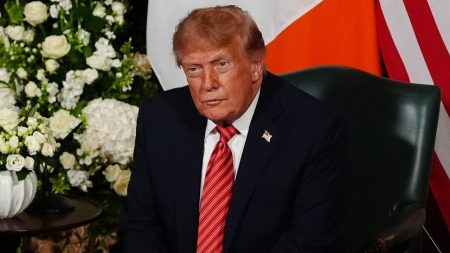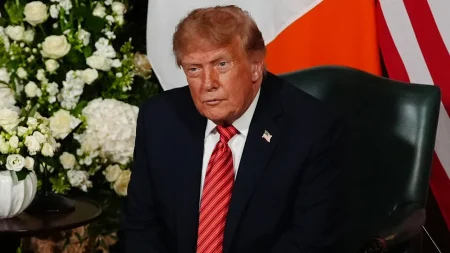






In a series of candid social media posts, President Donald Trump has once again set his sights on the North Atlantic Treaty Organization (NATO), reigniting a long-standing debate over global defense spending and international partnerships. Using his platform, Truth Social, the president voiced deep frustration with what he perceives as a deeply lopsided relationship. He lamented that the United States shoulders an astronomical financial burden to protect its allies without receiving any tangible returns. To drive his point home, Trump highlighted a massive stark contrast in defense expenditures, pointing out that while the U.S. has poured roughly $999 billion into the alliance over a decade-long period, key European allies like the United Kingdom, France, Italy, and Poland have contributed mere fractions of that amount, with other major nations like Germany lagging even further behind.
The figures cited by the president align closely with official NATO projections. A report from the alliance, which estimates defense expenditures through 2025, places the U.S. defense budget at approximately $980 billion, while the U.K. sits at $90.5 billion, France at $66.5 billion, Italy at $48.8 billion, and Poland at $44.3 billion. For Trump and his supporters, these numbers are not just statistics; they are proof of a fundamental unfairness where American taxpayers subsidize the security of nations that are fully capable of funding their own defense. By framing this financial disparity as “ridiculous,” the president is tapping into a sentiment shared by many Americans who feel that international agreements have historically taken advantage of U.S. generosity.
This public airing of grievances comes at a critical moment for the alliance, serving as a dramatic prelude to the upcoming NATO summit in Ankara, Turkey, which Trump is scheduled to attend. By criticizing the alliance so sharply on the world stage, the president is effectively setting the terms of the debate before he even arrives. This brand of high-stakes, public diplomacy is a signature of Trump’s foreign policy approach, designed to put pressure on European leaders to increase their financial commitments. Instead of behind-the-scenes diplomatic maneuvering, the president prefers a direct, transactional conversation with the American public and global leaders alike, demanding reciprocity and accountability from America’s oldest allies.
Beyond the financial arguments, Trump’s latest criticisms carry a deeply personal edge, accusing NATO of failing to support the United States during critical moments. In a particularly emotional post, he claimed the relationship is entirely “one-sided” and lamented that “they were not there for us” when it mattered most. This charge of abandonment strikes at the very heart of NATO’s founding principle of mutual defense. It suggests that, in the president’s eyes, the alliance has become a relic of the past that fails to address modern security crises, leaving the United States to navigate complex global conflicts largely on its own.
This sense of betrayal was particularly evident in Trump’s recent remarks regarding the U.S. conflict with Iran. Reflecting on a conversation with NATO leadership following a tense standoff in the Strait of Hormuz, the president claimed he told the alliance to “stay away” when they finally offered assistance, dismissively labeling NATO a “Paper Tiger.” From his perspective, the offer of help was too little, too late, demonstrating a pattern of uselessness when actual crises arise. This sentiment has found support among some conservative foreign policy circles, with former advisors to Margaret Thatcher echoing the sentiment that the president is entirely justified in his outrage over what they characterize as Europe’s betrayal regarding Iran.
Despite the president’s sharp rhetoric, the dynamics between Washington and NATO are complex. Just last month, Trump held a seemingly productive meeting at the White House with NATO Secretary General Mark Rutte, who has publicly praised some of Trump’s strategic decisions while acknowledging the president’s valid frustrations regarding ally contributions. Furthermore, recent polling indicates that a majority of Trump’s own supporters continue to back the alliance, recognizing its historical value even while agreeing that European partners must pay their fair share. As the Ankara summit approaches, the world will be watching to see if Trump’s aggressive posturing will successfully force European nations to step up their military spending, or if it will push the historic alliance to its breaking point.