




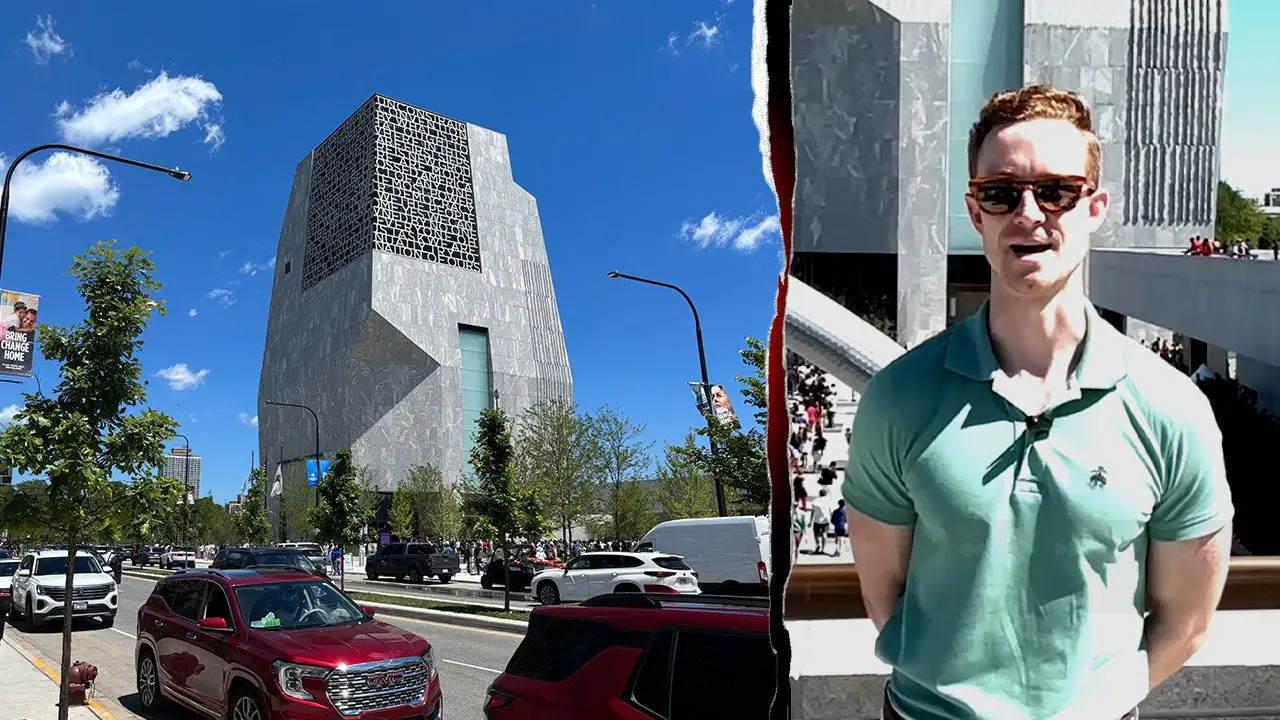
The crisp autumn air of Chicago’s historic South Side was thick with anticipation as thousands of eager visitors began pouring onto the newly minted 19.3-acre campus of the Barack Obama Presidential Center on its official public opening day. For years, this project had been a source of intense discussion, local organizing, and global anticipation, representing a physical manifestation of the legacy of America’s 44th president. Walking through the pathways of Jackson Park, one could feel the palpable, electric energy of a community witnessing history unfold in real-time. Parents held their children’s hands, pointing up at the soaring stone-clad tower, while elders from the neighborhood looked on with eyes filled with tears, recognizing the monumental shift this center represents for a historically underserved part of Chicago. This was not merely the opening of another sterile municipal building or a quiet, dusty archive; it was the unveiling of a dynamic civic sanctuary designed to breathe vibrant new life into the South Side. The atmosphere was a rich tapestry of human emotion, combining deep smiles of triumph with quiet moments of solemn reflection. Visitors used a lexicon of wonder to describe their first impressions, calling the massive structure “breathtaking,” “phenomenal,” and “futuristic.” This opening marked the culmination of a decade-long journey to honor Obama’s presidency in the place where his political identity was forged, creating a permanent home for hope, community organizing, and civic engagement. It symbolized a reclamation of space, placing a world-class cultural institution directly into the heart of a working-class neighborhood. To the people who flocked to the campus on that historic Friday, the center felt like a promise finally fulfilled, an architectural beacon that stood as a testament to what is possible when community organizing meets global ambition. Yet, beneath the celebratory surface, there was also an underlying current of complexity—a collective understanding of the weight this massive structure carries for the future of Chicago’s economy and social fabric.
Standing amid the bustling crowds was Chris Bird, a Washington, D.C.-based structural engineer who played an instrumentally vital role in bringing the tower’s most striking and unique feature to life. As a key member of the design team, Bird was tasked with translating an abstract, highly poetic concept into a structurally sound, physical reality at the very top of the massive building. The architects and the former president himself shared a mutual desire from the very beginning of the project: they wanted to create something undeniably bold, an architectural exclamation point that would reach toward the heavens while firmly grounding itself in the power of the spoken word. The result of this collaboration is a breathtaking physical collage of language, a monumental design featuring ninety-one carefully curated words extracted from various speeches delivered by Obama during his historic two terms in office. Wrapping effortlessly around the upper quadrant of the tower’s stone facade, these words comprise 433 individual letters, each standing at a towering five feet tall. For Bird, the process of conceptualizing, engineering, and physically installing this massive textual installation was completely uncharted territory. He notes that working alongside graphic designers and lead architects to figure out how to stretch, shape, splice, and physically anchor a dynamic presidential speech onto the face of a high-rise building was an entirely unprecedented endeavor in modern structural engineering. Traditional monuments often relegate quotes to plaques or flat, interior walls, but the Obama Presidential Center integrates the spoken word directly into its exterior skeletal structure. This innovative approach challenged conventional architectural design, transforming the building’s facade into a literal storyteller. Bird’s engineering triumph is not just a feat of load-bearing concrete and steel; it is a physical manifestation of historical rhetoric, permanently casting the words of a president into the Chicago skyline.
The sheer technical complexity of executing this monumental typographic feat required a delicate, agonizingly precise balance between artistic expression and structural integrity. Chris Bird and his multidisciplinary team spent countless hours analyzing wind loads, material fatigue, and the natural expansion and contraction of concrete under the harsh, unpredictable Chicago weather to ensure that the five-foot-tall letters would remain safely and beautifully anchored for generations to come. It was a painstaking labor of love that required graphic designers to experiment with kerning, depth, and shadow, finding the perfect visual rhythm so that the words could be effortlessly read from the ground far below. “There’s no architectural precedent, in my opinion,” Bird remarked during the opening festivities, his voice filled with a mixture of exhaustion and immense pride. He explained how they had to meticulously calculate the structural impact of cutting away portions of the tower’s stone facade to imbed the heavy stone letters, turning what could have been a monolithic block of concrete into a lyrical, breathing piece of art that catches the changing light of the sun throughout the day. By treating the letters not as decorative elements added onto the building, but as integral structural components, the design team succeeded in blending the visual arts with heavy construction. Humanizing this process means recognizing the tireless effort of the dozens of stone masons, detailers, and construction workers who spent months in the fluctuating Great Lakes climate, carefully hoisting each five-foot-tall letter into place high above the park. For these workers and designers, every curve of a “C” and every straight edge of a “T” represented a delicate interface between human hands and heavy machinery. The resulting installation invites onlookers to slow down and actively read the building, engaging in a cognitive and physical relationship with the architecture that is rarely demanded by contemporary corporate or civic skyscrapers.
Despite the visual majesty and the technical ingenuity celebrated by its creators, the towering centerpiece of the presidential complex has not been without its fair share of fierce controversy and emotional public debate. As soon as the scaffolding began to fall and the true scale of the concrete structure became visible, a wave of digital and local criticism washed over the project. For many online critics and traditional architectural purists, the towering stone monument felt out of place, with some going as far as to label it a “monstrous insult to architecture” and a “brutalist concrete nightmare.” The sheer scale of the tower, towering over the historic, lush landscape of Jackson Park, struck some as an imposing, even aggressive intervention into a public green space designed by the legendary Frederick Law Olmsted. Beyond the purely aesthetic debates, however, lies a much deeply humanized and urgent concern regarding the economic impact of the massive development on the surrounding South Side neighborhoods. Many local families and long-term residents of Woodlawn and South Shore have voiced valid apprehensions that this gleaming new monument could spark rapid gentrification, driving up property values, rents, and property taxes to the point of pricing out the very community the center seeks to honor. To these residents, the building’s formidable stone walls represent more than just a stylistic choice; they symbolize a potential barrier to their own continued survival in their ancestral neighborhoods. The polarization surrounding the building’s design reflects a deeper, ongoing struggle in urban America between the desire for prestigious, economy-boosting cultural institutions and the fundamental human need for affordable housing and community preservation. The physical tension of the building’s bold design has thus become a proxy for a larger sociological conversation about who city developments are truly built for and who gets left behind in the name of progress.
Faced with these lingering criticisms and the sometimes harsh characterizations of his structural masterpiece, Chris Bird remains steadfastly proud of the complex’s design, offering a passionate and humanized defense of the project’s architectural intent. When asked directly about those who label the massive tower a “monstrosity,” Bird politely but firmly pushed back, arguing that such a simplified and negative description completely misses the nuance and artistic grandeur of the site. “To say that it’s a monstrosity is wrong,” Bird asserted with conviction, adjusting his view toward the soaring monument. “I would say that it’s a really grand gesture and a bold statement.” From his perspective as an engineer who watched the structure rise from its very foundation, the tower acts as an intentional, poetic reach toward the sky, serving as a landmark that matches the scale and ambition of the surrounding Chicago urban environment rather than overpowering it. He emphasizes that the building does not exist in a vacuum; instead, it is meticulously integrated with some of the most spectacular landscape architecture in the country, creating a seamless, natural transition between the stone facade and the leafy canopies of Jackson Park. Bird points out that the design team went to great lengths to ensure the center would blend into the park in a way that feels organic, welcoming, and deeply respectful of the environment. Far from being a cold, sterile concrete blockade, the open plazas, winding public pathways, and community gardens are designed to invite local residents to gather, play, and reflect. For Bird, the boldness of the building’s verticality is matched only by the warmth and accessibility of its horizontal ground-level spaces, creating a balanced civic ecosystem where the grandeur of history and the simplicity of a neighborhood park walk can peacefully coexist.
Ultimately, the true success of the Barack Obama Presidential Center will not be decided by architectural critics in design magazines or by political commentators on social media, but by the everyday human lives that intersect with its physical space. As Chris Bird stood watching the diverse, intergenerational crowds explore the campus during its inaugural weekend, he noticed a common thread of deep, authentic human connection that transcended any architectural debate. “I mean, it’s nothing but smiles and some tears sometimes,” Bird observed quietly, reflecting on the raw emotion of the visitors. “I think everyone finds a bit of themselves that they knew or didn’t know they needed here, which is really special.” The center stands as a living, breathing testament to the idea that architecture is not merely about pouring concrete or welding steel beam to steel beam, but about creating spaces that can hold the collective dreams, struggles, and complex history of a community. It is a monument that honors the journey of a young community organizer who rose to the highest office in the world, reminding every child from Chicago’s South Side who looks up at those five-foot-tall letters that their voices, too, can carry immense weight. As the sun sets over Jackson Park, casting long, dramatic shadows across the ninety-one engraved words of hope and progress, the building serves as a permanent mirror for the human experience. It challenges us to embrace boldness over safety, to confront our disagreements with open dialogue, and to recognize that the pursuit of a more perfect union is a continuous, generational project. In the end, the Obama Presidential Center is more than just a controversial tower; it is a canvas of stone and light, waiting to be filled with the stories of the people who walk through its doors.