





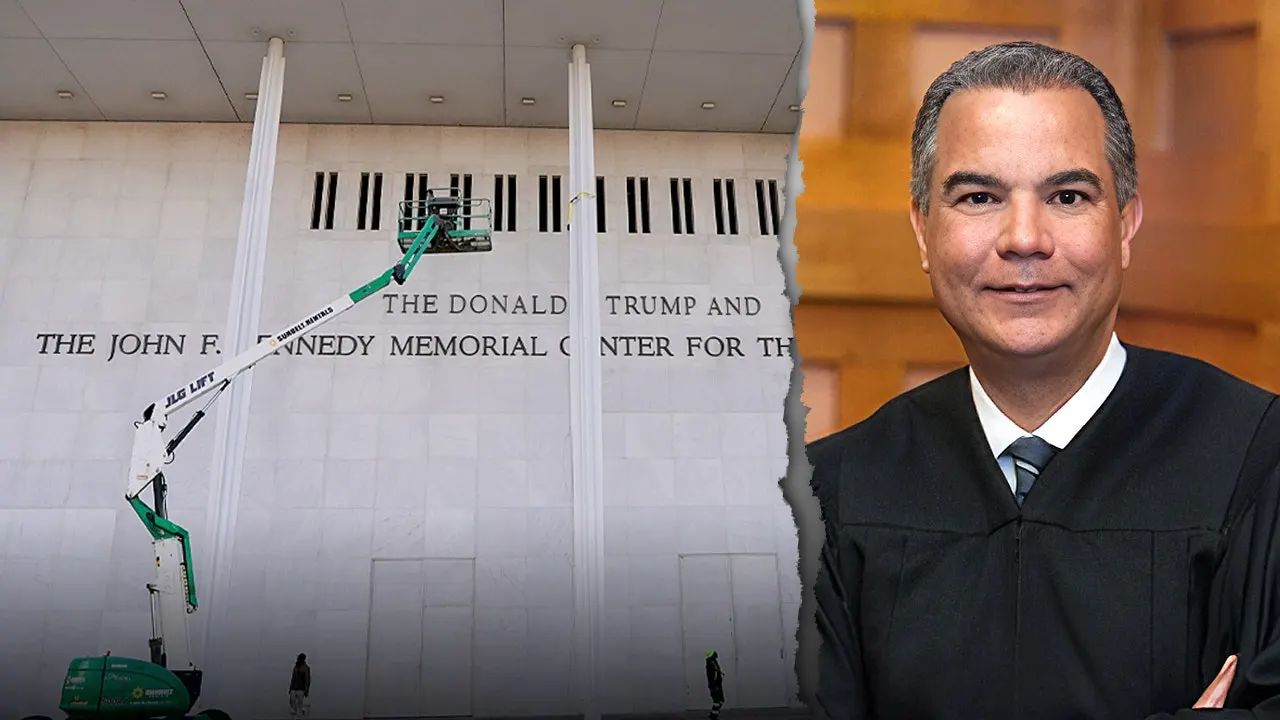
In an era where the boundary between the personal and the political has practically vanished, the American judiciary finds itself navigating a minefield of public skepticism. Judges, though expected to embody absolute detachment and objective wisdom, do not live in vacuums; they are human beings with households, spouses, and shared lives that naturally intersect with the highly charged atmosphere of the nation’s capital. This complex human reality lies at the very heart of the escalating controversy surrounding U.S. District Judge Christopher Cooper, who is currently facing a formal judicial misconduct complaint filed by the conservative watchdog organization, the Center to Advance Security in America (CASA). The dispute centers on a seemingly symbolic but highly contentious legal battle over former President Donald Trump’s efforts to rename the iconic John F. Kennedy Center for the Performing Arts. CASA asserts that Judge Cooper should have voluntarily stepped aside and recused himself from the case, arguing that his continued involvement created a severe, unresolvable conflict of interest that compromised the appearance of judicial neutrality. By choosing to remain on the bench and ultimately hand down a ruling that thwarted Trump’s agenda, Cooper has become the focal point of a larger, deeply polarizing debate about how the private careers of judicial spouses can cast long shadows over the fairness of the federal courts. It highlights the modern struggle to define where a judge’s professional duty ends and their family’s private interests begin, particularly when those interests are actively aligned with one side of a national political chasm. For many observers, this situation raises fundamental questions about whether anyone in the tight-knit elite legal circles of Washington, D.C., can truly be considered an objective arbiter of the law when the stakes involve the nation’s most powerful political figures.
The roots of this legal drama trace back to a bitter political tug-of-war over the cultural legacy of one of Washington’s most prominent institutions and the extent of executive authority. When Donald Trump sought to exercise his influence to rename the Kennedy Center, the move was met with immediate, fierce resistance from congressional Democrats, culminating in a lawsuit spearheaded by Representative Joyce Beatty of Ohio. For months, the legal wrangling simmered behind the scenes until Judge Cooper, who was appointed to the federal bench by President Barack Obama in 2014, delivered a decisive blow to the Trump administration’s plans by permanently blocking the proposed renaming initiative. While the ruling itself was celebrated by Trump’s critics as a victory for legislative oversight and institutional preservation, it ignited a firestorm of pushback from conservative circles, who perceived the decision not as an objective application of constitutional law, but as a partisan strike disguised as jurisprudence. CASA quickly seized on the ruling, filing an official complaint with the U.S. Court of Appeals for the District of Columbia Circuit. Rather than mounting a direct challenge to the legal merits of Cooper’s decision, the watchdog group directed its fire at the judge’s ethical obligations, claiming he had failed to disclose a web of deep-seated personal and financial conflicts that should have disqualified him from hearing the case in the first place. This strategy shifted the narrative from a dry statutory dispute to a dramatic examination of family loyalties, marital finances, and the integrity of a judge who chose to rule on a matter directly impacting his wife’s most prominent political adversary.
To understand the intensity of the grievance against Judge Cooper, one must look closely at the highly successful, politically active, and lucrative career of his wife, Amy Jeffress. A veteran attorney with deep roots in the Democratic establishment, Jeffress has built a professional reputation that is inextricably linked to some of the most high-stakes, anti-Trump litigation in recent political history. Her client roster reads like a roll call of Donald Trump’s chief antagonists: she previously served as counsel to the House January 6th Committee, famously represented former FBI lawyer Lisa Page during the fallout of the Russian collusion investigation, and currently acts as personal counsel to President Joe Biden in his legal battles with the Justice Department over the release of the Robert Hur interview recordings. According to CASA and its supporters, Jeffress’s legal practice is not merely an independent career; it is a highly profitable business model that directly benefits from opposing Trump and his allies in court. In a scathing public statement, CASA’s Director of Research and Policy, Curtis Schube, argued that Judge Cooper essentially “goes home every night” to a partner whose financial well-being and professional stature are built on actively dismantling the former president’s agenda through litigation. This domestic reality, critics argue, makes it virtually impossible for Cooper to view any case involving Trump with the clinical, unbiased detachment required of a federal judge, creating a profound conflict where a husband’s judicial power could be perceived as reinforcing, protecting, or validating his wife’s lucrative political crusade.
To ground their accusations in established legal standards, CASA’s complaint relies heavily on the Code of Conduct for United States Judges, specifically pointing to Canons 1, 2, and 3, which dictate the ethical boundaries of the federal bench. Canon 1 mandates that a judge must actively uphold the integrity and independence of the judiciary, a standard that critics argue is severely compromised when a judge’s household is financially tied to active political litigation against a party in their courtroom. Furthermore, Canon 2 strictly warns judges to avoid not just actual impropriety, but even the mere appearance of impropriety, a preemptive rule designed to safeguard public confidence in the judicial process even when no actual wrongdoing has occurred. CASA contends that even if Judge Cooper harbored no personal bias, the public perception of a judge ruling against a political figure who is simultaneously being sued or investigated by the judge’s own spouse is deeply damaging to the court’s institutional credibility. Finally, Canon 3 speaks directly to situations where a spouse’s financial interests or professional relationships could reasonably call a judge’s impartiality into question. By fusing these ethical rules with the specific details of Cooper and Jeffress’s marriage, the complaint paints a picture of a systemic failure to respect the necessary boundaries of the court, arguing that when public faith in the neutrality of the law is eroded by the appearance of self-interest, the very foundation of the American legal system begins to crumble.
This is far from the first time that Judge Cooper’s personal life and professional duties have collided in the public square, making him a recurring figure in the ongoing debate over judicial bias. Over the years, he has repeatedly found himself in the crosshairs of conservative critics and Trump allies who view him as a symbol of a biased judicial establishment in Washington, D.C. A notable precedent occurred during Special Counsel John Durham’s high-profile prosecution of Michael Sussmann, an attorney with ties to the Hillary Clinton campaign who was accused of lying to the FBI during the early stages of the “Crossfire Hurricane” Russia investigation. During that trial, critics argued passionately that Cooper should have recused himself because of his wife’s prior legal representation of Lisa Page, who was a central figure in the very FBI communications Durham was investigating. Although Cooper ultimately presided over the trial—which resulted in Sussmann’s acquittal—the episode cemented his reputation among conservatives as a judge unwilling to separate his courtroom from his family’s political network. Donald Trump himself has frequently targeted Cooper on social media, publicly lambasting him for harboring a blatant “conflict of interest” due to Jeffress’s high-profile Democratic ties. This long-standing friction illustrates how the personal histories of those who interpret the law have become ammunition in a broader cultural war, turning every courtroom decision into a battleground where a judge’s pedigree, marriage, and social circles are dissected for signs of ideological bias.
As the U.S. Court of Appeals for the D.C. Circuit considers whether to initiate a formal investigation into the misconduct complaint, both Judge Cooper and Amy Jeffress have maintained a quiet silence, declining requests for comment from major media outlets wishing to hear their side of the story. This silence, typical of the stoic traditions of the federal judiciary, stands in stark contrast to the loud, publicly aired grievances surrounding the case. Ultimately, this battle represents more than just a dispute over a building’s name or a single judge’s domestic life; it reflects a profound crisis of confidence in the institutions that govern American life, highlighting the growing difficulty of keeping partisan polarization out of the courtroom. In a highly polarized society where marriages are increasingly viewed through a political lens, the public struggle to trust that a judge can separate their private loyalty from their constitutional oath is only going to intensify. Whether the D.C. Circuit chooses to discipline Cooper or dismiss the complaint as a politically motivated attack, the debate itself has already left its mark, serving as a stark reminder of how difficult it is to maintain the illusion of an impartial, sterile judiciary when the human lives behind the black robes are so deeply entangled in the messy, high-stakes game of national politics.