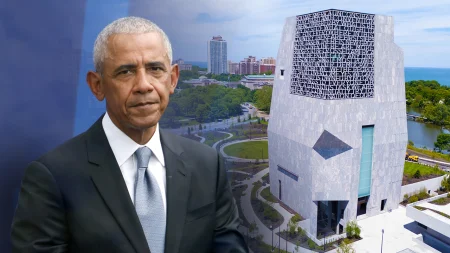


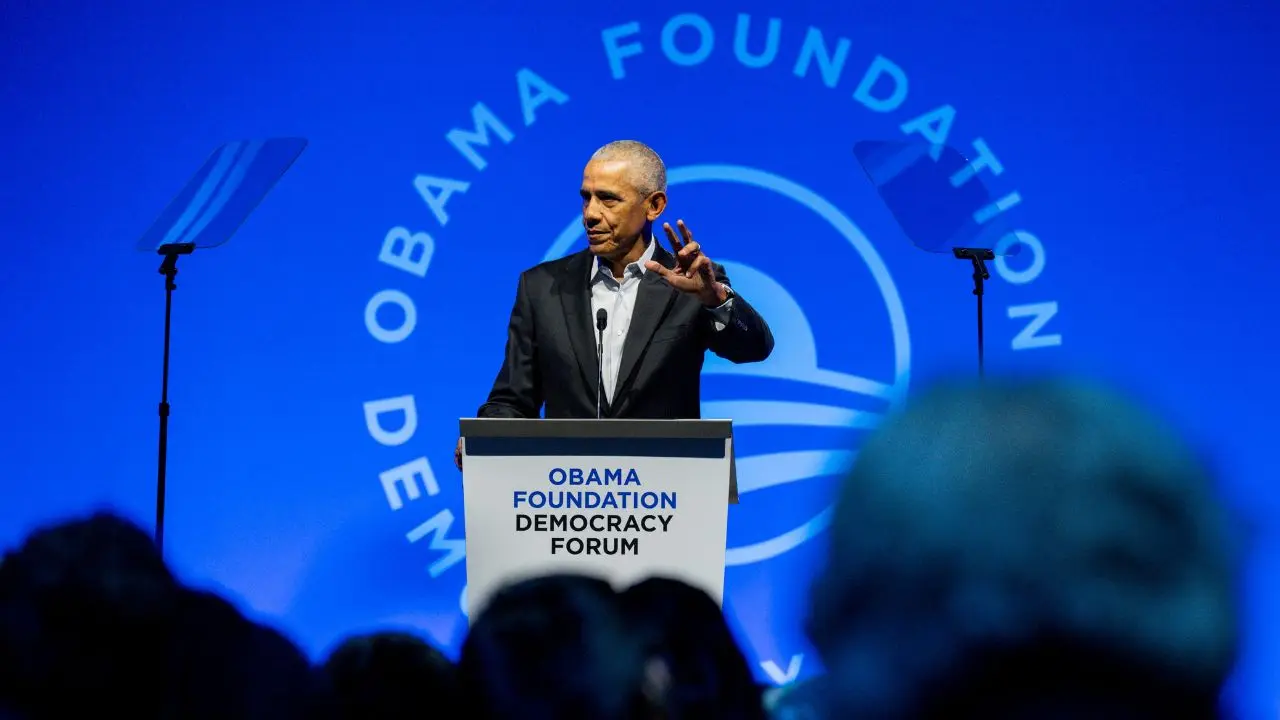
The Obama Foundation was supposed to be different. It carries the name of a president who spoke constantly about shared prosperity, the dignity of work, and the idea that everyone deserves a fair shot. But the foundation’s own payroll now tells a more complicated story. According to its 2025 tax filing, 172 of the 342 employees it reported earned more than $100,000 a year—roughly half of the workforce. At the very top, CEO Valerie Jarrett, a close confidante of Barack Obama and a former senior White House official, earned $771,000. That is not just a number. It is more than many of the people who build, clean, and staff the foundation’s flagship project will see in a decade. The disparity is especially hard to ignore because the Obama Presidential Center in Chicago, long delayed and badly over budget, now carries a price tag of $1 billion—nearly triple the original estimate. The center sits on 19.3 acres of public parkland in Jackson Park, and the foundation that built it is a private nonprofit. Its stated mission is civic good, education, and community uplift. Yet as the center finally opens its doors, the gap between the executive suite and the front lines has become impossible to overlook. Lower-wage employees—cleaning crews, visitor services staff, museum and technology workers—are organizing under Obama Workers United with AFSCME Council 31. They describe an atmosphere where benefits have been rolled back, workloads have grown heavier, and leadership has offered little support. They say experienced colleagues are leaving, taking valuable institutional knowledge with them, and leaving those who remain to do even more with less. The contrast between a CEO making three-quarters of a million dollars and workers fighting for union recognition is not just a public relations problem. It raises a fundamental question: Can an institution named for Barack Obama truly embody the values he once championed if its own employees feel unheard and undervalued? The foundation insists it pays market rates and treats its workers fairly, but the optics are difficult to shake.
The financial picture behind that question is stark. The Obama Foundation’s annual payroll and benefits bill reached $50.4 million in 2025, soaring from $18.5 million in 2018. Revenue came in at approximately $159 million, with nearly $151 million of that coming from contributions and grants. This is not a struggling charity scraping by on small donations. It is a wealthy, powerful institution with net assets exceeding $1 billion. The growth in spending reflects the foundation’s expanding ambitions: it runs leadership and civic programs around the world, and it has hired large numbers of specialized staff to manage those efforts. Emily Bittner, the foundation’s vice president of communications, defended the pay structure, saying employees are paid rates that are competitive with the market. She noted that the foundation now has more than 500 employees worldwide, with roughly 300 based at the Presidential Center. Brian Mittendorf, an accounting professor at Ohio State University who specializes in nonprofit finances, said the proportion of Obama Foundation employees earning more than $100,000 is clearly higher than the average nonprofit. But he also cautioned that the Obama Foundation is not an average nonprofit. It functions, in part, like a think tank, and think tanks need people with advanced degrees, policy expertise, and experience in government and business. Those people could command high salaries in the private sector, so the foundation has to match outside offers to attract and keep them. Mittendorf pointed out that a local food bank would look completely different, but an expertise-heavy institution like the Obama Foundation is likely to pay more. Still, even among presidential foundations, the Obama Foundation stands out. In 2025, roughly half its reported workforce earned above $100,000. That compares with 37% at the George W. Bush Presidential Center, 29% at the Carter Center, 23% at the Clinton Foundation, 13% at the Reagan Foundation, and 10% at the George & Barbara Bush Foundation, according to their most recent tax filings. Those comparisons do not settle the fairness question, but they do show that the Obama Foundation is at the high end of a very exclusive group.
The executive pay scale makes the contrast even more uncomfortable. Valerie Jarrett’s salary has climbed steadily since she became CEO in 2021. She earned about $581,000 in her first year, then $740,000 in 2022, holding at that level through 2024 before rising to nearly $755,000 in 2025. The 2025 filing lists her at $771,000, an increase of about $15,500 from the previous year. That puts her ahead of the leaders of several other presidential foundations. The Reagan Foundation paid its CEO about $735,000. The George W. Bush Presidential Center paid its top officer $661,000. The Carter Center paid $531,000. The George & Barbara Bush Foundation paid $426,600. The Clinton Foundation paid $425,000. Jarrett is not alone in the six-figure club. The Obama Foundation’s list of top earners reads almost like a roster of Obama administration alumni. Christina Tchen, who served as chief of staff to Michelle Obama, earned approximately $431,000. Michael Strautmanis, a former Obama campaign and White House aide, earned about $404,000. Laura Lucas Magnuson, a former White House communications official, earned about $396,000. Robbin Cohen, who previously led the real estate group founded by former Obama Commerce Secretary Penny Pritzker, earned about $666,000. Ammar Rizki, a former Cook County chief financial officer, earned about $400,000. At least four of the ten highest-paid executives have direct ties to the Obama White House or presidential campaigns. This pattern is not illegal, and presidential foundations often hire people who know the former president and understand his vision. But it does feed a perception that the foundation is not just a charitable endeavor. It is also a place where loyalists are rewarded. For an organization that has tried to position itself as a force for equity and opportunity, the payroll invites uncomfortable questions about who actually benefits from the Obama brand.
The Obama Foundation rejects the idea that its executive pay is excessive. In response to Fox News Digital, Bittner said the board of directors uses comparability data and a compensation consultant to review and approve the pay of the CEO, officers, and key employees on an annual basis. The foundation also pointed to other major charitable institutions with even larger CEO pay packages. The Getty Trust’s president and CEO earned about $2 million, the Rockefeller Foundation’s president earned $1.7 million, and the Mellon Foundation’s president earned $1.5 million. Those figures are accurate, but the comparison is not exactly apples to apples. The Getty Trust has a multibillion-dollar endowment, while the Obama Foundation reported about $14.2 million in endowment funds at the end of 2025. The foundation’s net assets exceeded $1 billion, but much of that is tied up in the Presidential Center itself. Mittendorf said Jarrett’s pay is not an unusual amount for a CEO of an organization of this size. He noted that large institutions need to offer competitive compensation to attract experienced leaders, even in the nonprofit world. At the same time, he acknowledged that high executive pay in charities often attracts criticism. People believe nonprofit pay should be more modest, even if the market justifies more. That criticism has been amplified by Illinois Republican Party Chairman Bob Grogan, a longtime opponent of the foundation’s use of public parkland. Grogan accused the Obama Foundation of using taxpayer dollars to make Barack Obama’s inner circle rich. The foundation maintains that construction of the Presidential Center was privately funded and that its operating costs are covered by revenues and private donations. Public funds were used for infrastructure improvements around the campus, not for the center itself. Still, the presence of a private nonprofit on public land, with an executive payroll that rivals for-profit companies, gives critics like Grogan a powerful talking point. The foundation can defend its practices as market-driven and legally sound, but the moral optics are much harder to manage.
While the foundation’s top executives collect hefty paychecks, the people who do the everyday work of the organization are trying to form a union. The effort is organized under Obama Workers United with AFSCME Council 31. It includes visitor services and cleaning staff, museum and technology workers, and employees involved in educational and global programs. These are not the policy experts and former White House aides who populate the upper ranks. They are the workers who greet visitors, keep the facilities running, and support the foundation’s programming. In a public letter, the workers said they are facing increasing workloads and rolled-back benefits. They said support from leadership has been minimal and that experienced colleagues have left, taking institutional knowledge with them and leaving those behind to do even more. They also urged the foundation to respect their right to organize and to avoid spending money on anti-union lawyers, messaging, or meetings. The unionization effort has an obvious symbolic weight. A foundation named after a president who frequently spoke about the dignity of work and the importance of standing together is now facing a labor organizing campaign from its own employees. The workers are not asking for the kind of salaries enjoyed by Jarrett and her executive team. They are asking for basic fairness: stable benefits, manageable workloads, and a voice in decisions that affect their lives. The foundation responded by saying it is deeply committed to the fundamental right of workers to organize and make their voices heard. It said it approaches the process with gratitude for their contributions, deep respect for unions, and a sincere commitment to working collaboratively with labor partners. That statement is carefully worded and supportive, but the fact that a union campaign is necessary at all is telling. In an organization led by people who spent years in Democratic politics, where organized labor is a core constituency, employees should not have to fight for recognition. The gap between the foundation’s public values and its internal labor relations is precisely the kind of contradiction that unions exist to address.
The Obama Foundation’s current predicament is bigger than one salary or one union drive. It is about the identity of an institution that was supposed to represent a new kind of politics. Barack Obama’s legacy is tied to the Presidential Center, a $1 billion project on Chicago’s South Side that was supposed to revitalize the neighborhood and inspire the next generation. Instead, the center has been dogged by delays, budget overruns, subcontractor disputes, and now a pay gap that seems to contradict the values the foundation promotes. For the people who work at the center, the question is personal. They see top executives with six-figure salaries and former White House officials with prestigious titles, while they worry about their own benefits and workloads. They are not asking for charity; they are asking for respect. The foundation’s response—that it pays competitive rates, that executives are vetted by consultants, that other nonprofits pay even more—may satisfy accountants, but it does not answer the deeper moral challenge. Nonprofits exist to serve the public good, and they are held to a higher standard than for-profit companies. When a charity named after one of the most admired political figures in the world pays its CEO $771,000 while its lower-level employees organize for basic protections, it risks losing the very trust that gives it meaning. The Obama Foundation still has time to change course. It can embrace the unionization effort without resistance, re-examine its compensation philosophy, and make sure that the people who carry out its mission are treated as partners, not afterthoughts. But the window is narrowing. The longer the gap between the executive suite and the shop floor remains, the more the foundation will be judged not by its rhetoric but by its payroll. And in the court of public opinion, a story about a $771,000 CEO and a union drive among workers is not a good one. It is a reminder that even the most noble missions can be undermined by the simplest measure of fairness: how an organization treats its own people.