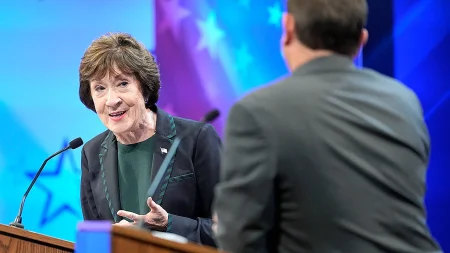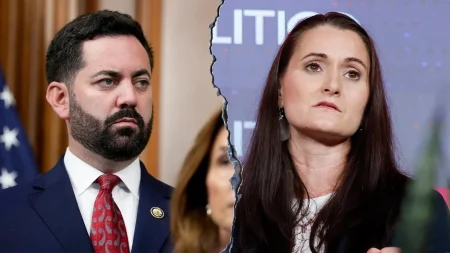





It was the kind of night that made the distance between two Maine lives feel both enormous and impossibly small. For more than an hour, Republican Senator Susan Collins and Democratic challenger Troy Jackson stood behind their podiums and traded accusations, but the fourth debate between them was never really about policy specifics or legislative trivia. It was about who could credibly claim to represent the people of a state that prides itself on independence, hard work, and a kind of stubborn, no-nonsense authenticity. Collins, the veteran incumbent who has spent decades navigating the corridors of Washington power, faced a challenger who grew up in the northern woods, worked as a logger, and talks like someone who has spent more time around chainsaws than Senate hearing rooms. Jackson, for his part, kept trying to paint Collins as a creature of the establishment, a senator who talks like a moderate but bends whenever the political moment demands it. The debate crackled with personal tension from the start. The moderator’s questions were sharp, the candidates’ answers were sharper, and the crowd’s audible reactions suggested that this wasn’t just another debate night in Maine. It was a moment when two competing visions of the state, and of the country, collided under the glare of television lights, with control of the United States Senate hanging in the balance.
The first flashpoint came early, and it was about money. Campbell donations, billionaire donors, and the uneasy relationship between political power and wealth have become central themes in the 2024 campaign, and Thursday night was no exception. Collins pressed Jackson about whether he had lived up to his promise to reject support from billionaires who had aligned themselves with Democratic campaigns across the country. Jackson admitted, almost reluctantly, that yes, some billionaires had contributed to his efforts, but he was quick to spin the admission. He insisted that his support came without strings attached, unlike the deals he suggested Collins had made with wealthy patrons. “But I haven’t made any deals like Senator Collins has with those billionaires,” Jackson said, as a murmur rippled through the audience. He then pivoted to a populist promise: “I’m going to tax those billionaires when I get to the U.S. Senate.” It was a striking moment, not because the exchange was unusual in modern politics, but because of the way it laid bare the awkwardness of a working-class candidate relying on the same big-money machinery he condemns. Jackson didn’t specify exactly what agreements he believed Collins had made, and Collins didn’t let the moment pass without noting the apparent contradiction. But the exchange captured something deeper: the challenge of running a populist campaign without populist resources. For Collins, the implication was clear: Jackson was not as pure as he pretended. For Jackson, the response was equally clear: he could accept money from billionaires while still working to tax them, and the distinction was not hypocrisy but strategy. It was the kind of exchange that leaves voters uneasy, because it reveals how much of modern politics depends on money, no matter how righteous the rhetoric.
From there, the debate moved to the question that has shadowed Collins for years: her independence from Donald Trump. The moderator asked Collins to identify a specific moment when she had defied the president and actually changed the outcome of a decision. Collins reached for a recent and dramatic example: her opposition to the confirmation of Defense Secretary Pete Hegseth. Hegseth, who had faced intense scrutiny over his qualifications and allegations about his personal conduct, was a contentious nominee, and Collins said she had worked behind the scenes to build opposition. “At one point, I had organized people to vote against Secretary Hegseth. As you undoubtedly have read, at the very last minute, one of our Republicans changed his mind. Otherwise, he would have been defeated for that job,” Collins said. It was a carefully chosen example, designed to show that she was willing to break with her party even on a high-stakes cabinet pick. But Jackson was ready with a devastating rebuttal. He pointed out that Hegseth was, in the end, confirmed. The outcome, Jackson argued, was what mattered. “Senator Collins likes to have it both ways. I mean, the reality is that 100% of the time when Donald Trump needs her, Susan Collins is going to be there. That has happened time and time again,” Jackson said. Collins pushed back, arguing that Jackson was distorting her record by cherry-picking votes. She noted that the 92 or 94 percent figure he kept citing only reflected a third of the votes, and that when you looked at the larger picture, she voted with Trump only about 72 percent of the time. It was a statistical counterattack, but it landed in an emotional landscape that statistics rarely capture. Voters who trusted Collins saw a principled moderate who was being unfairly caricatured. Voters who wanted change saw a politician who had made a career out of small gestures of defiance while ultimately remaining a reliable vote for the Republican agenda.
Then came the moment that made the debate personal in a way that no policy disagreement could. Jackson, a former logger who often speaks about his working-class roots, turned to Collins and asked a question that seemed to hang in the air longer than anything else that night. He said she had repeatedly dismissed his experience, implying that he wasn’t ready for the Senate. He wanted to know whether her skepticism was about him, personally, or about something broader. “And so, I guess, you know, what I’m curious about — is it just me that you look down on, or is it working-class people overall?” Jackson asked. The question was blunt, almost confrontational, and it seemed to hit Collins in a way that the earlier exchanges had not. She rejected the accusation firmly, but she also reached into her own biography in a way that felt both practiced and genuine. “Troy, I do not look down on you or on anyone. I grew up in Caribou. My first job was picking potatoes,” Collins said. “I have worked since I was age ten, literally since I was age ten. I have enormous respect for all the people of Maine.” It was a moment of genuine human connection, or at least an attempt at one. Collins was reminding voters that she, too, came from modest beginnings, that she understood the rhythms of life in a small town, and that her political career did not erase her roots. Jackson’s question, though, was a powerful rhetorical move. Even if Collins’s answer was sincere, the fact that the question had to be asked at all spoke to the larger class tensions running through the campaign. Jackson has made his working-class identity a centerpiece of his appeal, and Collins has struggled at times to respond without seeming condescending or dismissive. The exchange left both candidates exposed: Jackson vulnerable to accusations of playing identity politics, and Collins vulnerable to the perception that she is more comfortable in the Senate chamber than she is with the people she represents.
The debate took place against the backdrop of a national fight for control of the Senate, and every word felt weighted with that significance. Maine is not a state that is easy to categorize. It has a long tradition of independent-minded voters who care deeply about issues like fishing, forestry, and the rural economy, but who also respond to calls for fairness and social justice. Collins, a Republican who has survived in a blue-leaning state, has built her career on a reputation for moderation, for being willing to break with her party when she believes it’s necessary. Jackson, a state Senate leader who has clashed with his own Democratic governor, is trying to convince voters that Collins’s moderation is more performance than substance. He wants to be seen as someone who will fight for the working class, not just talk about it. His campaign has been full of sharp attacks on Collins, and he has tried to make this race a referendum on her relationship to Trump and the billionaire class. Collins, meanwhile, has painted Jackson as a socialist who would be a rubber stamp for the far-left agenda. At one point, she insisted that Jackson would not beat her, warning that he would “lose big time” in what she framed as a money battle. But the debate revealed that the race is about more than money. It’s about identity, dignity, and whose story feels more true to the people of Maine. Jackson’s question about whether Collins looks down on working-class people was not just a political attack. It was a challenge to Collins’s entire narrative, a way of asking whether her potato-picking childhood can really understand the struggles of a logger who has watched his industry change, his community shrink, and his sense of security erode. Collins’s response, rooted in her own lived experience, was an attempt to bridge that gap, to say that she too had known hard work and hardship. But whether Maine voters believe that bridge can hold is another question entirely.
In the end, the fourth debate left voters with more to consider than a list of policies or a scorecard of who “won.” It offered a glimpse into the human lives behind campaign slogans. There was Susan Collins, a woman who has spent thirty years in public life, defending a record she believes is honest and independent, even as her critics see her as out of touch and complicit. There was Troy Jackson, a man with calloused hands and a chip on his shoulder, demanding that the political establishment take working-class people seriously, even as he struggles with the contradictions of his own fundraising. The debate was not always pretty, and it was not always civil. There were moments when the candidates talked past each other, when the facts got tangled, when the emotions ran hot. But that is what makes democracy real. It is messy, personal, and sometimes uncomfortable. As the campaign heads into its final stretch, with the election just days away, Maine voters will have to decide what they value most. They can choose experience, stability, and a senator who knows how to navigate Washington’s treacherous waters. Or they can choose change, disruption, and a challenger who promises to fight not just against the other party, but for the people he says have been left behind. Both candidates have their flaws. Both has their stories. And both believe, with some justification, that they are the ones who truly understand what Mainers need. The fourth debate didn’t settle that question. But it made clear that the choice facing Maine is not just about who sits in the Senate seat. It is about what kind of representation feels real, what kind of leadership feels honest, and what kind of life experience deserves to sit at the table where the future is decided. In a year of national division, those are the questions that will matter most.