



Paragraph 1
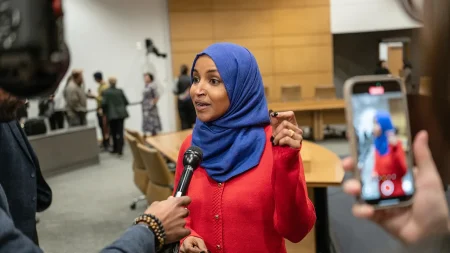
For days now, the scene outside the shared Washington, D.C., residence of Representative Ilhan Omar has felt less like the quiet rhythm of a lawmaker’s home life and more like the backdrop of a political thriller. The Democratic congresswoman from Minnesota has not been seen publicly since federal agents from Homeland Security Investigations swept through the property on Monday, carrying out a court-authorized raid as part of a criminal fraud investigation into her immigration paperwork. But while Omar remains out of sight, her husband, Tim Mynett, has been very much visible, stepping out repeatedly under the watchful eyes of cameras and reporters. On Wednesday alone, he emerged three times: first to walk Teddy, the family’s Golden Labrador Retriever, then again to take out the trash, and finally to walk out with one of his wife’s congressional staffers. There was something almost surreal about the ordinariness of these errands set against the extraordinary weight of the moment. The dog trotted along, tail wagging, unaware of the subpoenas, the seized cellphones, and the Truth Social posts. The trash bags were carried to the curb as if this were any other Wednesday. But the presence of security personnel, the stakeout in front of the house, and the tense exchanges with reporters made clear that this was no ordinary week. When Fox News Digital approached Mynett during his evening dog walk and asked about the swirling rumors that Omar had fled the country, he did not offer a calm denial or a carefully worded statement. Instead, visibly irritated, he snapped: “You guys are annoying the hell out of all the neighbors around here, man.” The frustration in his voice was palpable, a glimpse of a man under siege, trying to maintain some semblance of normal life while the world outside his front door is obsessed with every move he and his wife make. Even the small comfort of a fast-food dinner seemed laden with symbolism: one of Omar’s staffers was captured on video arriving at the home carrying two large bags from Burger King, escorted by security to the door, where she entered with the meal as officers stood guard. It was a strange juxtaposition—greasy burgers and federal raids, dog walks and criminal investigations—but perhaps that is exactly what life has become for the couple.
Paragraph 2
The raid itself has sent shockwaves through Washington and beyond, not only because of the dramatic image of federal agents at a sitting congresswoman’s home, but because of the nature of the investigation. According to reports first published by Fox News Digital, Homeland Security Investigations is looking into Omar’s immigration paperwork, specifically the pathway by which she became a U.S. citizen. Omar, who was born in Somalia, came to the United States as a young child and later gained citizenship through her father’s naturalization. The crux of the inquiry appears to hinge on her age at the time her father was naturalized—and whether she was, in fact, a minor when that happened. If she was a minor, she would have automatically derived citizenship from her father. If she was 18 or older, the legal validity of that citizenship could be called into question. This is where a seemingly small clerical detail has become a potential bombshell. According to reporters, Omar’s staff helped get her birth year adjusted from 1981 to 1982 in the Minnesota Legislative Reference Library. The change may seem trivial on its face, but the legal implications are significant. If Omar was actually born in 1981, she would have been 18 at the time of her father’s naturalization—no longer a child under the law, and therefore potentially not eligible for the automatic citizenship she received. If she was born in 1982, she would have been 17, squarely within the bounds of minor status. The altered birthdate, notably, was published during her entire tenure in Minnesota’s House of Representatives and for months into her time serving in Congress, meaning that official records long reflected the adjusted year. Federal authorities have reportedly seized Omar’s cellphone and passport during the raid, which has fueled intense speculation about whether she might try to leave the country or whether investigators feared she might. Rumors began swirling almost immediately that the congresswoman had fled the United States, though no confirmation has emerged. Her absence from public view, combined with the seizure of her travel documents, has done little to quiet those whispers. For now, the question remains open: Where is Ilhan Omar, and what exactly do federal investigators believe they will find in the tangled records of her immigration history?
Paragraph 3
Amid the chaos, Mynett has offered a simple, defiant defense of his wife. When asked about the federal investigation earlier this week, he told Fox News Digital that he has “no concerns” about what federal authorities will find while probing Omar’s immigration pathway. “My wife came here when she was 12 years old as a child war refugee,” Mynett said. “No concerns.” It was a statement that sought to frame Omar not as a subject of a criminal investigation, but as a survivor of war and displacement who built a life in America through legitimate means. Yet the investigation has only widened. Reports indicate that at least two of Omar’s relatives have been issued subpoenas as part of the Homeland Security Investigations probe, including her sister, Sahra Noor. The involvement of family members suggests that investigators are not simply reviewing paperwork; they are interviewing and compelling testimony from those closest to Omar, reconstructing the chain of events and decisions that led to her citizenship. The image of Mynett walking Teddy through the neighborhood, then taking out the trash, then escorting a staffer, seems almost incongruous with the gravity of what is unfolding around him. But there is a certain human reality to it: life does not stop, even when the federal government is knocking on your door. The dog still needs to be walked. The trash still needs to be taken out. The staffer still needs to be seen to the door. And yet the strain is visible beneath the surface. Mynett’s sharp retort to Fox News Digital—his complaint about reporters annoying the neighbors—was not the polished response of a political operative used to dealing with the press. It was the reaction of a man who is exhausted, defensive, and perhaps a little frightened, trying to hold the line while the world closes in. He has become a central figure in the saga, not only as Omar’s husband but as a man with his own business interests that have come under scrutiny. The couple’s shared rental home in Washington, the security presence outside, the steady stream of aides and lawyers and fast-food deliveries—all of it paints a portrait of a household in crisis, trying to function under the glare of a national spotlight and the weight of multiple federal inquiries.
Paragraph 4
Adding to the pressure, President Donald Trump has weighed in with characteristic bluntness, using his Truth Social platform to question Omar’s finances and cast doubt on the explanations she has offered for a dramatic amendment to her congressional financial disclosure. Trump’s post, published Tuesday, was a rambling and accusatory broadside that zeroed in on the discrepancy between Omar’s initially reported net worth and the revised figure she later claimed was correct. “Why did Ilhan Omar report a Net Worth of up to 30 Million Dollars just a short time ago, and then immediately say, ‘Oh, I made a mistake! It’s really $100,000.’ Could it be that her highly paid accountant actually reported the money that was stolen from her fraudulent activities in Minnesota? Would something like that be possible? Do you think the accountant actually gave the right number the first time, 30 Million Dollars, and then she was forced to disavow because she never would have been able to report where that much money came from? She must have freaked out when she saw that money!” Trump wrote. He went on to question the origins of Omar’s house, her cars, and her “lovely place in Washington, D.C.,” noting that members of Congress do not typically make that kind of money and asserting that Mynett, according to his information, “makes almost nothing.” The president then pivoted to the immigration investigation, asking, “How many people did she illegally bring into our Country from Somalia? America wants answers, and we want them, NOW!” The post was quintessentially Trump—a stream of rhetorical questions, insinuations, and exclamation points that blur the line between legitimate inquiry and political attack. But it also crystallized the stakes for Omar. She is now facing not only a criminal investigation into her immigration paperwork but a separate examination of her financial disclosures, and the president of the United States is publicly accusing her of fraud and theft. The combination is potentially devastating, both legally and politically. For Mynett, who has been named in the financial questions, Trump’s claim that he “makes almost nothing” is particularly pointed, given that the amended disclosure now values his ownership interests in two businesses at zero. The public scrutiny of the couple’s finances has become a second front in the battle, one that may prove just as dangerous as the immigration investigation.
Paragraph 5
Indeed, the financial questions have taken on a life of their own. Following Monday’s HSI raid, former prosecutor and current political commentator Jeanine Pirro said Tuesday that her office is also investigating Omar’s financial disclosures, specifically regarding the reporting of her and Mynett’s shared net worth. The scrutiny intensified after Omar’s 2024 congressional financial disclosure listed business interests associated with Mynett valued at between $6 million and $30 million. That filing raised eyebrows immediately, given that Omar and Mynett had previously reported far more modest assets. But then, in a swift and somewhat embarrassing reversal, Omar’s office said the figures were incorrect and amended the filing. The largest changes involved Mynett’s assets. His reported ownership interests in both his winery and his venture capital advisory firm, which had been valued in the millions of dollars, were now listed with no value at all. Specifically, the original disclosure valued Mynett’s share in the winery at between $1 million and $5 million, and his share in the venture capital advisory firm at between $5 million and $25 million. After the amendment, both equity interests were listed at $0. It is a striking transformation—from a paper millionaire to someone whose ownership stakes are, according to official filings, worth nothing. Omar’s office attempted to explain the discrepancy by noting that Mynett has partners in both businesses and saying that the earlier disclosure mistakenly reflected the total equity of the businesses rather than his actual ownership interest. The office also argued that the original filing had listed assets without accounting for liabilities. In other words, the $30 million figure was an overstatement, and the corrected filing was the true picture. But the explanation has not fully silenced the critics. Trump’s insinuation that the accountant “actually gave the right number the first time” taps into a deep well of public skepticism about how politicians report their finances—and why they sometimes amend those reports when questions are raised. Officials have been careful to note that the investigation into Omar’s financial disclosures is unrelated to the raid on her home, meaning the congresswoman is now navigating two separate federal inquiries that touch on two different aspects of her life: how she became a citizen and how she has managed her money.
Paragraph 6
Taken together, the events of the past week paint a picture of a political figure and her family caught in a perfect storm of legal peril, media scrutiny, and public speculation. Ilhan Omar, once a trailblazing freshman congresswoman celebrated by progressives as a voice for refugees and marginalized communities, now finds herself at the center of a federal criminal investigation, a separate financial probe, and the wrath of a president who has made her a symbol of everything he claims is wrong with Washington. And yet, for all the high-stakes drama, there remains a deeply human dimension to the story. It is visible in the image of Tim Mynett walking Teddy the Labrador through the quiet D.C. streets, trying to ignore the cameras and the shouted questions. It is visible in the staffer carrying Burger King bags into the house, as if a fast-food dinner could provide some small comfort in the midst of chaos. It is visible in the tension in Mynett’s voice when he tells reporters they are annoying the neighbors, a plea for a moment of peace that will not come. The neighbors themselves, according to the exchange, are caught up in the spectacle, their ordinary lives disrupted by the presence of federal agents and news vans. The rumors that Omar has fled the country may or may not be true, but they reflect the uncertainty that surrounds her whereabouts and her future. Her passport has been seized; her phone has been taken; her relatives have been subpoenaed. The machinery of the federal government is moving, and the couple can do little but wait, walk the dog, and try to maintain a semblance of normalcy. The investigation into Omar’s citizenship, rooted in a single digit in a birth year, raises fundamental questions about who belongs in America and how citizenship is granted. The investigation into her finances raises equally uncomfortable questions about wealth, disclosure, and accountability. And the political context—a former president using his platform to demand answers “NOW”—adds a layer of noise and fury that makes it difficult to separate fact from fiction, legal reality from political theater. For Omar and Mynett, the coming weeks will likely bring more revelations, more subpoenas, and more headlines. But for now, in the strange interim period between raid and resolution, they are left with the small routines of daily life: the dog, the trash, the staffers, the fast food, and the relentless presence of the press outside their door. It is not a dignified picture, but it is a human one—and perhaps that is the most important thing to remember as the story continues to unfold.