


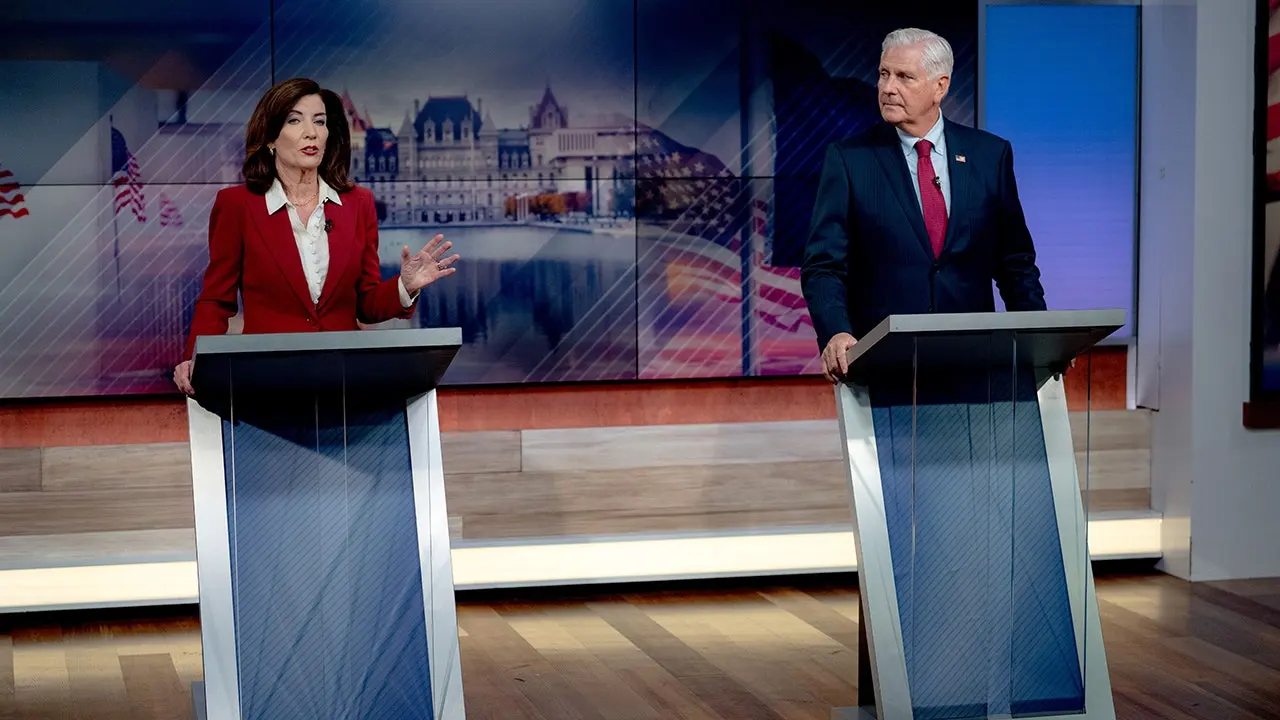
The New York gubernatorial race erupted into open warfare on Tuesday night as Democratic Governor Kathy Hochul and Republican challenger Bruce Blakeman met on the debate stage, and from the very first exchange, it was clear that this would not be a polite policy discussion. The two candidates went at each other with the kind of raw, personal intensity that only a high-stakes election can produce, each one convinced that the other is leading New York down a dangerous path. The debate opened with a question about U.S. Immigration and Customs Enforcement, or ICE, and specifically about a recent incident in the Bronx that had shaken the city to its core. Federal agents had been conducting a targeted operation when they opened fire on a vehicle driven by 28-year-old Oscar Bergal, a Dominican national who, according to the Department of Homeland Security, refused to comply with lawful orders. The shooting drew immediate outrage because there was a five-year-old boy inside the car, and while the child miraculously escaped unharmed, the image of bullets flying toward a vehicle with a young child in it was impossible to shake. For Blakeman, the incident was not an accident or a tragedy that warranted investigation; it was a direct consequence of Hochul’s policies, and he wasted no time making that case to the audience.
Blakeman did not mince words. He placed the blame for the entire situation squarely on Hochul’s shoulders, arguing that her embrace of sanctuary state policies had created the conditions for dangerous criminals to walk freely in New York neighborhoods. He pointed to Bergal’s record, noting that the man had entered the country illegally, had prior convictions, and was facing pending charges for drug dealing, which Blakeman described as poison to children. He called him a gang member and demanded to know why Hochul was defending him. But Blakeman did not stop there. He contrasted his own approach as Nassau County Executive, describing a cooperative agreement with ICE that, in his telling, had allowed his county to remove more than two thousand undocumented immigrants with criminal records, ranging from rape and attempted murder to robbery, burglary, drug dealing, carjacking, and gang activity. He insisted that his county had done this without raiding schools, hospitals, daycare centers, or churches, and he framed cooperation with federal law enforcement as the only sensible path to public safety. Then he turned the knife directly on the governor, saying that Hochul had taken that ability away from local officials, and that her policies were the reason tragedies like the Bronx shooting happen. It was a blistering attack, delivered with the confidence of a man who believes he has the moral high ground, and it set the tone for a debate that would only grow more combative as the night went on.
Hochul, for her part, refused to accept the premise of Blakeman’s argument. She dismissed his response as a “non-answer,” and she zeroed in on the fact that he had declined to condemn the ICE agents who fired into a vehicle without knowing who was inside. She painted a visceral picture of the danger involved, pointing out that the shots could have killed a five-year-old child, and she suggested that any person with a functioning conscience should be horrified by the mere idea of law enforcement shooting at cars in a residential area. Hochul made clear that she oversees more than five hundred policing agencies across New York State, with over half a million arrests every year, and she argued that this kind of reckless conduct was not how professional law enforcement operates. She described ICE as being out of control, and she extended that criticism directly to Nassau County, implying that Blakeman’s willingness to excuse such behavior was itself a kind of failure. Her tone was one of moral outrage, and she seemed genuinely stunned that her opponent would not even acknowledge the danger posed to the child in the car. But Blakeman was not about to back down. He shot back that the incident never would have happened if not for Hochul’s sanctuary policies, repeating his central accusation that she had invited criminals into New York and then barred local law enforcement from working with federal agents to remove them. He returned to his own record, insisting that Nassau County had been safer because local police could cooperate with ICE, and he accused Hochul of handing out free benefits to undocumented immigrants while ignoring whether they had criminal backgrounds. For him, this was not a matter of nuance; it was a simple question of cause and effect, and he placed the blame squarely at the governor’s feet.
Hochul, however, was not willing to let that characterization stand. She demanded the right to respond, and she did so with sharp, declarative language, saying that the entire exchange had become so absurd that she had to correct the record. She insisted, in no uncertain terms, that New York is not a sanctuary for criminals, and she repeated that phrase as if to hammer it into the consciousness of everyone watching. It was a direct rebuttal to Blakeman’s central narrative, and while she did not offer a detailed plan for addressing the complexities of immigration enforcement, she made it clear that she would not accept the label of being soft on crime. The exchange revealed the deep fault lines in the race, and it underscored how difficult it can be to have a substantive conversation about immigration policy when both sides are operating from such fundamentally different assumptions about the nature of the problem. But the debate was far from over, and the candidates soon moved on to another battleground: President Donald Trump and the state of the American economy. Here, Hochul took the offensive, mocking Blakeman for his friendship with the former president and his enthusiastic support for Trump’s agenda. She pointed out that Trump had promised to lower energy costs and reduce grocery prices, and she argued that the exact opposite had happened. Gasoline prices, energy costs, and the price of everyday goods had all risen, she claimed, and she blamed Trump’s tariff policies for driving up costs across New York. She laughed at Blakeman’s adoration of the former president, portraying it as a kind of blind loyalty that was hurting ordinary families. “My gosh,” she said, “it’s absurd how adoring you are of him.” Her tone was dripping with sarcasm, and she used the moment to try to paint Blakeman as out of touch with the struggles of real New Yorkers who were feeling the pinch at the grocery store and the gas pump.
Blakeman, though, was ready for the attack, and he responded by turning the argument back on Hochul. He accused her of constantly bringing up Trump because she wanted to distract from her own record, which he described as one of misery and failure. He cited high taxes and utility rates that he said were seventy percent higher than the national average, and he used those numbers to argue that her policies were crushing middle-class families. But then he did something interesting. Instead of leaning further into his support for Trump, he tried to broaden his appeal by highlighting relationships with liberal Democrats. He mentioned Bonnie Lautenberg, a liberal Democrat whose late husband Frank served in the Senate and was a pillar of the Democratic Party, and actress Debra Messing, another liberal Democrat who had endorsed him because she trusted him to make communities safer and improve quality of life. It was a strategic move, an attempt to show that he was not just a partisan warrior but a candidate who could draw support across the aisle. Hochul, ever quick with a retort, dismissed the list with a sarcastic jab, saying, “Alright you got two votes. Good for you.” The moment drew knowing laughter, and it captured the combative spirit of the entire evening. Much of the debate was not about finding common ground or exploring the complexities of policy; it was about drawing sharp contrasts, defending one’s record, and landing rhetorical blows. In that sense, both candidates knew exactly what they were doing, and they did it well.
Looking beyond the specific exchanges, the debate laid bare the competing visions that define this race. Hochul presented herself as a defender of New York’s values, someone who believed in the promise of the state and who was willing to stand up to federal overreach, even when it was politically unpopular. She framed her opposition to ICE’s tactics as a matter of basic decency, and she tried to position herself as the grown-up in the room, a governor who could uphold public safety without sacrificing the state’s humanity. Blakeman, on the other hand, ran as a law-and-order candidate who saw the immigration system as broken and dangerous, and who believed that the only way to keep New Yorkers safe was to cooperate fully with federal enforcement. He cast Hochul as a governor more interested in pleasing progressive activists than in protecting ordinary families, and he used the Bronx shooting as a rallying cry for his approach. The debate also reflected the broader national polarization that has come to define American politics. There was no amicable agreement to disagree, no statesmanlike acknowledgment of the other side’s good intentions. Instead, there were two people who genuinely believe the other is not just wrong, but dangerous, and they were not shy about saying so. The result was an hour of intense, often uncomfortable, rhetoric that highlighted the stakes of the upcoming election. For voters watching at home, the contrast could not have been clearer: one candidate is asking for a continuation of the current path, while the other is demanding a radical change in direction. Who wins the election will ultimately be up to the voters of New York, but one thing is certain: this debate did little to heal the fractures in the state. Instead, it deepened them, reminding everyone that in this fight, there is no middle ground, only two opposing visions, each one believing it alone can save New York.