



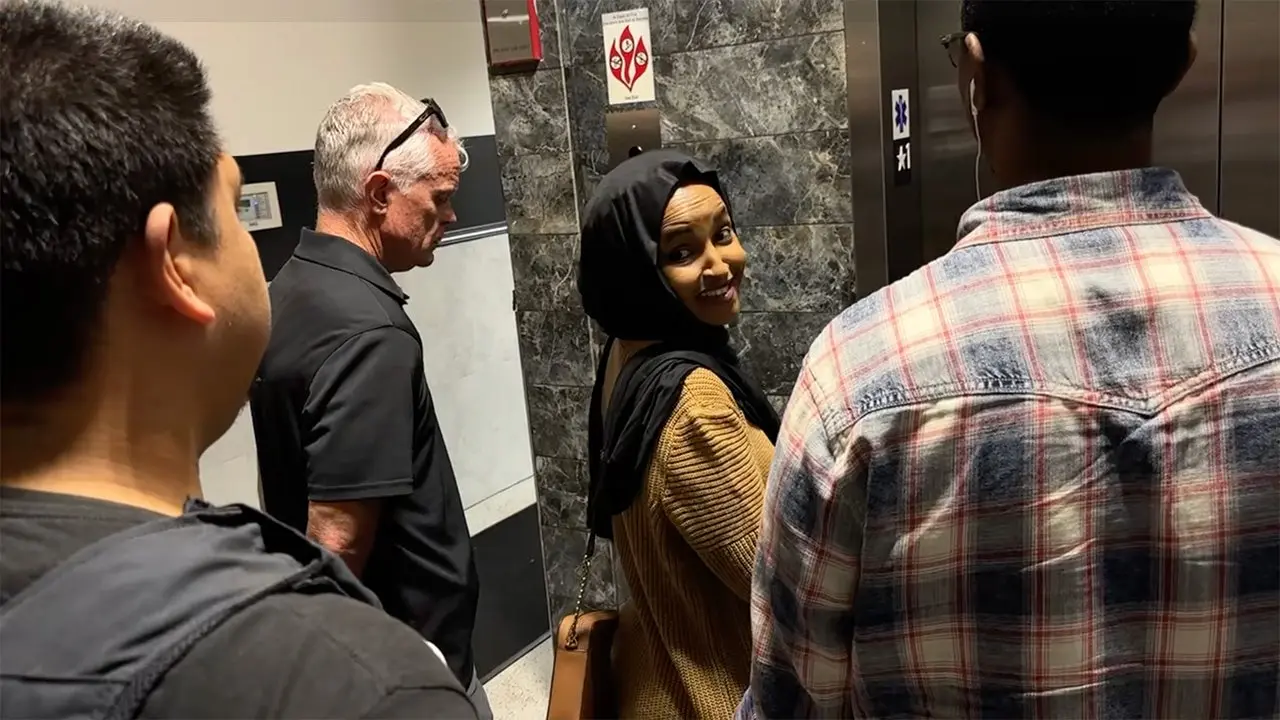
On a quiet Friday afternoon, Representative Ilhan Omar walked through the Karmel Mall of Somalia in Minnesota, heading toward the Karmel Masjid inside the mall for Friday prayers. It was a familiar scene for the Democratic congresswoman, who has represented the state’s 5th District since 2019 and remains one of the most recognizable and polarizing figures in American politics. But the rhythm of the day was interrupted when a reporter from Fox News Digital approached her with a question about her name. Omar did not stop walking, and she did not hesitate. “Ilhan Abdullahi Omar, you know it,” she said. “It’s Ilhan Abdullahi Omar.” The answer was sharp, almost defiant, as if she had heard the question many times before and was tired of it. Yet her assertion stood in stark contrast to what federal prosecutors had written in a court filing just days earlier. That filing identified the congresswoman as “Ilhan Nur Said Elmi, a/k/a Ilhan Abdullahi Omar,” using the last name of her ex-husband, Ahmed Nur Said Elmi, a man whom reports have alleged is actually her brother. The discrepancy was not a minor clerical issue. It sat at the heart of an ongoing federal investigation into whether Omar and her father committed immigration fraud when they became naturalized American citizens. For Omar, the moment outside the mosque was a chance to reclaim her identity. For investigators, it was a reminder that names matter—especially when the government believes the name on a legal document is not the name a person was born with.
The federal filing that set off the latest firestorm was a motion filed in D.C. federal court on Wednesday by the U.S. Attorney’s Office for the District of Columbia. It asked a judge to keep sealed the search warrant that had led to a dramatic raid on Omar’s Washington, D.C., residence earlier this month. The motion was filed in response to three applications from media outlets seeking to unseal the warrant and the ex parte proceedings connected to it. The government argued that federal agents had not yet finished executing the warrant and that releasing it could compromise an active investigation. But the most explosive part of the motion was the name it used: “Congresswoman Ilhan Nur Said Elmi, a/k/a Ilhan Abdullahi Omar.” The legal abbreviation “a/k/a” means “also known as,” and in a federal filing it carries weight. Two people familiar with the investigation, including a law enforcement source, told Fox News Digital that Omar’s real name is Ilhan Nur Said Elmi. One source directly disputed Omar’s account, saying, “That’s not her real name.” Another source said the language in the filing reflected the evidence compiled so far. The use of “a/k/a” suggested that federal authorities view “Ilhan Abdullahi Omar” as a name she has used publicly, not necessarily the name on her birth certificate or official immigration records. That distinction is more than a matter of personal preference. It goes to the heart of a federal investigation that has already touched Omar’s family, her home, and her phone.
The legal stakes of the name dispute are enormous. A former Minnesota federal immigration judge told Fox News Digital that if prosecutors can prove in court that Omar was not using her real name, every single form she ever filled out could become subject to investigation. That would include voter registration documents, passport applications, campaign finance reports, and the immigration paperwork she and her father submitted during the naturalization process. The investigation itself is focused on whether Omar or her father committed immigration fraud, and the raid on her D.C. home was carried out by Homeland Security Investigations, a federal agency with a broad mandate to investigate customs and immigration violations. Since the raid, federal authorities have issued subpoenas to members of Omar’s family and seized her cellphone. Her sister has also been questioned by federal agents. The reach of the investigation is unmistakable. For Omar, the personal and the legal have become inseparable. A name is not just an identity; it is a key that unlocks a lifetime of records. If the government believes she used a false name, then even routine paperwork could be reframed as evidence of deception. The former judge’s warning made clear that the investigation is not limited to one document or one moment in time. It could sweep across her entire public life. And because the federal filing explicitly identifies her by a name that Omar herself rejects, the legal battle is not just about whether a crime occurred—it is about who she actually is in the eyes of the government.
Omar and her team have responded with forceful denials. Her spokesperson told Fox News Digital that reports of her being “Ilhan Nur Said Elmi” are “completely false,” and then pivoted to attack Fox News for publishing the story. The spokesperson also denied that Omar was ever married to her brother, calling the claim a “disgusting conspiracy theory.” Omar herself has long dismissed such allegations as politically motivated smears, and this month she called former President Donald Trump a “creep” after he revived the fake-name and marriage allegations. The political context is impossible to ignore. A Republican lawmaker has threatened to move to expel Omar from Congress over the Department of Justice probe, and her opponents have seized on the investigation as proof of a pattern of deception. Her supporters, meanwhile, see the investigation as part of a broader effort to target a Somali-born, Muslim, refugee woman who has refused to be silent. The spokesperson’s reaction—denial followed by an attack on the media—reflects the defensive posture that has come to define Omar’s public life. But the government’s filing was not a campaign advertisement or a political opinion. It was a formal legal document, signed by federal prosecutors, and it used a name that Omar herself does not acknowledge. That gap between legal assertion and personal identity has become the new battleground. For now, the investigation is ongoing, and no final judgment has been made. But the mere fact that a federal court filing includes the name “Ilhan Nur Said Elmi” has shifted the conversation from rumor and gossip to the official record of the United States government.
For the Somali community in Minnesota, the spectacle is deeply personal. The Karmel Mall, where Omar was spotted, is more than a shopping center; it is a gathering place and a symbol of the largest Somali population in the United States. Omar was once a community organizer, then a state legislator, and then a history-making member of Congress, one of the first Muslim women ever elected to the House. To many in that community, she is not simply a headline or a target of federal investigators. She is a neighbor who goes to Friday prayers like everyone else, a woman who walks through the same mall, a public figure who has carried their hopes and their visibility into the halls of power. The fact that she was on her way to a mosque when the name question was posed is a reminder of the life she lives outside the spotlight. It is also a reminder of how deeply the allegations cut. To accuse someone of marrying a sibling is not just a legal accusation; it is a cultural and religious insult. To accuse someone of changing their name to hide that relationship is to suggest a calculated, long-running fraud. That is why the response from Omar’s camp has been so visceral. It is not simply about a legal name. It is about who she is, how she is seen, and whether her entire public career has been built on a foundation of lies. The investigation may answer some of those questions, but it will not resolve the emotional divide between those who believe Omar is being persecuted and those who believe she is being exposed.
The coming weeks will likely bring more revelations, more legal filings, and more political fallout. A judge will have to decide whether to unseal the search warrant and related documents, and federal investigators will continue to gather evidence. Omar, meanwhile, has not retreated from public view. She was seen walking into the mosque, apparently undeterred, carrying the weight of an investigation that could define her political future. Her answer to the reporter—“you know it”—was both a defense and a dare. It was the response of someone who has been asked the same question many times and refuses to let it knock her off balance. But the federal filing has changed the terms of the debate. It is no longer just a rumor or a political attack; it is a formal assertion by the U.S. government, written into a court record. Whether that assertion holds up remains to be seen. What is already clear is that the investigation has moved from the shadows to the center of American politics. For Omar, the path forward is uncertain. For her supporters, she remains a trailblazer under siege. For her critics, the justice system is finally asking hard questions. And for the rest of the country, the case has become a stark reminder that in America, a name is more than a label—it is a legal identity, a personal history, and sometimes, a battlefield. As Omar emerged from the mosque, the controversy was still waiting. But so was the community that knows her by the name she chooses to use. The question of who Ilhan Omar really is may ultimately be decided in a courtroom, but it will be lived out in the daily rituals of faith, family, and public life.