


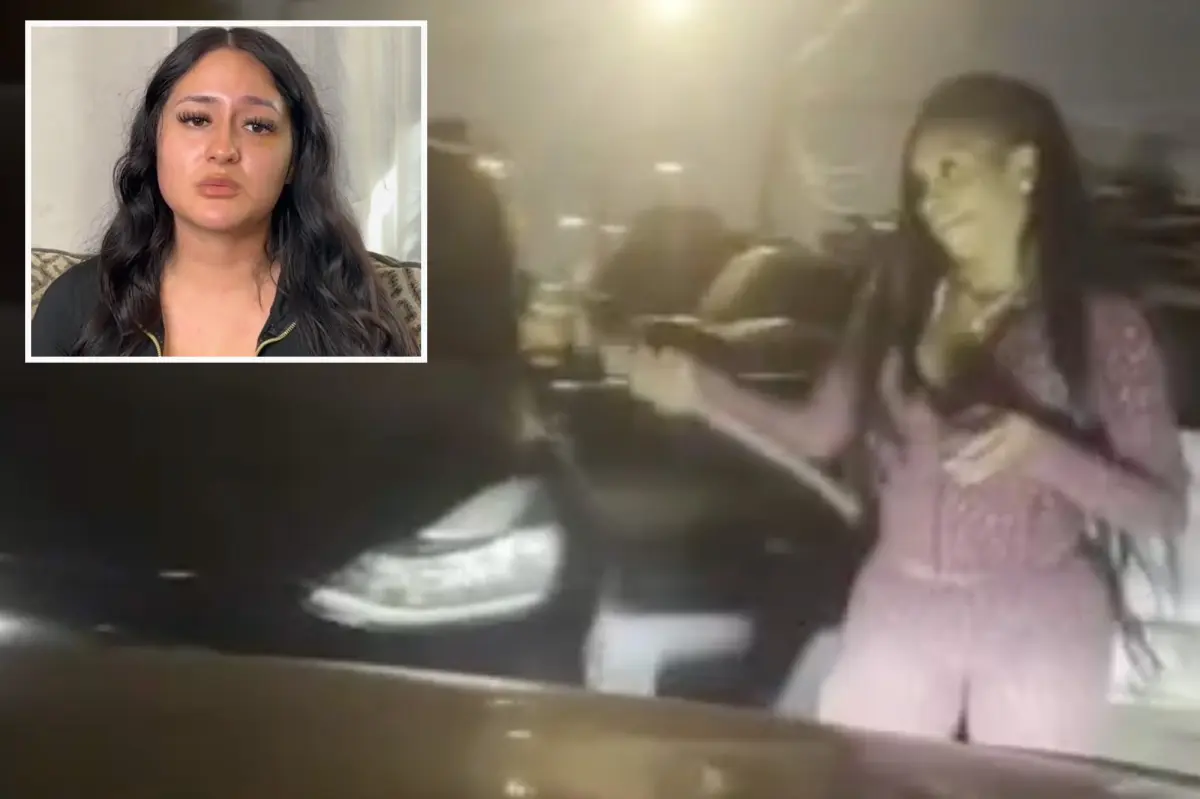
It was just before four in the morning on a quiet Saturday, when the streets of South Los Angeles were still dark and mostly empty, and Samantha Baez-Vargas was likely thinking about little more than getting home. The drive, which should have been routine, suddenly turned into a waking nightmare on a narrow, one-way street where two headlight beams met head to head. There she found herself face to face with another driver, both vehicles too large and the street too tight for them to pass. What should have been a moment of awkward negotiation quickly became something far more sinister. Baez-Vargas, a South LA resident, later said she believed the other driver was going the wrong way, and calmly asked her to back up. But instead of a simple gesture of cooperation, the woman allegedly emerged from her vehicle armed with a crowbar, her face calm, her intentions anything but. In seconds, the quiet street was filled with the crunch of metal and shattering glass, as an ordinary inconvenience transformed into a terrifying attack that would leave Baez-Vargas hospitalized, bruised, bitten, and shaken to her very core. It was the kind of violence that no one expects, a sudden explosion of rage that changed the course of her night, and perhaps her life.
The entire assault was captured on camera, a chilling document of human fury that police and the public would later study with disbelief. In the footage, the suspect can be seen calmly approaching Baez-Vargas’s vehicle, not running, not screaming, but moving with a deliberate intention that made the violence that followed even more disturbing. One by one, she smashed the headlights, cracked the windshield, and shattered the driver’s-side window, her crowbar rising and falling like a butcher’s tool. In the background, a voice can be heard screaming, “Are you deada–? What’s wrong with you?” But the suspect did not stop. She did not flinch. And when Baez-Vargas made the instinctive, terrifying decision to get out of her car, the woman allegedly turned the weapon on her. What followed was no longer just property damage but a savage physical assault. The suspect struck Baez-Vargas with the crowbar, then lunged at her, repeatedly attempting to bite her, turning the violence primal and personal. It was a street brawl captured in raw, unfiltered reality, leaving onlookers and later viewers shocked that a dispute over right-of-way could spiral into such brutality. In a matter of minutes, the battle over space on a narrow road became a fight for personal safety, and Baez-Vargas found herself utterly defenseless against a stranger’s inexplicable rage.
For Baez-Vargas, the shock did not fully set in until later, after the crowbar had been lowered and the suspect had finally disappeared into the night. Standing in the wreckage of her car, surrounded by glass and silence, she realized her body was throbbing, her skin torn, her mind spinning. “I didn’t know how to react. I was shocked. I didn’t know how to defend myself,” she later told reporters, her voice still carrying the bewilderment of someone who had never imagined such violence could touch her. At the hospital, doctors found bruises covering her body, along with marks that appeared consistent with human bites, evidence of how close the attack had come to becoming something even worse. Lying in a hospital bed, Baez-Vargas said she felt the weight of her mortality for the first time. “After the fact, I was in the hospital. I felt like I could have lost my life.” Those words were not hyperbole. When someone attacks you with a crowbar and tries to bite you, the line between surviving and not is terrifyingly thin. She recalled thinking the woman would eventually stop, that reason would prevail, but it never did. The suspect smacked her in the head with the crowbar and even snatched her phone from her hand, cutting off any immediate hope of calling for help. For Baez-Vargas, the attack was not just physical; it was psychological, a reminder that safety can shatter as easily as a windshield.
The aftermath of the attack has moved beyond one victim’s pain and into the wider community, as law enforcement works to find the woman responsible. The Los Angeles County Sheriff’s Department confirmed that the footage was turned over to investigators, and the department soon announced that they had positively identified the suspect. “South Los Angeles Station detectives have been actively investigating this case and have positively identified the suspect. Detectives are currently working to locate and apprehend her,” the department said in a statement. While the suspected woman’s name has not been released to the public, the fact that she has been identified brings a measure of hope that justice may be near. But for Baez-Vargas and her family, the wait has been agonizing. Each passing hour that the suspect remains free is another hour of fear, another chance for the same rage to flare elsewhere. The attack has shaken not only the victim but her mother, Elizabeth Vargas, who has made a desperate plea to the public and to authorities. “Please do your job. This evil can’t be out there,” she said, her words carrying the weight of a mother who watched her daughter return from the hospital covered in wounds. It is a plea for action, for accountability, for the simple and yet profound reassurance that someone who causes such harm will not simply vanish into the crowd.
What makes this story so haunting is not just the brutality of the attack, but how deeply and suddenly it upended an ordinary life. Before that early morning, Baez-Vargas was presumably like any of us: going through her routine, expecting a quiet drive home. She did not wake up anticipating a fight for her life. She did not dress for battle or brace herself for a stranger’s fury. And yet, in the span of a traffic standoff, everything changed. The streets she had driven a hundred times now feel dangerous. The sight of a narrowing roadway may trigger a wave of anxiety. A simple question asked of a stranger now carries with it the memory of a crowbar and teeth. This is the hidden cost of road rage incidents, the invisible wounds that remain long after the bruises fade. Baez-Vargas is no longer just a woman trying to get home; she is a survivor, a symbol of a larger epidemic of anger that seems to be swallowing our roads and public spaces. Her story serves as a powerful reminder that we share these streets with strangers whose inner lives we know nothing about, and that a moment of calm or a moment of violence can hinge on the smallest of choices. Her mother’s plea resonates not just for her daughter, but for all of us who have ever driven down a narrow street, met an approaching car, and wondered what the other person might do.
As the search for the suspect continues, one can only hope that justice will come swiftly, and that the woman who caused such pain will be held accountable. But beyond the legal outcome, this incident calls us to reflect on the world we are building, one where rage seems to simmer just below the surface of daily life, waiting for the smallest trigger to explode. Road rage incidents are not new, but they appear increasingly frequent, increasingly violent, and increasingly impossible to ignore. The answer is not just policing but mindfulness, not just punishment but prevention. For Baez-Vargas, the road to healing will be long. She will carry the physical scars, and likely the emotional ones, for some time. But she has also shown incredible strength in speaking out, in sharing her story, in refusing to let fear silence her. Her mother’s desperate words echo as a challenge to all of us: Do not look away. Do not let evil hide. Whether we are witnesses on the street or readers online, we have a role to play in creating communities where such violence is unthinkable, where a traffic dispute never escalates to a crowbar, where a stranger is still a human being capable of compassion. Until the suspect is found, there will be no closure. But there can be awareness. There can be solidarity with a woman who almost lost her life over a parking spot, a wrong turn, a few seconds of impatience. In that solidarity, we can begin to build something stronger than rage, and perhaps prevent the next Samantha from having to say, “I felt like I could have lost my life.”