


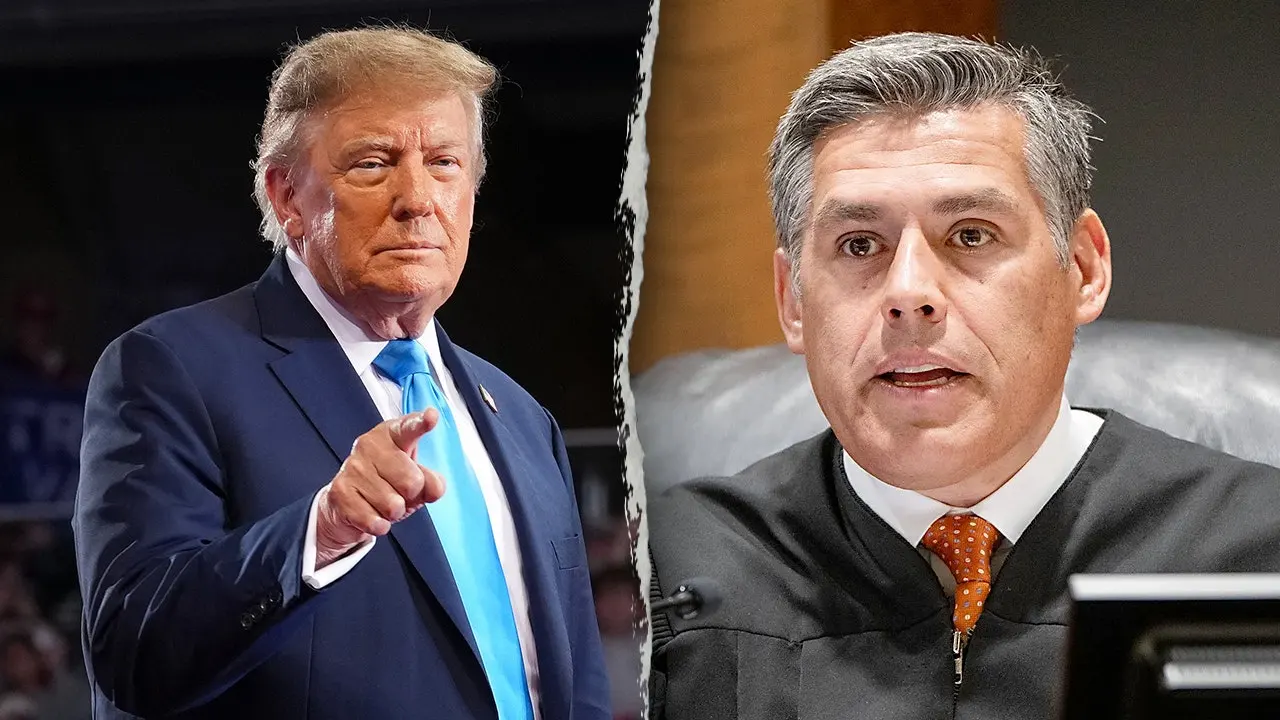
In the quiet, mountain-framed city of Provo, Utah, a courtroom drama has erupted into the national spotlight, not only because of the gravity of a capital murder case but because the former president of the United States has chosen to weigh in with unsparing fury. The case involves the brutal killing of Charlie Kirk, a father whose life was cut short in a crime prosecuted as an assassination, leaving behind two children so young they may not even remember their father. The man accused of that killing, Tyler Robinson, now faces the possibility of the death penalty, and the legal machinery around his trial has become a painful, slow-moving ordeal for everyone touched by the tragedy. In a series of blunt remarks, President Donald Trump took aim at the judge overseeing the case, declaring that the proceedings are taking far too long and that the judicial system is failing. “The judge in the Charlie Kirk case is doing a terrible job!” Trump wrote on Truth Social. “This case should be tried within a month, not three years — and it should be over with! The judge is desecrating the memory of the Great Charlie Kirk, while taking forever to ask questions that people already know the answer to. The whole Country is mocking him and our ‘Legal’ System. JUSTICE FOR CHARLIE!”
The sharp personal critique from a sitting president is extraordinary enough, but it also captures the deep frustration simmering among Charlie Kirk’s family, friends, and supporters, who feel that justice is being postponed to an almost unimaginable distance. At the heart of the controversy is the proposed trial timeline put forward by Tyler Robinson’s defense team. Rather than seeking a prompt resolution, the defense has suggested that the trial should not begin until the third quarter of 2029 — a date that, if accepted, would mean more than five years would pass between the alleged crime and the start of a courtroom reckoning. For a family already drowning in grief, that kind of delay feels less like legal strategy and more like an eternity of unresolved pain. The defense argues that the sheer volume of evidence — much of it still unreviewed — and the inherent complexity of jury selection in a death penalty case make any earlier date impossible to responsibly set. They speak of “false precision,” warning that locking in a trial date now could trample Robinson’s constitutional rights. In capital cases, they insist, “death is different,” and therefore the process must move with extraordinary caution, even if the calendar stretches far into the future.
But behind the legal jargon and the carefully worded motions lies a human story that no document can fully capture. Charlie Kirk was not just a name in a case file; he was a father, a partner, a provider, a presence whose absence is felt in every ordinary moment of family life. Erika Kirk, Charlie’s widow and the voice of the family’s anguish, has emerged as a forceful advocate for moving the case forward. In her response to the proposed 2029 timeline, she described it as “grossly out of line” with how similar cases have been handled, and she asked the court to schedule a trial for the earliest practicable date in 2027. Her words were haunting because they measured the delay not in court terms but in the changing faces of her children. At the time of their father’s murder, they were just three and one years old — too young to understand what had happened, too young to even grasp the permanence of losing a parent. Under the defense’s proposed schedule, she wrote, they would be seven and five by the time a verdict was reached. That means their entire early childhood would unfold in the shadow of an unresolved murder, with each birthday, each holiday, each school year marked by the slow tick of a calendar that never seemed to move toward closure.
The prosecution, for its part, insists that justice can and should arrive much sooner. Prosecutors have stated they expect to be ready for trial by October 4, 2027, a date that is still years away but feels almost immediate compared with the defense’s proposal. The divide between 2027 and 2029 is more than a matter of months; it is a statement about what the legal system values. Is the priority a painstakingly slow, bulletproof process that risks leaving a grieving family suspended in amber? Or is it an earnest, efficient pursuit of truth that respects the public’s right to see justice carried out in a reasonable timeframe? Former federal prosecutor Fred Tecce has no doubt about the answer. He sees the defense’s push for 2029 as a transparent delaying tactic, a legal maneuver designed not to prepare a better case but simply to run out the clock. “There’s a legal term,” Tecce told Fox News Digital. “It’s called kick the can down the road. It is just done for the purposes of delay and I think it’s wholly inappropriate. Society has a right to have these things adjudicated quickly, honestly, openly and by the rules and regulations.” He went further, acknowledging what many people privately think: “It is the job of a defense lawyer to delay and obfuscate.” In a life-or-death case, that instinct is understandable — but for the victim’s family, it feels like a second injury.
Beyond the outrage and the legal chess, this case exposes something uncomfortable about the American criminal justice system when it intersects with the death penalty. Capital cases are unlike any other kind of litigation. The stakes are literally life and death, and courts have historically been willing to grant defendants enormous latitude in gathering evidence, filing motions, and preparing appeals. Every safeguard, every layer of review, exists to prevent the irreversible mistake of executing an innocent person. But there is another side to that caution. When the process stretches on for years, when the accused sits in custody while a family waits with hollow eyes, the system can start to feel less like justice and more like punishment imposed on everyone involved. The memory of Charlie Kirk is caught in that paradox. His family wants justice, but they also want a chance to heal, and healing is nearly impossible when the wound is kept open by continuous legal delay. President Trump’s comments, for all their bluntness, tapped into a wider public frustration. People see a trial date proposed for 2029 — nearly a decade after the crime itself — and they ask how that can possibly serve anyone. The judge in the case has already explained why the death penalty remains on the table, and the legal battles over evidence, mental health, and procedural fairness will undoubtedly continue. But somewhere amid the legal filings and the press releases, there is a simple truth: a man was killed, two children lost their father, and the world is still waiting for the person responsible to be held accountable.
On a Friday afternoon, Tyler Robinson was again scheduled to appear in court, the latest step in a journey that seems to have no final destination in sight. For the supporters of Charlie Kirk, the day brought more of the same cycle — hope, frustration, and the crushing weight of a process that moves in its own time. The courtroom is a strange place. It is a theater of grammar and procedure, where the deepest human sorrows are reduced to objections and exhibits. Yet inside that sterile arena, the battle over Charlie Kirk’s memory will be decided. Will the trial happen soon enough to feel like a victory, or will it slip further into the distance until the memory of Charlie Kirk fades into a footnote? The family’s request for an earlier court date is not just a procedural preference; it is a plea for the system to acknowledge that justice delayed can be justice denied. Trump’s intervention, unconventional as it may be, has ensured that the case will not be forgotten. It puts a national spotlight on how long is too long, and how much grief a family should have to endure before they hear a verdict. In the end, all anyone can hope for is that the judge, the attorneys, and the system itself will find a way to balance the constitutional rights of the accused against the human rights of the survivors. Charlie Kirk cannot speak for himself anymore. His children cannot articulate the depth of their loss. But the world is watching, and the demand for justice for Charlie has become a demand for the machinery of law to remember that behind every case number is a life — and behind every life is a family that still needs answers.