

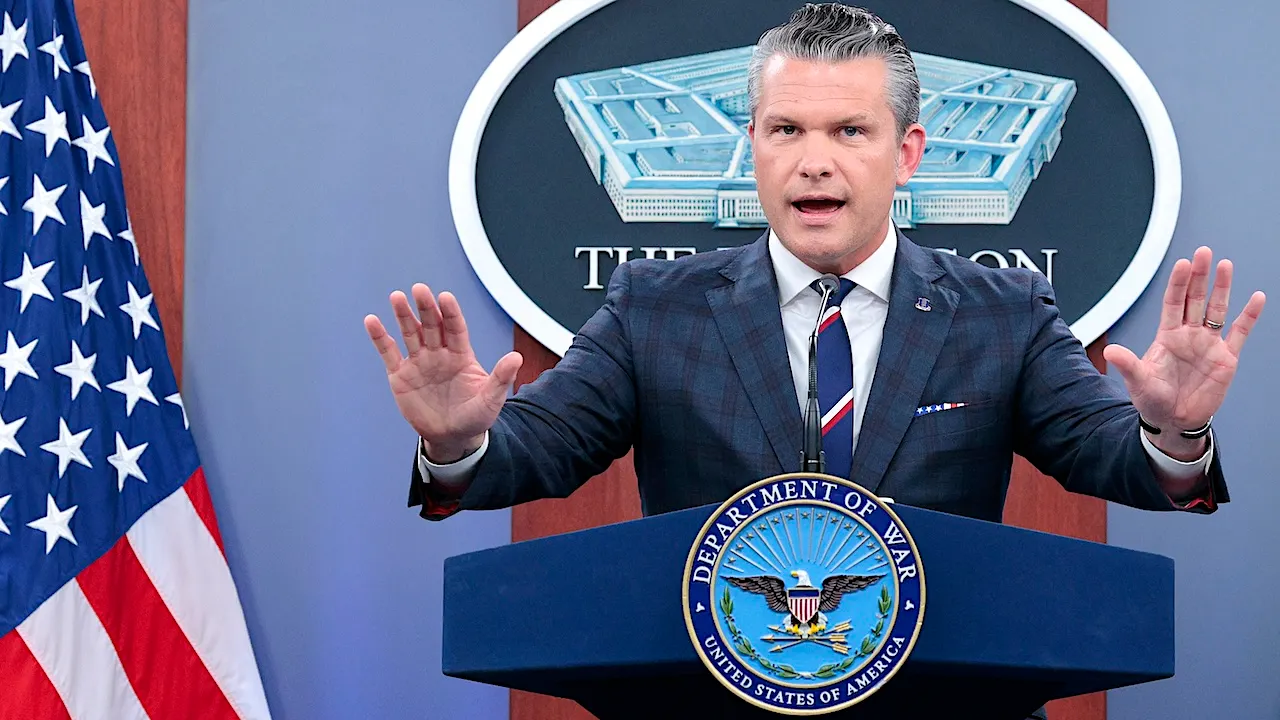
At a Pentagon press conference on Tuesday morning, Defense Secretary Pete Hegseth stood at the podium with the kind of frustration that comes from being on the defensive for something you believe is fundamentally unjust. He wasn’t facing questions about a military failure or a scandal. He was facing an impeachment resolution filed by a fellow Republican, Rep. Thomas Massie of Kentucky, and Hegseth made no effort to hide his contempt for the effort. He called it a “farce,” a “stunt,” and, most pointedly, an attempt to turn ordinary policy disagreements into impeachable offenses. “One disgruntled congressman wants to shred it over policy disagreements. That’s what it is: policy disagreements, not high crimes, not misdemeanors, not treason, not bribery, not the kinds of offenses the founders intended when they wrote the impeachment clause,” Hegseth said, his voice carrying the weight of someone who believes history is on his side. He argued that the proper remedy for disagreeing with a defense secretary’s decisions is legislation, debate, and ultimately the next presidential election—not the constitutional nuclear option. But Massie’s resolution, introduced the day before, is far more sweeping than a simple complaint about strategy. It alleges that Hegseth violated congressional war powers, authorized unlawful military operations, and retaliated against a sitting senator for exercising his constitutional rights. The clash puts the limits of impeachment at the center of a growing fight over President Donald Trump’s national security agenda, and it forces a difficult question: are lawmakers using impeachment as a legitimate constitutional check, or are they just trying to overturn military decisions they don’t like through a process the founders never intended for that purpose?
Massie’s eight articles of impeachment zero in on some of the most controversial national security decisions of the Trump administration. Three of them accuse Hegseth of violating the War Powers Resolution during the war against Iran. The outgoing Kentucky Republican, who lost his primary earlier this year and is finishing his time in Congress, alleges that Hegseth initiated hostilities without congressional authorization, continued military operations after Congress directed their termination, and disregarded statutory deadlines requiring the withdrawal of U.S. forces. These are not small claims. They go to the heart of the constitutional balance between the president’s role as commander in chief and Congress’s power to declare war. But the resolution doesn’t stop there. Other articles accuse Hegseth of failing to comply with laws designed to minimize civilian casualties, including in connection with a strike on an Iranian school, and conducting unlawful maritime strikes against suspected drug traffickers in the Caribbean. There is also an article alleging that Hegseth retaliated against Sen. Mark Kelly, D-Ariz., over a video Kelly posted urging service members to refuse unlawful orders. And still more articles accuse Hegseth of unlawfully directing military operations in Yemen and the capture of former Venezuelan leader Nicolás Maduro. Massie has pushed back hard against the suggestion that his effort is just a referendum on Hegseth’s job performance or the administration’s policies. “The question is whether he committed impeachable acts,” Massie wrote on X Monday. “And the answer is yes, eight times.” For Massie, this is not about being a disgruntled politician; it’s about a pattern of conduct he believes crosses the line from policy into lawlessness.
Constitutional law scholar Jonathan Turley, who has testified in impeachment proceedings before and is often cited by Republicans, largely agreed with Hegseth’s team that the impeachment effort is on shaky legal ground. Turley wrote on X that, in his view, six of the eight articles should be dismissed outright, including the Iranian articles. His reasoning is important for understanding the broader debate. Turley acknowledged that Congress has a legitimate constitutional interest in asserting its war powers, but he argued that Massie is trying to use impeachment to settle a longstanding dispute over presidential authority that has been going on for decades. Presidents of both parties—including Bill Clinton, Barack Obama, and Joe Biden—have claimed broad authority to launch military operations without congressional approval. Trump, Turley noted, is exercising authority long claimed by his predecessors. “Massie is not going to ‘litigate’ the matter through impeachments,” Turley wrote. That is a crucial point: if every disputed exercise of presidential power became an impeachable offense, then almost every modern president would have faced impeachment a dozen times over. But Turley drew a distinction between those broad disputes over executive authority and two allegations he considered more serious. The maritime strikes against suspected drug traffickers, for example, raised questions about whether the administration engaged in a “double tap” strike—a second attack on the same target after rescuers had arrived. Turley called that allegation a potential war crime if true, though both Trump and Hegseth have denied issuing such orders. He also took seriously the effort to punish Sen. Kelly over a video urging troops to refuse unlawful orders, noting that it raises serious questions about a sitting senator’s free speech rights and potential undue command influence. Still, Turley stopped short of concluding that either allegation meets the constitutional threshold for impeachment. He said he would be looking for underlying evidence on those two articles, describing them as potentially problematic but difficult to establish as “high crimes and misdemeanors.”
Hegseth, meanwhile, has remained defiant, and he made clear Tuesday that he has no regrets about any of the operations cited in the resolution. “I stand behind every one of these operations. I was proud to execute them, and I would do it again tomorrow,” he said. That kind of language is exactly what his supporters want to hear, and it is also exactly what his critics point to as evidence of an unchecked leader who believes he is above the law. The Trump administration has circled the wagons around him. President Trump himself rallied behind his defense secretary following the press conference, praising his performance and attacking Massie, who is leaving Congress after losing his primary. White House spokesperson Olivia Wales issued a statement defending Hegseth and accusing Massie and the Democrats of playing political games. “In just under two years, Secretary Hegseth has worked side-by-side with President Trump to restore American power on the world stage, build the strongest military in generations, and instill a warrior ethos at the Pentagon,” Wales said, adding that the administration’s actions had denied the Iranian regime the ability to develop a nuclear weapon, brought narco-terrorist Nicolás Maduro to American justice, and defended the homeland from terrorists and cartels. “This spectacle only proves what we’ve known all along: Thomas Massie and the Democrats are far more interested in playing political games than working to improve the lives of the American people,” she added. Several Trump Cabinet officials, including Collins, Burgum, Rollins, Mullin, and Turner, posted messages of support on social media, while Secretary of State Marco Rubio and others defended Hegseth publicly. Rubio said Hegseth had carried out Trump’s orders “quite effectively,” and another ally rejected claims that Hegseth had done anything illegal or wrong. The message from the administration is clear: this is a political attack, not a legitimate legal proceeding.
Vice President JD Vance also weighed in, and his comments captured the administration’s broader strategy of framing the impeachment effort as a misuse of congressional power. “Has Pete Hegseth committed impeachable crimes? The question is absurd and the answer is: obviously not,” Vance wrote on X. He argued that Congress has so many tools for registering policy disagreements—legislation, hearings, oversight, the power of the purse—that resorting to impeachment is a sign of weakness, not strength. “Rather than use them, they’re going to try to impeach Pete Hegseth,” Vance continued. He also suggested that the real motivation behind the effort has nothing to do with Iran. “This isn’t about Iran, this is about the fact that Pete took on the bureaucracy at the Pentagon,” Vance wrote. That is an important framing. Hegseth has been a controversial figure not just because of the operations he has authorized, but because of his broader changes at the Pentagon, including shifting U.S. forces away from Europe and Ukraine and reorganizing the military’s senior leadership. He has been a disruptor, and disruptors tend to make enemies. The impeachment effort is, in part, a reaction to that disruption. Massie, by contrast, insists that his motives are constitutional, not personal. He argues that the allegations in his resolution are specific, serious, and supported by evidence. Democrats, who have been eager to criticize Hegseth since his confirmation, have rallied behind Massie’s effort and signaled that more may be coming in January. The vote on whether to advance the resolution will test whether lawmakers view the allegations as grounds for impeachment or as a dispute better addressed through Congress’s legislative and oversight powers.
In the end, this fight is about more than Pete Hegseth. It is about the meaning of impeachment itself, and whether the Constitution’s most powerful check on executive misconduct can be used to challenge military policy decisions that a faction of Congress opposes. The Constitution authorizes impeachment for treason, bribery, or other high crimes and misdemeanors. That standard does not require proof of a criminal offense, and Congress has historically treated serious abuses of official power as potential grounds for impeachment. But the precise boundaries remain contested, and this case highlights just how contested they are. Lawmakers can disagree with a defense secretary’s decisions without those disagreements rising to the level of impeachable misconduct. But allegations that an official knowingly violated the law or abused the powers of his office present a different constitutional question, one that cannot be dismissed simply by saying “policy disagreement.” Hegseth and his supporters argue that everything he did was lawful and directed by the president. His critics say he crossed a line. The House was expected to vote Tuesday evening on whether to advance the resolution, and while impeachment would require only a simple majority in the House, removal from office would require conviction by a two-thirds majority in the Senate. That is a high bar, and it seems unlikely that enough Republicans would vote to convict their own party’s defense secretary. But the vote itself is significant. It will show where lawmakers stand on the limits of presidential war powers, the role of Congress, and the meaning of impeachment. And no matter how the vote turns out, the debate will not disappear. It will echo into the next election, into future court challenges, and into the ongoing struggle between the executive branch and Congress over who truly controls American military power. For now, Hegseth remains in office, defiant and unbowed, insisting that he would do it all again. The question is whether Congress, and ultimately the American people, will accept that answer.