

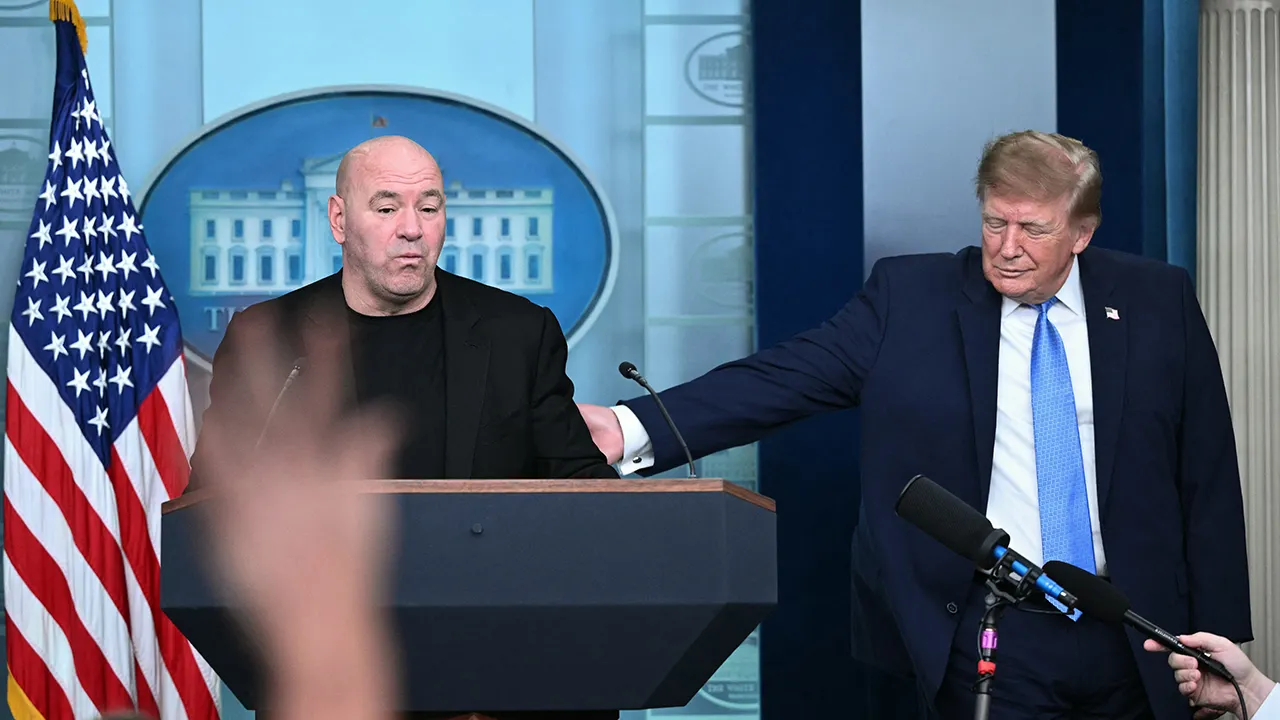
In the rarefied, often sterile air of the White House briefing room, an unexpected collision of worlds took place on Monday. The polished wood-paneled walls that usually echo with the clipped cadence of political rhetoric instead served as a velvet-lined backdrop for the visceral, high-octane energy of the Ultimate Fighting Championship. There stood Dana White, the famously combative CEO of the UFC, his short, stocky frame clad in a dark suit that seemed almost like a costume for a role he was clearly uncomfortable playing. He was there at the behest of his friend, President Donald Trump, a man who has long understood the symbiotic relationship between raw entertainment and political power. The occasion was a press briefing that had the air of a strange, improvised summit, a meeting of the minds between a commander-in-chief and a fight promoter, brought together by a whirlwind of rumors and a single, off-the-cuff joke that had spiraled into the national news cycle. As the cameras clicked and the reporters leaned forward, the room was charged with the peculiar tension of waiting for a punchline that might never come, a moment where the rigid protocols of the White House melted into the chaotic, spontaneous theater that seems to follow Trump wherever he goes.
President Trump, clearly amused by the spectacle he had accidentally created, took to the podium to set the record straight. He explained that his recent suggestion to appoint White as his press secretary was, in fact, a jest, born from the frustration of a particularly brutal week of media coverage. With a shrug of his shoulders and a wry smile, Trump recounted the genesis of the rumor, explaining that during a rough news cycle, he had blurted out White’s name as a potential replacement for his beleaguered press team. He admitted he was “sort of kidding” when he floated the idea to a group of journalists, but the offhand remark was seized upon and broadcast as a genuine personnel decision. The President’s explanation painted a portrait of a man who treats the media apparatus as an extension of his own reality-TV instincts, where a casual aside to a reporter can become a headline that dominates the discourse for days. The clarification served a dual purpose: it defused the notion of a major political hire while simultaneously shining a massive spotlight onto his friendship with White. It was a classic display of Trump’s ability to manufacture news from nothing, turning a bad press day into a story about his own loyalty to a celebrity friend, and forcing the press corps to do the work of parsing his jokes for deeper meaning.
When Dana White himself stepped up to the microphone, the shift in tone was palpable. Gone was the formal, diplomatic veneer of the White House; in its place was the blunt, unpolished cadence of a man who has spent his life managing athletes, negotiating brutal contracts, and building a multi-billion-dollar empire out of blood, sweat, and pay-per-view buys. White immediately quashed any notion that he harbored political ambitions, offering a terse, categorical denial. “I have zero political aspirations,” he declared, the statement sounding more like a rule of law than a polite refusal. He painted a vivid picture of the chaos that had engulfed his life over the previous 24 hours, revealing that he had been at a Zuffa Boxing event in London when the call came in from Trump. He described the bewildering sensation of being thrust into a political maelstrom, fielding phone calls and press inquiries from around the globe while trying to manage his actual job. The humanizing detail of the London trip grounded the surreal scenario in reality, showing that even the most powerful figures in entertainment can be caught off guard by the gravitational pull of the American presidency. White’s discomfort with the attention was a stark contrast to the polished politicians around him, and his insistence that he had never explicitly told Trump “no” hinted at a complicated relationship where friendship and obligation often blur.
The most revealing moment of the briefing came when a reporter, leaning into the absurdity of the setting, asked White to break down a hypothetical UFC cage match between Trump and former President Joe Biden. The question was ridiculous, a provocation designed to get a reaction, and White delivered with the lethal efficiency of a fighter landing a knockout blow. He pivoted from the hypothetical to a deeply personal testimonial about Trump’s character, elevating the conversation from sports banter to a discussion of resilience and survival. White spoke with genuine emotion about Trump’s toughness, calling him “the toughest, most resilient human being that I’ve ever met in my entire life.” He recounted the countless times he had privately questioned Trump’s decision to continue fighting in the political arena, asking him, “Why? Why do you keep doing this?” The question laid bare the immense pressure and scrutiny that comes with the highest office, a burden that White, as a friend, has observed from a close and protective vantage point. But the true emotional weight of his words came when he addressed the assassination attempt on Trump’s life. White described it as the defining proof of Trump’s unique character, stating, “He proved he is a one-of-one unique human being.” In that brief moment, the press briefing transcended politics, becoming a raw expression of loyalty and awe from a friend who had witnessed unimaginable adversity. When forced to address the actual fight, White dismissed it with a laugh, noting it would be “very bad,” a subtle acknowledgment that the scenario was so one-sided it wasn’t worth exploring further, before sarcastically marveling that he was actually being asked such questions.
The conversation then veered into another realm of sports and legacy—the case of Pete Rose. White was asked what advice he would give Trump regarding a potential posthumous pardon for the legendary baseball player, who had died in 2024. Rose’s legacy remains a tragic scar on the sport, a story of unprecedented athletic achievement marred by a self-inflicted wound of gambling on games, including his own team, the Cincinnati Reds. The historical context was heavy: Rose had been banned from the Hall of Fame, a punishment that had hung over him for decades until MLB Commissioner Rob Manfred, in a surprising 2025 decision, removed Rose and sixteen other deceased players from the permanently ineligible list. The question of a presidential pardon for Rose is an unusual one, blurring the lines between federal crimes, sports ethics, and personal redemption. Trump, who has always been drawn to figures of rebellion and redemption, had previously voiced his support for pardoning “the Hit King,” framing it as an act of justice for a man who had been punished too harshly. White’s presence in this discussion underscored the strange advisory role he plays in Trump’s life, acting as a conduit between the sports world and the executive branch. The subtext of the exchange was deeply human: a conversation about grace, about second chances, and about the complicated nature of legacy when a person’s greatest triumphs are overshadowed by their greatest mistakes.
In the end, the appearance of Dana White at the White House briefing was less about the actual rumors of a political appointment and more about the enduring, symbiotic bond between the worlds of combat sports and national politics. It was a masterclass in media manipulation, where a joke became a news cycle, and a news cycle became a platform for friendship. White left the podium having fiercely defended his friend, shutting down political rumors while cementing his role as a loyal confidant. For Trump, the moment was a chance to bask in the adoration of a man he respects, a man who embodies a version of grit and toughness that resonates deeply with his political base. Beneath the surface of the spectacle, the human elements were undeniable: the shared understanding of being in the arena, of taking hits from the press, and of the resilience required to keep fighting. White, for all his protests about having “zero political aspirations,” found himself playing a pivotal role in the theater of the presidency, using his credibility to humanize Trump through emotional anecdotes about the assassination attempt. It was a transient moment of political absurdity, but it revealed something genuine about the bonds we form, the loyalties we keep, and the strange, magnetic attraction between the world of spectacle and the world of policy. As the briefing adjourned, one was left with the image of two fiercely loyal friends, standing together in the halls of power, navigating the fickle currents of public opinion with the grit of fighters.