


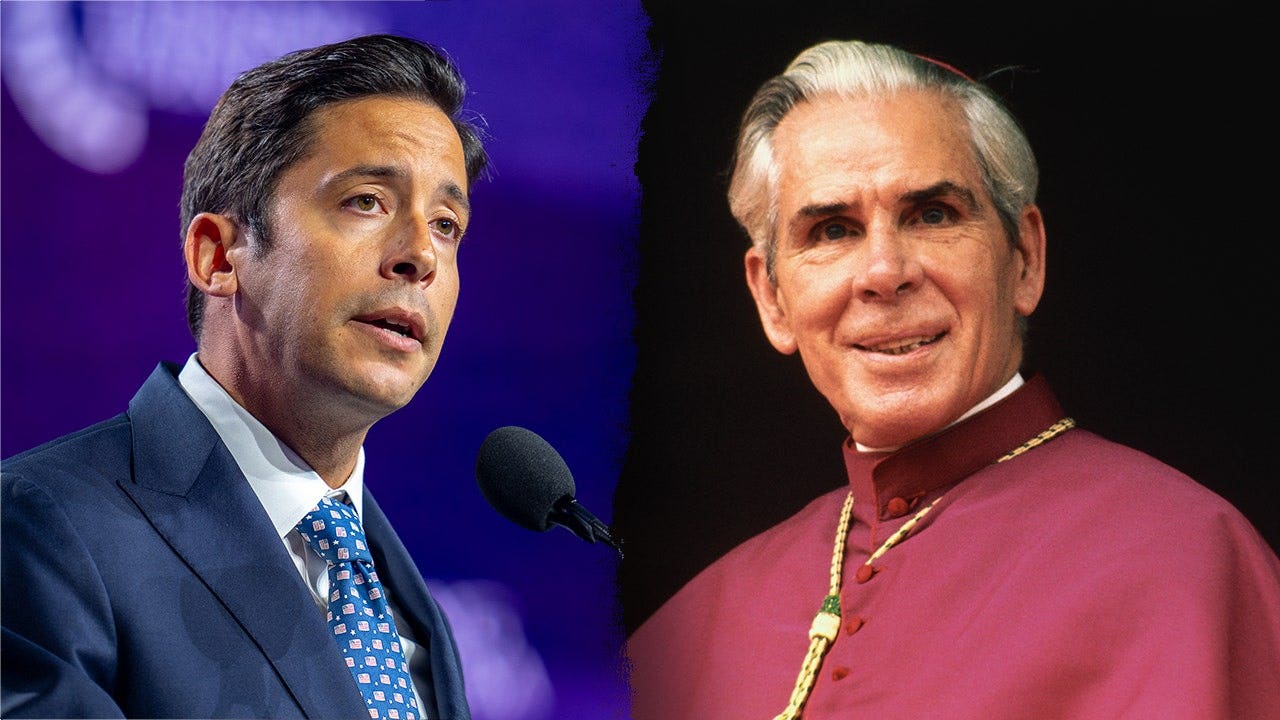
Imagine an era before streaming algorithms and outrage machines, when a man in a cape and clerical robes could sit down in front of a chalkboard and, with nothing but words, hold an entire country in thrall. That man was Archbishop Fulton Sheen. He was not a pop star or a political pundit. He was a Catholic bishop who believed that the Gospel of Jesus Christ was the most urgent news of any age, and he had the rare gift of making that news sound as compelling as a breaking bulletin. At its height, his television program “Life Is Worth Living” reached an estimated 30 million viewers—a number that seems almost impossible for a religious broadcast even today. He did it without elaborate sets, without a band, without a teleprompter. He did it with a chalkboard, a piece of chalk, and the kind of confidence that comes from a man who has been with God before he steps in front of a camera. More than seventy years later, conservative commentator Michael Knowles believes Sheen could take the exact same words, the exact same tone, and be instantly branded a “far-right extremist.” Knowles told Fox News Digital that Sheen would not need to change a single syllable of his message. “He wouldn’t need to change his message,” Knowles said. He would simply be greeted by a culture that has lost the ability to engage with unblinking moral conviction. That observation is not just a commentary on Sheen. It is a commentary on us, on how much the culture has shifted, and on how quickly we dismiss voices that refuse to flatter our assumptions. Sheen was beatified in St. Louis on Thursday, and President Donald Trump and first lady Melania Trump joined the celebrations. The White House called Sheen the first American-born bishop to be beatified, a step toward sainthood for a man who once competed with Milton Berle and Frank Sinatra for ratings. It was a moment of strange convergence: a modern president honoring a mid-century messenger, and a Church recognizing a soul who had always pointed far beyond himself.
Sheen’s path to this remarkable moment began on the radio. His program “The Catholic Hour” reached more than four million people, making him a trusted voice in homes across the country before television made him a face. But radio was only the opening act. When Sheen moved to television, he found the medium that would make him a legend. “Life Is Worth Living” was simple in concept and almost intimidating in its directness. Sheen would enter dressed in his robes, stand before a chalkboard, and begin to speak. He might draw a crude diagram or write a telling phrase, but the real action was in his eyes and in his voice. He looked into the camera as if he were looking at a single human being, and he talked about the things that mattered most: faith, doubt, pain, love, death, and the hope of eternity. He did not condescend. He did not simplify the faith beyond recognition. He trusted his viewers to be able to think, and they rewarded him with their loyalty. Knowles calls Sheen “the very first televangelist,” but he means it as a compliment, not a criticism. Sheen understood something that remains true in the age of podcasts and social media: you go where the people are. He did not wait for people to come to church; he brought the church into their living rooms. And he did it so effectively that he beat Milton Berle and Frank Sinatra in the ratings, made the cover of Time magazine, and won an Emmy for outstanding television personality. It is almost impossible to imagine a bishop winning an Emmy today. But Sheen was not just a bishop who appeared on television; he was a communicator who used every tool available to him. Knowles believes Sheen would have been just as excited by podcasts and viral clips. He would have learned the algorithms, mastered the platforms, and still found a way to make a chalkboard feel relevant. The medium changes, but the message—and the hunger for the message—does not.
If Sheen were alive today, what would get him canceled first? Knowles was asked exactly that, and his answer was immediate. It would not be any single issue. It would be everything about him, all at once. “His absolutely unapologetic apologetics,” Knowles said. Sheen’s traditional Catholic teaching about sex, marriage, and human nature would draw ferocious criticism in a culture that has made a god of self-invention. He would be called a bigot and a reactionary. His views would be caricatured and condemned. And Sheen, Knowles says, would not flinch. He would not apologize. He would not issue a vaguely worded statement distancing himself from Catholic teaching. He would do what he always did: explain the truth with clarity, defend it with patience, and love the people who attacked him. Knowles imagines the cancellation would be swift and merciless, but he adds that Sheen would have “the last laugh in heaven.” The phrase is more than a punchline. It is a reminder that Sheen was not seeking the approval of the culture. He was seeking something far more lasting. He understood that a Christian who lives only for the applause of the moment has already received his reward. Sheen wanted to be faithful, not popular. That is a hard perspective to maintain in an age when public opinion seems to change with every news cycle. But Sheen possessed it, and it gave him a freedom that most public figures never know. He did not have to calculate how far he could go before being canceled. He did not have to hedge. He simply had to be a priest, a teacher, and a shepherd. That made him dangerous to every ideology that wants to reshape human nature without God. It also made him attractive to millions who were tired of being told that there were no answers, only preferences. Sheen offered a solid ground to stand on, and even those who rejected his Church could recognize that he was standing on something real.
At the center of Sheen’s public ministry was his opposition to communism, which the White House recalled by quoting his warning that the world was “threatened by the titanic forces of communism.” Sheen saw communism not merely as a political system but as a spiritual crisis—a denial of God and an attempt to remake human beings in the image of the state. In the 1960s, he sounded a warning that still resonates: “Our nation is too full of those that are crying, ‘Down.’” He listed the institutions being attacked—schools, churches, teachers, government, police—and asked, “Can you build anything down?” Those words were prophetic. We live in a culture that often seems more comfortable tearing down than building up, more skilled at deconstruction than construction. Knowles ties Sheen’s insight to the Christian doctrine of original sin. Communism and every other utopian movement begins with a mistaken belief about human nature. It assumes that people are basically good and that only corrupt institutions make them bad. But Sheen knew, and the history of the twentieth century proved, that human beings carry within themselves the seeds of both great holiness and terrible evil. Any system that does not take sin seriously will eventually become a system of control, because it must force people to be what the ideology says they should be. Sheen’s anti-communism was not a matter of Cold War strategy. It was a pastoral conviction rooted in the Gospel. He believed that when a society rejects God, it does not become more free. It simply replaces the worship of God with the worship of something else—the state, the leader, the party, or the self. That message ended with the Soviet Union, but it did not end with the twentieth century. We have our own utopias, our own false promises of paradise through politics, technology, or unbridled self-expression. Sheen would remind us that the human heart is too big for any earthly system. It was made for God, and it will not rest until it finds its rest in Him.
But the beatification was not about Sheen’s political commentary or his television career. It was about the Church’s judgment that he lived a life of heroic virtue. His cause opened in Peoria, Illinois, in 2002. The miracle that cleared the way for his beatification involved a child born in 2010 without heartbeat or respiration. After 61 minutes, the child was revived and went on to make a full recovery—a healing attributed to Sheen’s intercession. Pope Francis approved the miracle in 2019. At the beatification Mass in St. Louis, Cardinal Luis Antonio Tagle represented Pope Leo XIV, who had approved the beatification. Tagle spoke not of Sheen’s fame but of his relationship with Christ and his missionary work. An apostolic letter from Pope Leo described Sheen as an evangelist who used modern communications to proclaim the Gospel. Among the millions who encountered Sheen on television was a boy who would one day become Pope Leo XIV; he recalled Sheen’s preaching from his childhood, and decades later he approved the step that brought the archbishop closer to sainthood. Sheen’s life was intertwined with the papacy. He participated in the Second Vatican Council, where he met Archbishop Karol Wojtyla, the future Pope John Paul II, and Father Joseph Ratzinger, the future Pope Benedict XVI. In 1979, a weakened Sheen approached John Paul II at St. Patrick’s Cathedral in New York and tried to kneel. The pope lifted him up and embraced him, saying, “You have written and spoken well of the Lord Jesus Christ. You are a loyal son of the Church.” Sheen died two months later. That embrace was a kind of seal on his life’s work. He had used every gift he possessed to speak of Christ, and now the vicar of Christ welcomed him as a son. The beatification is not a reward for a man who no longer needs rewards. It is a declaration to the world that his way of life is worth following.
What made Sheen so appealing, even to those who disagreed with him, is a quality that is hard to define but easy to recognize. Knowles described it perfectly: “He took life seriously. He just didn’t take himself seriously.” Sheen could discuss the most profound mysteries of the faith without becoming ponderous. He could make a philosophical point with a joke and a wink. He had the courage to wear a cape, to stand before a chalkboard, to be theatrical in an age that was learning to distrust theatrics. Some people today might discover him through his anti-communism, others through his cultural traditionalism, and others simply through his elegant formal dress—a welcome contrast, as Knowles joked, to people wearing sweatpants at the airport. But the deepest truth about Sheen was hidden from the cameras. He maintained a daily Holy Hour before the Eucharist throughout his ministry. He called it “the hour that makes my day.” That practice was the source of everything else. Sheen did not speak from his own wisdom. He spoke from a place of silence, prayer, and surrender. He knew that he was only a servant, and that all the eloquence in the world meant nothing if it did not flow from a life united to Christ. That is why Knowles says it is not enough to admire Sheen. “It would be far better for you and for all of us to follow his example,” he said. We may not be called to stand before a camera or speak to millions. But we can spend an hour with God. We can speak the truth with love. We can build instead of tear down. Sheen’s life says that this is possible, not because he was a superhero, but because he was a man who let grace do its work. In a world full of noise, he offers a quiet and lasting invitation: take your faith seriously enough to live it, and take yourself lightly enough to let God be God.