






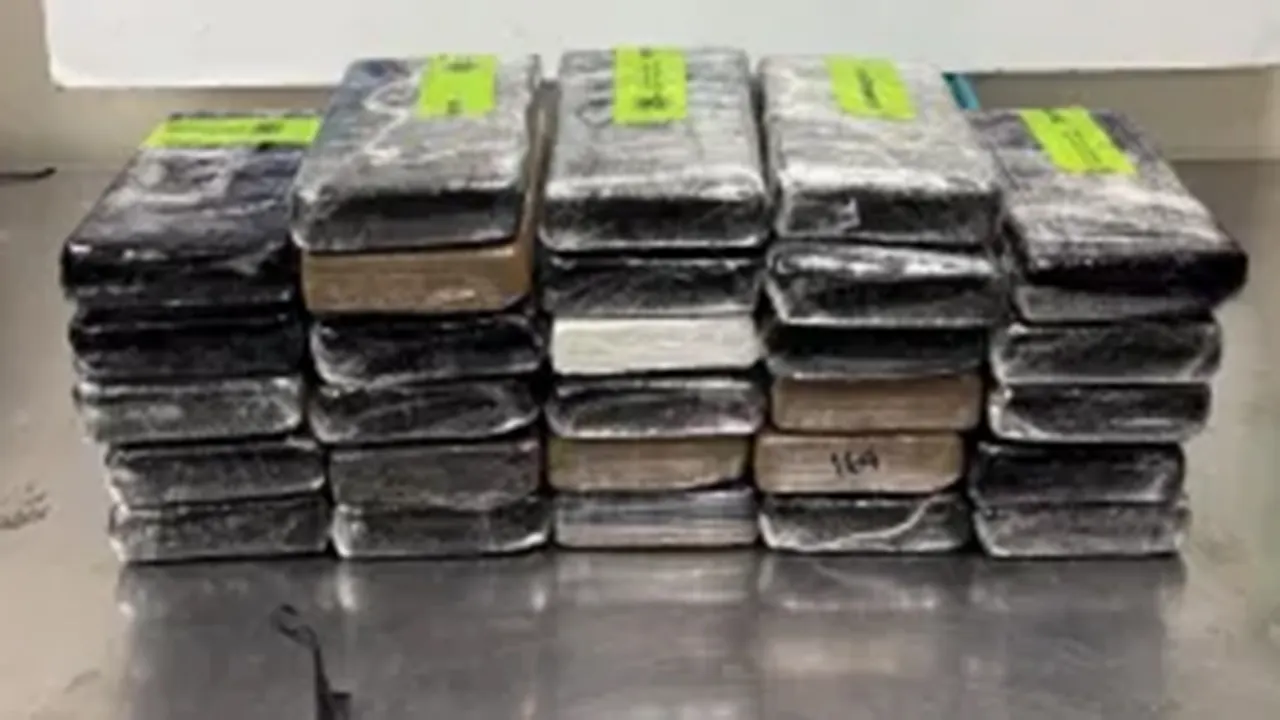
At the southernmost tip of Texas, where the persistent hum of commercial diesel engines serves as the constant soundtrack to international commerce, the Pharr International Bridge stands as one of the busiest arteries of trade between the United States and Mexico. Under the blazing sun, U.S. Customs and Border Protection (CBP) officers navigate a daily sea of shipping containers, commercial flatbeds, and cargo holds, searching for the invisible threads of illicit trade woven into the fabric of legitimate business. On a seemingly ordinary Wednesday, this exhausting, high-stakes routine yielded one of the year’s most staggering narcotics seizures. A tractor-trailer rolled up to the checkpoint, its manifest claiming a cool, innocent haul of fresh green cucumbers. Yet, beneath the crisp exterior of the produce lay a massive, multi-million-dollar deception. Thanks to the keen senses of a CBP canine partner and the sophisticated technology of a nonintrusive imaging system, officers flagged anomalies in the vehicle’s cargo hold. A physical inspection revealed that the shipment was not destined for grocery store shelves, but was instead a Trojan horse concealing 112 tightly wrapped packages containing 278.88 pounds of high-purity cocaine. With a street value estimated at an incredible $3,723,654, this massive haul represents the thin line CBP officers walk daily between routine bureaucratic paperwork and frontline national security.
This massive cucumber bust is not an isolated incident, but rather a vivid chapter in a continuous, high-stakes game of hide-and-seek played out along our southern border, where smugglers increasingly exploit the basic necessities of human life to mask their toxic cargo. There is a deep, unsettling irony in the way drug cartels attempt to hide destructive chemicals beneath fresh, life-sustaining agricultural goods. Only a few months prior, in February, border agents intercepted a commercial truck carrying what was supposed to be a romantic floral shipment of fresh roses; instead, they unearthed 515 pounds of cocaine hidden among the delicate petals. The trend continued into early spring when, on April 2, alert officers discovered 298 pounds of cocaine—valued at approximately $2.6 million—shoved deep inside a commercial cargo transport carrying sweet orange carrots. This persistent, creative camouflage demonstrates that smuggling syndicates view natural produce as an ideal cloak, believing that the perishable nature of the goods will force officers to rush their inspections. However, this calculations underestimates the profound patience and rigorous training of the CBP staff, who look past the comforting, familiar imagery of fresh produce to spot the minute, mechanical discrepancies that reveal a loaded vehicle’s true and deadly intention.
But the threats passing through these bustling ports of entry are far from limited to illicit narcotics. While the domestic conversation often focuses on the northward flow of drugs, the weapons going in the opposite direction pose an equally terrifying danger to communities on both sides of the border. In late April, CBP officers stopped a vehicle that, on the surface, appeared to be a standard traveler crossing the boundary. A deeper search of the outbound vehicle revealed a chilling arsenal of military-grade hardware: a rocket-propelled grenade (RPG) launcher, 16 AK rifles, 24 high-capacity rifle magazines, 16 rifle stocks, 20 tactical pistol grips, and an assortment of other critical weapon components. This seizure was a stark reminder of the deadly reciprocal trade that fuels violent criminal networks. By intercepting these weapons of war before they could be deployed in cartel conflicts, border agents did not just make a bust; they undoubtedly saved countless lives and disrupted a pipeline of violence that stretches deep into both nations. It underscores the reality that border security is a multi-dimensional safeguard, protecting citizens from chemical dependency while simultaneously dismantling the heavily armed infrastructure of transnational crime syndicates.
This constant stream of sophisticated smuggling attempts comes at a particularly paradoxical moment in modern border dynamics, highlighting the complex ways in which security challenges evolve. Statistically, the sheer volume of unauthorized migrants crossing the southwestern border has undergone a historic and dramatic decline. From a towering peak of over 144,000 migrant encounters in December, crossings plummeted to a staggering low of just 10,000 by April. This downturn might lead an outside observer to assume that the border has quieted down, or that the pressure on federal agents has finally eased. In truth, the reality on the ground is far more complex. As fewer resources are occupied by humanitarian processing and migrant care, transnational criminal organizations have pivoted their operational focus, doubling down on highly coordinated, commercial-scale smuggling operations. With fewer people crossing illegally through the brush, cartels are relying more heavily on the commercial cargo lanes, betting that the sheer volume of daily trade will allow their multi-million-dollar shipments of cocaine, weapons, and synthetic drugs to slip through unnoticed. For CBP, this shift means that the demand for absolute vigilance has never been higher, requiring officers to pivot from humanitarian management to intense, hyper-focused counter-narcotics enforcement.
Behind every successful seizure, and behind every high-tech scanner, are the human faces of the officers who sacrifice their peace of mind, their holidays, and their physical safety to stand watch on the frontline. Port Director Carlos Rodriguez, who oversees the Hidalgo Port of Entry and the surrounding operations, speaks of his team not just as law enforcement officers, but as a dedicated shield defending the nation’s families 24 hours a day, seven days a week. “This interception is a powerful reminder that our CBP officers are on duty 24/7, employing every resource to detect and deter those who attempt to exploit our borders,” Rodriguez noted, reflecting on the cucumber seizure. This sentiment captures the heavy burden of constant alertness worn by these men and women. For a border agent, there is no such thing as a routine day; a simple cargo of vegetables, a trunk full of flowers, or a casual family sedan can transform in an instant into a highly dangerous encounter. The mental stamina required to treat the ten-thousandth vehicle of the day with the exact same level of scrutiny as the first is monumental, yet it is this exact discipline that prevents millions of dollars of narcotics from reaching urban centers, suburban neighborhoods, and rural towns across America.
Ultimately, the battle waged at the Pharr International Bridge is a profound human story about resilience, community protection, and the silent victories that go unnoticed by the public until a major bust makes the headlines. Every package of cocaine kept off the streets, every rifle prevented from reaching a cartel enforcer, and every weapon component seized represents a network of devastation that was successfully severed. The $3.7 million value of the seized “cucumber” shipment is a staggering statistic, but the true value of the bust lies in the untold stories of families spared from the heartbreak of addiction and the communities saved from the trauma of gun violence. As Port Director Rodriguez aptly summarized, “The threat of illicit narcotics is constant, but so is our vigilance.” This simple, unwavering philosophy is what guides the officers of the CBP as they stand as sentinels of our borders. Though the tactics of the smugglers will undoubtedly continue to evolve, shifting from cucumbers to carrots, and from roses to rocket launchers, the dedicated men, women, and canine partners of the border patrol remain an unyielding wall of defense, quietly securing the nation one shipment at a time.