



In an era where digital connectivity is no longer a luxury but a fundamental baseline for human interaction, employment, and daily survival, the rising cost of personal technology is a deeply felt burden for the average consumer. Against this backdrop of economic vulnerability, Representative Alexandria Ocasio-Cortez, D-N.Y., has initiated a vital conversation about the unchecked growth of the Silicon Valley giants that dictate our modern lives. The progressive lawmaker recently made headlines by declaring that the United States Congress must seriously evaluate breaking up mammoth conglomerates like Apple. This provocative policy stance comes at a time when Apple, long considered the gold standard of consumer hardware, has signaled that it may soon have to hike the retail prices of its signature iPhones and MacBooks. For Ocasio-Cortez, these impending price hikes are not merely the neutral result of market forces, but rather a symptom of a highly concentrated corporate landscape that lacks the competitive friction and consumer safeguards necessary to protect ordinary working people from being priced out of the digital world.
At the heart of Ocasio-Cortez’s critique is a profound philosophical concern regarding the nature of corporate governance and its creeping encroachment on democratic self-determination. She has warned that these colossal technology firms no longer behave simply as businesses looking to turn a profit; instead, they have begun to act like sovereign, unregulated governments that answer only to their shareholders rather than the public interest. This concentration of unchecked power allows a select few executives in executive boardrooms to make unilateral decisions that reshape the economic realities of millions of household budgets. By advocating for aggressive antitrust intervention, the congresswoman is arguing that humanizing the tech sector requires a shift in power dynamics, stripping away the monopolistic leverage that allows a single corporation to pass its systemic inefficiencies and rising overhead costs directly down to the pockets of everyday citizens.
To understand why a retail giant like Apple is feeling the squeeze, one must look at the highly vulnerable and complex physical reality of global supply chains. For years, Apple has enjoyed relatively unchallenged dominance in securing high-performance semiconductor processing chips—the microscopic silicon “brains” that allow our pockets to hold entire processing centers. However, outgoing Apple CEO Tim Cook recently delivered a blunt dose of reality, admitting in an interview with the Wall Street Journal that the company is reaching a breaking point where shielding consumers from rising resource costs is no longer sustainable. Cook emphasized that while Apple has tried to absorb these ballooning upstream manufacturing and logistical expenses, the sheer scale of the global supply crunch has forced their hand, making consumer price hikes seemingly inevitable. This admission highlights a deeper human irony: even the most valuable corporation on earth remains entirely beholden to the physical limits of raw material extraction and precision manufacturing.
The primary catalyst disruptively driving up the price of these essential processing chips is the gold rush toward artificial intelligence. Generative AI models operate on incredibly dense neural networks that require massive, specialized computational power to train and run, creating an overnight explosion in demand for the exact same high-tier semiconductor processors that Apple relies on for its consumer devices. Suddenly, the hardware components that once quietly powered our smartphones are being bid up in a high-stakes, international competition between traditional consumer electronics companies and hyper-funded AI startups. This intense resource competition has created a bottleneck in the tech industry, causing component costs to skyrocket and proving that the virtual, frictionless world of AI has a very real, very physical anchor in the material world—one that is currently driving up the cost of living for regular people who just need a working phone to navigate their daily lives.
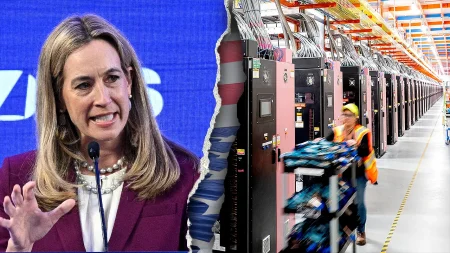
Beyond the immediate financial toll on consumer electronics, the rapid scaling of artificial intelligence is placing a severe physical and ecological strain on local communities across the nation. This is primarily happening through the quiet construction of massive data centers—the sprawling, windowless warehouses packed with hot, power-hungry servers that run the cloud. Ocasio-Cortez has pointed out that while the public often views artificial intelligence as an ethereal, weightless cloud technology, it actually acts as a massive physical parasite on local municipal power grids and water systems, which are used to cool the relentless heat generated by these servers. This unseen infrastructure crisis means that local working-class neighborhoods are quietly bearing the localized environmental and utility costs of the global AI race, facing potential spikes in their own utility bills and strains on their local energy security just to keep the servers of multinational tech giants running at cool temperatures.
This disconnect reveals a significant gap in national technology policy, particularly in how the federal government has historically approached subsidizing innovation. Congress put forward a major effort to secure domestic manufacturing through the 2022 CHIPS Act, a landmark piece of legislation that allocated billions of dollars to modernize the national energy grid and incentivize domestic chip production. However, as Ocasio-Cortez rightly observes, this bill was conceived and debated before the sudden, explosive public emergence of generative AI, meaning it was never designed to anticipate or regulate the staggering, gluttonous energy consumption of modern deep-learning data centers. By calling for a reassessment of federal technology policy, she argues that the public should stop subsidizing the private infrastructure of AI giants without demanding corresponding public protections, resource regulations, and pricing guardrails. Ultimately, humanizing this fast-evolving technological landscape means ensuring that innovation serves to elevate, rather than exploit, the communities and consumers who ultimately keep the lights on.