


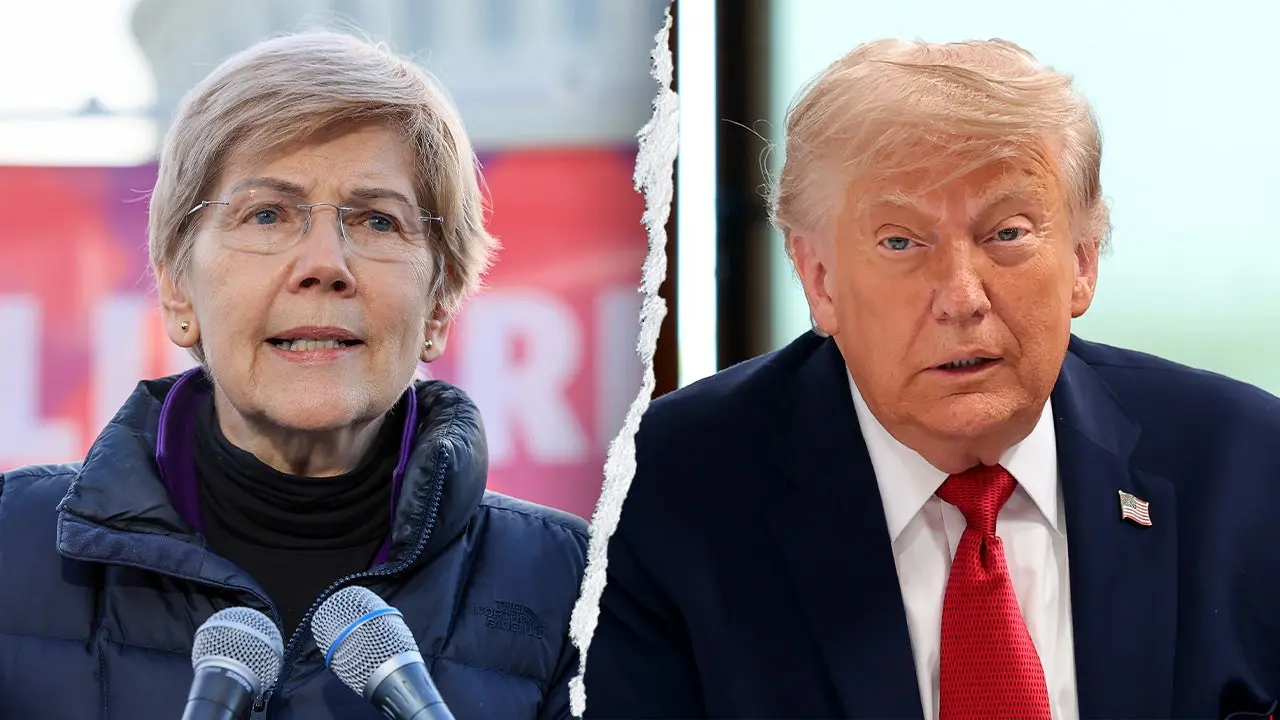
In a stark reminder of the intensifying heat and raw emotion that currently defines American political discourse, Senator Elizabeth Warren of Massachusetts recently delivered a blistering, unrestrained critique of Donald Trump that cut right through the usual polished veneer of congressional diplomacy. Appearing on Boston’s WCVB-TV during a segment of the local public affairs program “On the Record,” the progressive champion was visibly fueled by deep-seated frustration as she addressed the sudden legislative stall of an expansive, highly anticipated bipartisan housing package that had seemed destined for the president’s desk. Without hesitating, Warren tossed aside traditional legislative politeness and leveled a direct, fiery demand at Trump: “Sign the damn bill.” She went on to characterize the former president’s refusal to put pen to paper as a petulant “tantrum,” going so far as to label him a “man-child” who is actively prioritizing personal political theater over the material well-being of the electorate. For Warren, the high-stakes delay of this critical legislation is not merely a routine procedural hiccup in Washington; rather, it is a glaring, deeply disappointing indictment of a leadership style that she argues fundamentally lacks empathy for the severe economic struggles of everyday citizens. By framing Trump’s reluctance as a direct betrayal of working-class families who are desperately trying to survive in an increasingly hostile and expensive economy, Warren sought to highlight what she views as a profound and damaging disconnect between the self-serving games played in the halls of power and the urgent, real-world needs of the American people who are left to weather the cold consequences of political gridlock.
At the heart of this volatile political battle lies a quiet but devastating crisis that has been slowly eroding the American Dream for decades: the national housing emergency. Across the country, from bustling urban centers to quiet suburban towns, the sheer scarcity of available homes has driven prices to unprecedented heights, creating an agonizing financial bottleneck for millions of aspiring homeowners. The reality is that decades of systemic under-building, coupled with complex supply chain issues and skyrocketing local costs, have left the United States short of millions of residential units, leaving young families, middle-income workers, and retirees facing a cutthroat real estate market where stable shelter is increasingly treated as a luxury. This is the structural emergency that the “21st Century ROAD to Housing Act” was designed to address. As a massive, bipartisan legislative package containing nearly fifty meticulously crafted provisions, the bill represents a comprehensive effort to lower the steep barriers to construction and make the building of new homes significantly easier and more affordable. Warren emphasized that this bill was not a partisan wish list, but a practical, hard-fought roadmap aimed at jumpstarting supply, reducing construction overhead, and finally providing relief to an exhausted public that has spent years watching the cost of putting a stable roof over their heads climb further out of reach. For the millions of families facing eviction, priced out of their childhood neighborhoods, or trapped in cycles of rising rent, this legislation was seen as a glimmer of tangible hope—a rare moment where the federal government seemed poised to step in and offer structural relief to a fundamental human need.
Beyond simply boosting the supply of physical homes, the legislation carries a deeply humanized and protective secondary focus that aims to shield local neighborhoods from the predatory behavior of Wall Street. In recent years, a quiet invasion has taken place in the American suburbs: multi-billion-dollar private equity firms and corporate investment giants, armed with immense capital, have been quietly buying up single-family starter homes en masse, frequently outbidding local families who rely on traditional mortgages. This corporate consolidation of the housing market has effectively transformed entire communities, turning what should be opportunities for generational wealth creation into permanent income streams for distant shareholders. Cosponsored by Warren alongside conservative Senator Tim Scott of South Carolina, the bill takes direct aim at this phenomenon by attempting to block corporate entities from monopolizing local real estate markets, offering a rare display of cross-aisle unity in defense of local communities. Warren passionately argued that without these protections, America is rapidly sliding toward a dystopian future wherein the country is systematically converted into a “nation of renters,” where hard-working citizens are permanently locked out of the stability, pride, and financial security that owning a home provides. By uniting a progressive firebrand and a prominent conservative leader, the bill stood as a powerful testament to the universal understanding that the rapid commodification of neighborhoods by Wall Street is an existential threat to the social fabric of American life, stripping away the dream of homeownership from the very people who build and sustain these communities.
What makes the current political stalemate so incredibly frustrating for lawmakers and advocates alike is just how tantalizingly close this legislation came to becoming a reality. Before it was abruptly halted, the 21st Century ROAD to Housing Act enjoyed an overwhelming wave of bipartisan support, representing a miraculous consensus in a Congress normally defined by gridlock and ideological warfare. In the days leading up to the setback, Capitol Hill was alive with rare optimism; lawmakers from both sides of the political spectrum were actively taking to social media, proudly claiming authorship and racing to share credit for what they viewed as a historic victory for the American middle class. Republican and Democratic senators alike were online exclaiming that they had helped craft a truly monumental piece of legislation, eagerly presenting it to their constituents as proof that government could still function and deliver tangible results. Warren recalled this brief window of celebration with a mix of irony and sorrow, describing how the bill was essentially “handed to the president on a silver platter” with a ready-made victory lap waiting for everyone involved. To have that momentum completely shattered at the finish line felt to many like a betrayal of the legislative process itself. The sudden shift from cooperative, bipartisan triumph to a deadlocked standstill serves as an agonizing reminder of how quickly constructive policymaking can be derailed, leaving hard-working civil servants and hopeful citizens watching in disbelief as a rare moment of political unity evaporated into thin air over non-germane disputes.
The mechanism of this sudden halt lies in a high-stakes legislative maneuver by Trump, who canceled a previously scheduled signing ceremony and declared a hardline freeze on all new laws until the Senate approves the unrelated SAVE America Act—a controversial, voting-centric measure championed by his base. This political leverage play has effectively turned the housing bill into a legislative hostage, a move that critics argue uses the economic survival of struggling families as a bargaining chip to secure a separate partisan victory. Meanwhile, a different set of challenges emerged from conservative and libertarian critics of the housing bill itself, who argued that while the legislation talks a big game, it fails to allocate fresh federal funding, does not directly lower the immediate out-of-pocket costs of buying a home, and does not go far enough to permanently slash the dense web of local environmental and zoning permits that slow down development. These critics contend that the bill may be more of a symbolic gesture than a silver bullet, suggesting that without addressing those deep-seated regulatory bottlenecks, the housing shortage will persist regardless of federal intervention. As the White House remained silent in the immediate aftermath of Warren’s media appearance, refusing to offer a direct response to her scathing criticisms, the stalemate solidified. This clash exemplifies the painful friction of modern governance, where essential policy reforms are perpetually weighed down by unrelated political demands, ideological purity tests, and strategic leverage games that prioritize party victories over public welfare.
Ultimately, the fierce public spat between Senator Warren and Donald Trump over the stalled housing package exposes a much deeper, more systemic wound in the American political apparatus: the painful disconnect between the daily struggles of ordinary families and the strategic chess matches played by leaders in Washington. For the mother working two jobs to afford a rent increase, or the young couple watching their homeownership dreams slip away as corporate buyers cash-out local properties, the theoretical debates over legislative leverage and unrelated voting bills offer zero comfort. These citizens do not care about political posturing, the timing of signing ceremonies, or which party gets to take ultimate credit for a bill; they simply need a safe, affordable place to raise their children and build a stable future. When essential, bipartisan legislation that directly addresses a national emergency is delayed or discarded to secure unrelated political victories, it deepens the public’s growing cynicism toward democratic institutions and fosters a belief that the government has abandoned its most basic responsibilities. The housing crisis is not an abstract economic theory to be debated in sterile television studios or used as ammunition on social media; it is a visceral, everyday struggle that shapes the mental health, physical safety, and long-term prosperity of millions of human beings. Until our political leaders choose to elevate the lived experiences of these families above the endless cycles of partisan warfare and strategic gridlock, the economic foundation of the American workforce will continue to erode, leaving a weary nation to wonder if its government will ever again prioritize people over power.