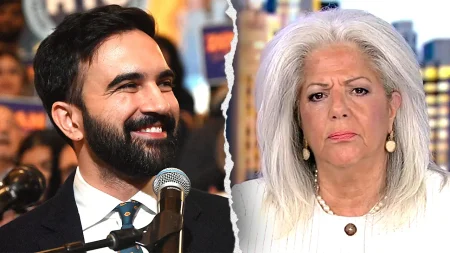




The morning of September 11th began the way it always does in Lower Manhattan: with silence, broken only by the reading of the names. Families gathered around the reflecting pools where the Twin Towers once stood, clutching photographs and flowers, waiting to hear the voices of their loved ones spoken aloud into the cool morning air. It is a ritual of collective grief, a day when the nation turns its eyes to Ground Zero and remembers the nearly three thousand lives cut short by terror. In that sacred space, every gesture carries weight, every expression can feel like a statement. So when a television feed cut from a young man sobbing at the memorial to New York City Mayor Zohran Mamdani and Representative Alexandria Ocasio-Cortez appearing to grin and laugh as they spoke, the contrast was jarring. Their conversation was inaudible, and the camera offered only a fleeting image, but the sight of two prominent politicians sharing what looked like a lighthearted moment during the reading of victims’ names was enough to ignite a storm of anger that would spread across social media within minutes.
The backlash was swift and unforgiving. Critics from across the political spectrum demanded an explanation, and many did not wait for one. Steve Guest, a former top staffer for Senator Ted Cruz, described the moment as “disgraceful,” writing, “AOC and Mamdani look happy.” Meghan McCain, daughter of the late Senator John McCain, was more direct, posting, “Why the f— are these two laughing?” The sentiment echoed through thousands of replies and reposts, with users expressing disbelief that anyone could find humor in such a place on such a morning. “They always show us who they really are,” one critic wrote. Others piled on with characteristic fury. Spencer Pratt, the former Los Angeles mayoral candidate, declared, “While normal Americans cry, commie Mamdani and AOC laugh it up at the 9/11 memorial in New York. They hate you. They hate your country. They enjoy your misery. We cannot allow these people to have power.” The outrage was not confined to anonymous voices. Councilwoman Inna Vernikov, a Republican from Brighton Beach, wrote, “After thousands of families of victims of terror beg Mamdani not to show up, he stands there and laughs while families weep. This is NYC’s Mayor.” Richard Sementa, a well-known radio producer, tweeted, “Un-freaking believable,” while Juanita Broaddrick, a figure known for her accusations against Bill Clinton, called the two politicians “two disgusting degenerates.” The tone was hot, personal, and unrelenting.
But as the clip continued to circulate, a different story began to emerge. Michael Ragusa, described as the head of security for former Mayor Rudolph Giuliani’s entourage, took to social media to push back against the viral interpretation. “The videos of [them] laughing are not true. I was standing next to them the whole time,” he tweeted. “The camera just caught her greeting him hello. Multiple other politicians were laughing and joking behind me. Republicans and Democrats.” His words offered a crucial reminder of how easily a split-second snippet can be stripped of context and weaponized. There is, after all, a difference between laughing at a private joke during a solemn ceremony and exchanging a polite greeting that happens to catch the camera at an unfortunate angle. Mamdani, for his part, was also seen at other moments standing somberly between New Jersey Governor Mikie Sherrill and New York First Gentleman William Hochul Jr., his face still, his hands clasped, his attention fixed on the proceedings. The television feed that captured the alleged laughter did not show those moments, nor did it explain what the mayor and congresswoman were actually discussing. It simply offered a pixelated glimpse of two human beings in the middle of a grief-laden event, and invited the world to fill in the blanks with assumptions.
Yet the underlying controversy cannot be dismissed entirely as a misunderstanding. Mamdani’s presence at the 9/11 Memorial was already a source of deep tension, long before the camera caught him smiling. A petition signed by more than 110,000 people had urged him to stay away, and victims’ families had made their feelings known in visceral, painful terms. The reasons for their anger were rooted in Mamdani’s political record, particularly his positions on Israel and his alliances with democratic socialists whose rhetoric many families experience as hostile to the memory of those killed by Islamist terror. Some called him a “vile antisemite,” a charge his defenders reject but which has nonetheless followed him through the mayoral campaign and into office. Retired Port Authority officers had gone so far as to tell Mamdani and Governor Kathy Hochul to stay away from Ground Zero on the anniversary, arguing that their politics disqualified them from participating in a ceremony meant to honor the dead. Representative Randy Fine, a Florida Republican, embraced the hostility in crude terms, referring to the mayor as “Jihad Mamdani” and insisting that he and Ocasio-Cortez should have no place near the memorial. “They do not mourn this country, they mock it,” Fine tweeted. “Have some damn respect.” For the families who lost parents, children, spouses, and friends, the idea that a man they view as a defender of those who wish harm on America would stand at the memorial at all was a wound in itself, and the appearance of laughter made that wound feel even deeper.
What this entire episode reveals, perhaps more than anything, is the impossible position of public figures in an age of viral media and raw, unprocessed grief. Ground Zero is not a normal place. It is a cemetery without headstones, a cathedral of absence, a scar in the middle of the city where thousands of people died in plain view of the world. For many, the appropriate expression is one of unbroken solemnity, a face carved from stone, silence without interruption. But human beings, even politicians, are not statues. They fidget, they whisper, they cast nervous glances, they sometimes smile out of discomfort or relief at seeing a familiar face in a crowd. None of that justifies disrespect, but it does complicate the certainty with which strangers on the internet declare what was in someone’s heart during a fraction of a second. The same television feed that captured Mamdani and Ocasio-Cortez allegedly laughing also captured families weeping, first responders standing with their hands over their hearts, and a nation holding its breath. To reduce the entire ceremony to one split-screen image is to do a disservice to the complexity of human emotion and the reality of a day that is simultaneously intensely public and deeply private. Still, the political figures involved ought to recognize that every moment they spend at such events is subject to scrutiny, and that their presence carries symbolic weight beyond their intentions. A mayor and a congresswoman who know they are being filmed, who know why their presence was controversial, could have been more careful. They could have saved the greetings, the smiles, the easy rapport for a less hallowed place. The fact that they did not speaks to a kind of political instinct that is either extraordinarily naive or troublingly dismissive.
In the end, the story of the 9/11 Memorial and the politician caught smiling is not really about two individuals. It is about the way grief and politics have become entangled in modern America, and how a single image can reshape a narrative in an instant. For the families of the victims, the annual reading of the names is not a performance; it is a lifeline, a way of insisting that the people they lost are still remembered, still cherished, still present in the rhythm of the city that could not save them. When politicians stand at the edge of the reflecting pools, they are guests in a sanctuary, not stars on a stage. They are there to honor, not to network, to mourn, not to mingle. The best response to the controversy might be neither outrage nor excuse, but a sober acknowledgment that everyone involved could have done better. Mamdani could have apologized for the appearance of impropriety, even if he believed nothing was wrong. His critics could have paused before assuming the worst of two human beings caught in an awkward frame. The country could have used the moment not as an occasion for partisan warfare, but as a reminder that, twenty years on, the wounds of September 11th still have the power to bring us together and, too often, to tear us apart. What remains, beneath all the noise, is the memory of the dead and the love of the living, and perhaps that is the only truth that ultimately matters. The young man sobbing in the shadow of the fountain did not need a camera, and he did not need a hashtag. He needed only to be allowed to grieve, and to know that his grief was witnessed, not exploited. That is the standard every public figure should be held to, not just on September 11th, but every time they step into a place where the dead still speak.