





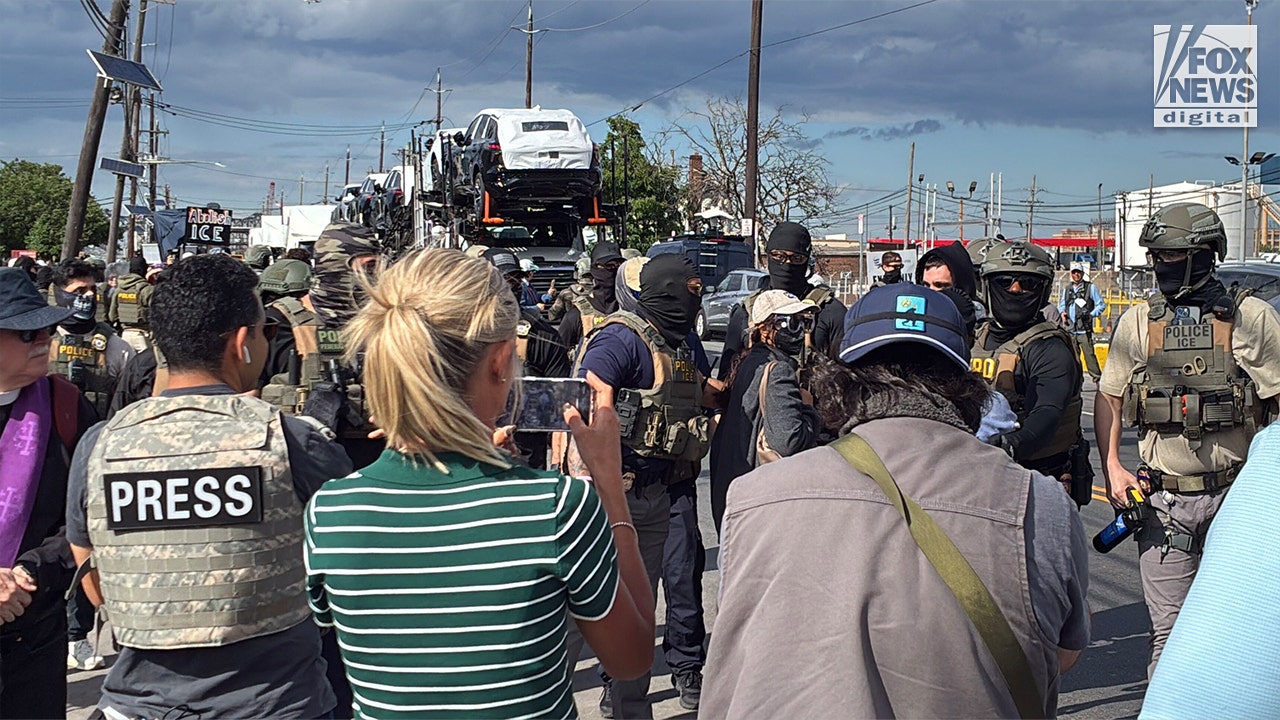
The air outside Delaney Hall in Newark, New Jersey, hung heavy with a volatile, suffocating mixture of diesel exhaust fumes, autumn chill, and raw human desperation as night fell on Thursday. What began as a solemn vigil of conscience rapidly mutated into a chaotic, screaming battleground of competing ideologies and violent physical collisions, drawing a desperate crowd of over a hundred demonstrators who stood shoulder-to-shoulder under the dim, unforgiving glare of perimeter floodlights. To walk through the gathered crowd was to feel a palpable, vibrating anxiety; these were mothers fearing for the safety of their children, lifelong neighbors demanding basic human dignity, and passionate young activists fueled by a righteous, boiling anger against the relentless machinery of federal deportation. On the other side of the high, chain-link fences stood the federal agents—weary, heavily guarded, and tasked with enforcing a law that has deeply polarized the nation’s conscience. The fragile atmosphere shattered completely whenever the headlights of unmarked federal vehicles cut through the darkness, prompting protesters to rush forward in a desperate, frantic human barricade to block their path. In these fleeting, terrifying moments, the abstract academic debate over national immigration policy dissolved into bruised flesh and shattered ribs. Brave men and women repeatedly threw their bodies in front of moving steel, resulting in violent, localized scuffles where bodies were thrown to the cold pavement and shirts were torn in the struggle. One man, dragged to the asphalt only feet from onlookers, became a flashpoint of collective grief and anger, his face pressed against the earth as federal zip-ties bound his wrists. For those watching, the scene was not merely a political dispute but a visceral display of human suffering, where the distance between physical safety and state custody was measured in mere inches and a few seconds of defiance. This confrontation represented the culmination of days of escalating anger, transforming the industrial block into a temporary theater of war where the currency was human pain and political defiance.
This localized explosion of rage did not happen in a vacuum, but rather erupted from weeks of simmering political standoffs and unresolved questions about the treatment of the estimated nine hundred human beings detained within the private walls of Delaney Hall. The moral friction reached a boiling point when prominent New Jersey Democrats, including newly inaugurated Governor Mikie Sherrill and U.S. Senator Andy Kim, sought to pull back the veil of secrecy shrouding the facility. Stirred by heartbreaking reports that several desperate detainees had embarked on a hunger strike—using their own physical bodies as the absolute final, silent weapon of protest—the lawmakers marched directly to the front gates demanding basic humanitarian access, only to be flatly turned away by facility administrators. This blunt denial of oversight deeply inflamed an already tense situation, transforming the cracked pavement outside the facility into a symbolic front line for civil liberties. For Senator Kim, the stakes became intensely personal and physical when he was caught in the chaotic crossfire of a previous demonstration, allegedly struck by the burning haze of pepper-ball spray deployed by security forces to disperse the crowd. The image of a sitting United States Senator struggling to breathe alongside grassroots activists underscored a profound breakdown in civic communication. In the halls of power, representatives like Sherrill are now passionately calling for the absolute, permanent closure of Delaney Hall, arguing that the denial of transparency and the reported conditions inside represent a severe violation of basic human rights that the state cannot, in good conscience, continue to host. They demand that the federal government answer for the physical and psychological well-being of the hundreds of souls locked behind those sterile walls. These political figures argue that a democratic society cannot allow private, for-profit facilities to operate in complete isolation from public scrutiny, especially when human liberty is at stake. The refusal to grant entry to elected officials has only deepened the public’s suspicion that something profoundly unjust is occurring behind closed doors, fueling the fire of resistance that now consumes the streets of Newark.
Down on the cracked, rain-slicked asphalt of Newark’s streets, the total absence of local municipal authority created a strange, lawless vacuum where everyday citizens and federal agents were left to negotiate their own volatile boundaries. Newark Mayor Ras J. Baraka had previously made it clear that city police would not act as an extension of federal immigration enforcement, a sanctuary-aligned policy that resulted in a break in cooperation and a legacy of tension. This policy manifested as a noticeably sparse local police presence during some of the week’s most intense clashes, leaving federal agents and civilian protesters to clash without an impartial mediator. Without traditional traffic control, barricades, or municipal crowd mitigation, the street became a theater of raw, unedited human behavior, stripped of civilized pretense and exposed to the elements. An elderly protester, his face deeply lined with the worries of a lifetime of social advocacy, stood precariously in the active roadway holding a makeshift sign scrawled on the torn cardboard of a discarded Costco box, desperately pleading with passing motorists to slow down and witness the unfolding drama rather than speeding past. Nearby, the toxic atmosphere infected even the youngest onlookers; a father and his young son sat parked in a car across the street, their windows rolled down as they shouted furious, profanity-laced obscenities into the night, their voices joining a cacophonous chorus of frustration that echoed off the brick walls of nearby warehouses. When an unmarked federal truck became physically wedged within the dense thicket of bodies, the panic was immediate and infectious. A female demonstrator screamed in terror, accusing the driver of intentionally attempting to run over women protesters, while another man was violently shoved against the side of the vehicle during the ensuing melee. These moments of uncurbed friction revealed how deeply the trauma of the immigration crisis has fractured the local community, transforming ordinary suburban streets into zones of profound psychological and physical warfare where neighbors are pitted against the state.
Yet, to understand the full weight of the tragedy playing out in Newark, one must also look through the windbreaks of the federal officers who found themselves on the receiving end of this systemic fury. From the perspective of the Department of Homeland Security and the individual ICE agents stationed at Delaney Hall, the situation was not one of systemic cruelty, but of a dangerous breakdown of public order and a direct physical threat to officers who were simply performing their legally mandated duties. Federal authorities painted a much darker, more menacing picture of the demonstrations, describing scenes where activists abandoned peaceful assembly to launch heavy wooden pallets and discarded mattresses directly at security personnel. Agents faced an operational nightmare as human chains blocked the ingress and egress of official vehicles, hindering the vital transport of personnel, medical supplies, and resources necessary to maintain the basic functions of the facility. The Department of Homeland Security released firm, uncompromising statements declaring that law and order would be restored at all costs and that “violent rioters” would not be permitted to compromise federal operations or intimidate law enforcement. They vehemently denied the existence of any hunger strike inside the facility, dismissing it as a manufactured narrative designed to inflame public sentiment and manipulate the media. For the agents on the line, who must return home to their own families at the end of their shifts, the protests represent a highly volatile environment where split-second decisions carry life-altering consequences, and where the line between maintaining order and escalating violence is razor-thin. They argue that behind the political theater lies a critical mission of public safety that cannot be abandoned to a mob, pointing out that the arrested individuals face serious allegations of physical assault against law enforcement officers who are merely doing their jobs. These officers feel caught in the gears of a massive political machine, taking physical blows for policies they did not write but are legally bound to execute. The tension they feel is not just professional, but deeply personal, as they are continuously vilified by the public while trying to maintain the security of a facility housing hundreds of detainees who require order and safety within the walls.
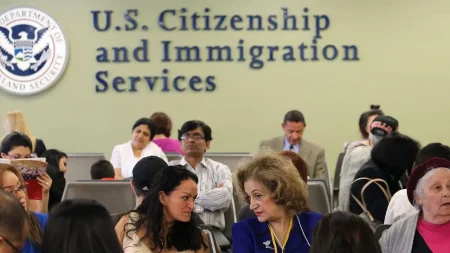
The shockwaves from the Delaney Hall clashes are traveling far beyond the municipal borders of Newark, echoing across the northeastern United States as a symptom of a much broader, systemic anxiety regarding the federal government’s immigration strategy. In Massachusetts, Governor Maura Healey recognized the escalating fear paralyzing immigrant communities and preemptively issued comprehensive, statewide guidance for public institutions. Her administration’s directive advised schools, child care providers, colleges, healthcare facilities, and places of worship on how to navigate unexpected interactions with federal immigration agents, aiming to preserve these spaces as safe havens of essential service and community trust. This administrative maneuver highlights the profound human cost of the immigration debate: the quiet terror that keeps parents from sending their children to school, the sick from seeking medical care, and the faithful from attending prayer services out of fear of detention and separation. Families across the region are living in a permanent state of hyper-vigilance, their daily routines dictated by the rumor of ICE checkpoints and the terrifying specter of the sudden deletion of a loved one from their lives. The Newark protests are not an isolated incident but rather the visible, boiling crest of a massive undercurrent of fear that has civilian institutions scrambling to build legal and physical firewalls to protect their most vulnerable residents. By humanizing these protocols, Healey’s administration attempted to restore a sense of agency to communities that feel entirely powerless in the face of federal enforcement, illustrating that the conflict is not merely about physical borders, but about the boundaries of human compassion and daily survival in a fractured society. The psychological toll on these communities is immeasurable, as children study under the shadow of potential raids, and the sick suffer in silence rather than risk stepping into the light of public services. This statewide approach serves as a stark acknowledgment that the trauma of immigration enforcement is not confined to detention centers, but ripples outward, destabilizing the entire social fabric of neighborhoods and placing a heavy burden on educators, doctors, and religious leaders who find themselves thrust onto the front lines of a humanitarian crisis.
As the deep blue hues of dawn finally begin to replace the harsh artificial lighting over Delaney Hall, a fragile, exhausted quiet settles over the cracked asphalt, leaving behind only the litter of discarded protest signs, plastic zip-tie fragments, and the heavy, invisible residue of pepper spray hanging in the damp morning air. Inside the facility, nine hundred human beings remain in a state of agonizing administrative limbo, their immediate futures decided by a complex, glacial legal apparatus, while outside, the fundamental questions of human dignity, national sovereignty, and community safety remain entirely unresolved. The escalating violence observed this week serves as a sobering, painful reminder of the stark limits of a system that relies primarily on physical containment, locked gates, and federal force to solve deep-seated humanitarian crises. True resolution and societal healing cannot be found in the throwing of heavy wooden pallets, the blocking of vehicles, or the deploying of painful chemical irritants, nor can it ever be achieved by locking out the very elected leaders who represent the public’s search for transparency and accountability. What is ultimately required to break this cycle of confrontation is a return to a shared human empathy that tenderly recognizes the fear of the immigrant family, the professional duty and physical danger faced by the enforcement officer, the moral frustration of the community advocate, and the heavy constitutional responsibility of the lawmaker. Until a concrete path toward comprehensive, compassionate, and transparent reform is forged, the streets outside detention facilities like Delaney Hall will continue to be haunted by the cries of the dispossessed and the angry shouts of the citizenry. These streets will remain a stark, unsettling monument to a nation locked in a painful, unresolved struggle with its own soul, wondering if it can ever balance the rigorous letters of the law with the fundamental dictates of the human heart.