



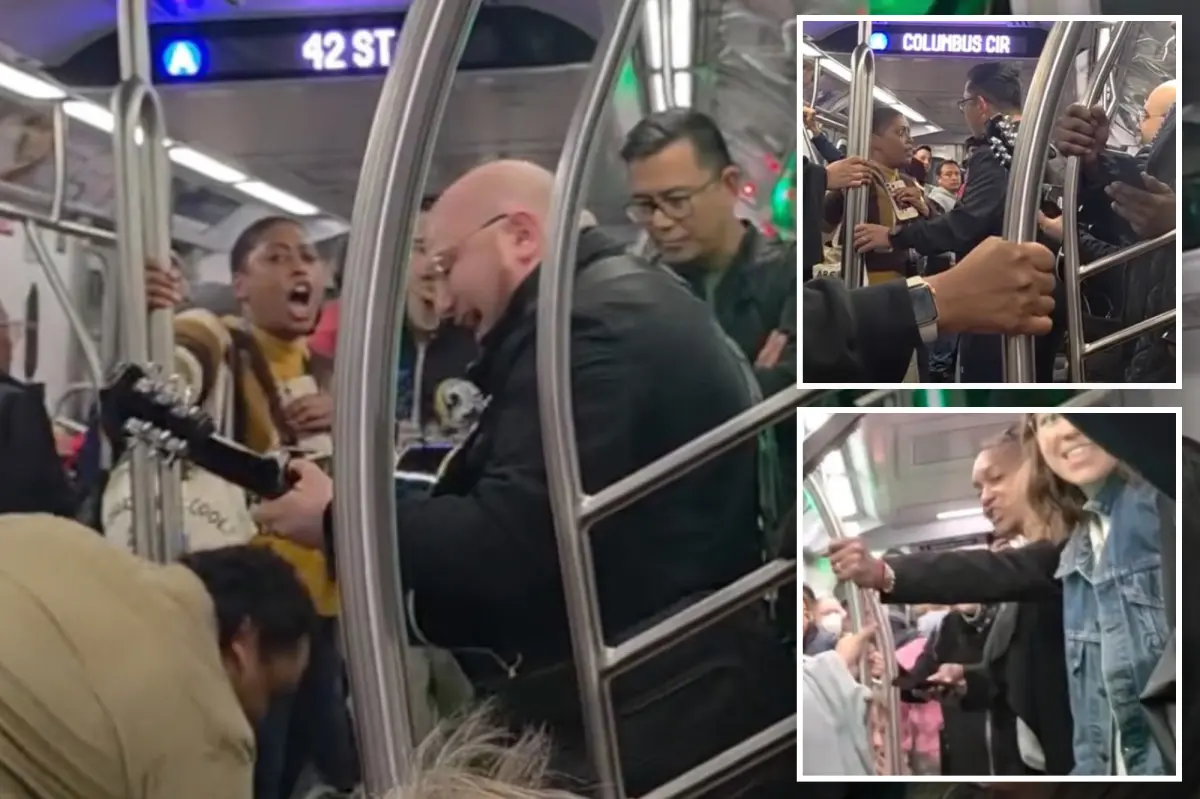
New York City’s subway system has always been more than a way to get from one place to another. It is a rolling theater of human life, where musicians set up amplifiers on crowded platforms, dancers turn empty cars into stages, and strangers are forced to share intimate space with one another’s joys, sorrows, and occasional outbursts. On a Wednesday afternoon, that theater delivered one of its strangest performances yet. Shane Dan Turner, a 29-year-old singer who competed on Season 23 of American Idol last year, was busking on an A train as it traveled the express route from 125th Street to Columbus Circle. He was doing what countless subway performers do: playing guitar, singing his heart out, and hoping the people around him might toss a few dollars into his tip case. But the performance took an unexpected turn when a woman on the car decided that his music was causing her physical pain. She claimed she had recently had surgery on her ear and that her ears were too sensitive for the sound. Instead of simply moving to another car, she confronted Turner, grabbed his tip money, and began screaming loudly over his playing in an attempt to drown him out. The whole scene was caught on video, and it did not take long for the footage to spread across the internet, offering a glimpse of a confrontation that felt both uniquely New York and painfully universal. For Turner, this was not just another gig. He is a working artist trying to build a career after his national television exposure, and subway busking is part of how he connects with audiences and makes a living. The woman who attacked him did not know that, or perhaps she did not care. All she knew was that she wanted the music to stop, and she was willing to make a scene to get what she wanted. As the train rattled through the tunnel, the situation could have escalated into something much worse. But what followed was a strange, messy, and ultimately hopeful example of how ordinary people respond when someone is being wronged in front of them.
The video opens in the middle of the chaos. The woman is already locked in a tussle with Turner, her hands near his tip money, her voice rising above the rumble of the train as she pleads with the other riders to “make him stop” playing. She is clearly upset, and she tells anyone who will listen that she just “had surgery on my f–king ear,” as though that gives her the right to take over the space and silence the performer. Another woman in the car, however, is not impressed. She starts shouting at the antagonizer, telling her to “get your ass off the train” and suggesting that if she is really recovering from a medical procedure, she should call Access-a-Ride instead of riding the subway. The two women exchange a stream of vulgar insults, their voices bouncing off the metal walls of the car as other passengers look on in disbelief. At this point, many people might have packed up their guitar and retreated to the next car. But Turner, to his credit, did the opposite. He calmly changed a broken guitar string, checked his tuning, and began playing “I Don’t Love You” by My Chemical Romance. Later, he explained that he chose the song specifically because he hoped it would aggravate the woman enough that she would leave the car. It was a small act of rebellion, a way of saying that he would not be bullied out of a public space. He had every right to be there, and he was not going to let one hostile passenger take that away from him. The choice of song was pointed in more ways than one. “I Don’t Love You” is a brooding, emotional anthem, the kind of song that demands a certain amount of space and attention. By playing it, Turner was reclaiming the space that the woman had tried to claim for herself. He was also refusing to let her dictate the terms of the encounter. She wanted silence; he gave her music. She wanted control; he kept his cool. The other passengers, who had initially seemed frozen by the awkwardness of the situation, began to watch with a different kind of interest. What had started as a confrontation was slowly becoming a performance, and Turner was determined to be the one who finished it.
The woman, however, was not so easily deterred. Instead of leaving the car or backing down, she began singing along at full volume, her voice drowning out Turner’s music in a strange and unsteady wail. She was not trying to harmonize or help; she was trying to compete, to make enough noise that no one could enjoy the performance. Turner later described the moment with a mix of wonder and humor, saying that the woman had “lungs that I couldn’t compete with without a microphone.” The absurdity of the scene was not lost on the other riders. People who had been staring at their phones, trying to ignore the conflict, started to look up. They began to smile and exchange glances, as if they could not quite believe what they were hearing. Here was a woman claiming to have a sensitive ear after surgery, and yet she was screaming at the top of her lungs, apparently with no concern for her own hearing or anyone else’s. The more she sang, the more ridiculous she looked, and the more the crowd seemed to side with Turner. He kept playing, his fingers moving across the strings with practiced ease, his voice steady even as the woman tried to overpower him. It was a strange kind of duet, but it had a clear winner. The audience was no longer neutral. They were rooting for the musician, the underdog, the man who had been attacked for no good reason and who had chosen to respond with music instead of anger. This was also a reminder of how much buskers have to endure. Subway performers are often treated as background noise, ignored or dismissed, but they are real artists with real dreams and real bills to pay. They deal with everything from indifferent crowds to hostile passengers, and they have to develop a thick skin just to keep doing what they love. Turner’s decision to keep playing was not just about winning a battle on a train. It was about protecting his identity as a musician and refusing to let someone else’s bad day become his breaking point. The fact that he did it with such composure made the moment feel almost heroic, a small victory for anyone who has ever felt silenced or dismissed.
But the roots of the conflict ran deeper than a disagreement over noise. As Turner later explained when he reshared the video on his Instagram page, the woman had actually started the encounter by trying to sing over him before she noticed a pin he was wearing. The pin read, “I’m autistic, awkwardness may occur,” a simple and honest disclosure that Turner uses to help people understand why he might behave differently than they expect. For many autistic people, such a pin can be a useful way to preempt misunderstandings. But the woman saw it as something else entirely. She accused him of wearing the pin for marketing, saying that he was “applauding an autistic guy” who was probably just trying to exploit his diagnosis to get more tips. When Turner told her that he was, in fact, actually autistic, she responded with a cruel and baffling insult: “that’s disgusting and narcissistic.” Then she reached for his tip money again. The moment was a sharp reminder of the ableism that autistic people face every day, even in supposedly progressive cities. There is a tendency to treat autism as either a tragedy or a gimmick, and people who do not fit a narrow image of what autism looks like are often accused of faking. Turner had worked hard to build a career, appearing on American Idol and sharing his music with the world. He had learned to navigate a world that is not always kind to people who are different. And yet, in that moment, a stranger decided that she knew more about his identity than he did, and she tried to punish him for it. For Turner, this was not just an attack on his performance; it was an attack on who he is. He has been open about his autism and his mental health struggles, and he has used his platform to advocate for people who feel marginalized. To have someone dismiss his disability as a marketing stunt was painful, especially in front of a car full of strangers. But instead of letting that pain turn into rage, he channeled it into his music. He kept playing, kept singing, and kept his dignity intact. In doing so, he taught everyone on that train a small lesson about grace. He did not need to prove anything to the woman who had insulted him. He just needed to keep being himself, and that was enough.
By the end of the clip, the tide had turned completely in Turner’s favor. The crowded car erupted in applause, and riders who had been silent during the confrontation began to voice their support. They also made a point of handing their tips directly to Turner, placing money in his hand instead of his tip case, because they had watched the woman try to grab the cash for herself. It was a small but meaningful gesture of solidarity, a way of telling him that they saw what was happening and they wanted to be on the right side of it. Turner was visibly moved by the response, and he later shared the moment with his followers, emphasizing how much the support meant to him. He also took the high road when talking about the woman who had attacked him. He acknowledged that he lives with a litany of mental health problems himself, and he refused to demonize her. “I got nothing on this person,” he said. “I just wish she gets the help she needs; she was probably just having a very bad day.” It was a remarkably compassionate response, especially given that she had tried to steal from him and sabotage his performance. But it also revealed something important about Turner’s character. He understood that the woman’s behavior was not really about him. It was about her own struggles, her own pain, her own inability to cope. That does not excuse what she did, but it does explain why he was able to let it go and move on. There is something almost saintly about that kind of forgiveness, but it is also deeply practical. Holding onto anger would only give the woman more power over him. By wishing her well, Turner freed himself from the weight of the encounter. He could have used the video to mock her or to stir up outrage, but he chose a different path. He chose empathy. That is not always easy, especially in a city where people are quick to shout past each other and slower to listen. But it is exactly what made this story resonate with so many people. In a world full of conflict, seeing someone respond to cruelty with kindness is genuinely refreshing. It reminds us that we all have bad days, and that the person causing chaos in front of us might be dealing with something we know nothing about.
In the end, this was a story about a man who refused to be silenced, a woman who was probably not okay, and a subway car full of strangers who unexpectedly became a community. It is easy to dismiss New Yorkers as cold or indifferent, but anyone who has spent time on the A train knows that there is an unwritten code. You mind your business, but you also know when someone is being wronged. The passengers on that car recognized that Turner was being bullied, and they responded the only way they could in the moment: by giving him their attention, their applause, and their money. The video has since made its way across the internet, and Turner has used it as a platform to talk about autism, mental health, and the challenges of being a working performer in a city that never sleeps. He did not get the peaceful afternoon of busking he probably expected, but he did get something better. He got proof that he can hold his own, that his music matters, and that even in the loudest, strangest, most uncomfortable moments, there is always room for compassion. The woman with the sensitive ear may have tried to derail his performance, but in the end, she only helped him find an audience that was more on his side than ever. There is a certain justice in that, a kind of poetic irony that could only happen in a place like New York, where every ride on the subway is a gamble and every performance is a chance to prove yourself. The story also leaves us with a question: What would we have done if we were on that train? Would we have looked away, or would we have stood up for a stranger? Turner’s experience is a reminder that small acts of kindness can make a huge difference. A few dollars, a round of applause, a kind word, all of these things have the power to turn a terrible moment into a triumphant one. And for Turner, the support of those passengers was worth more than any viral moment. It was a reminder that he is not alone, that people see him, and that his voice matters. That is a gift no one can take away, no matter how loud they scream.