

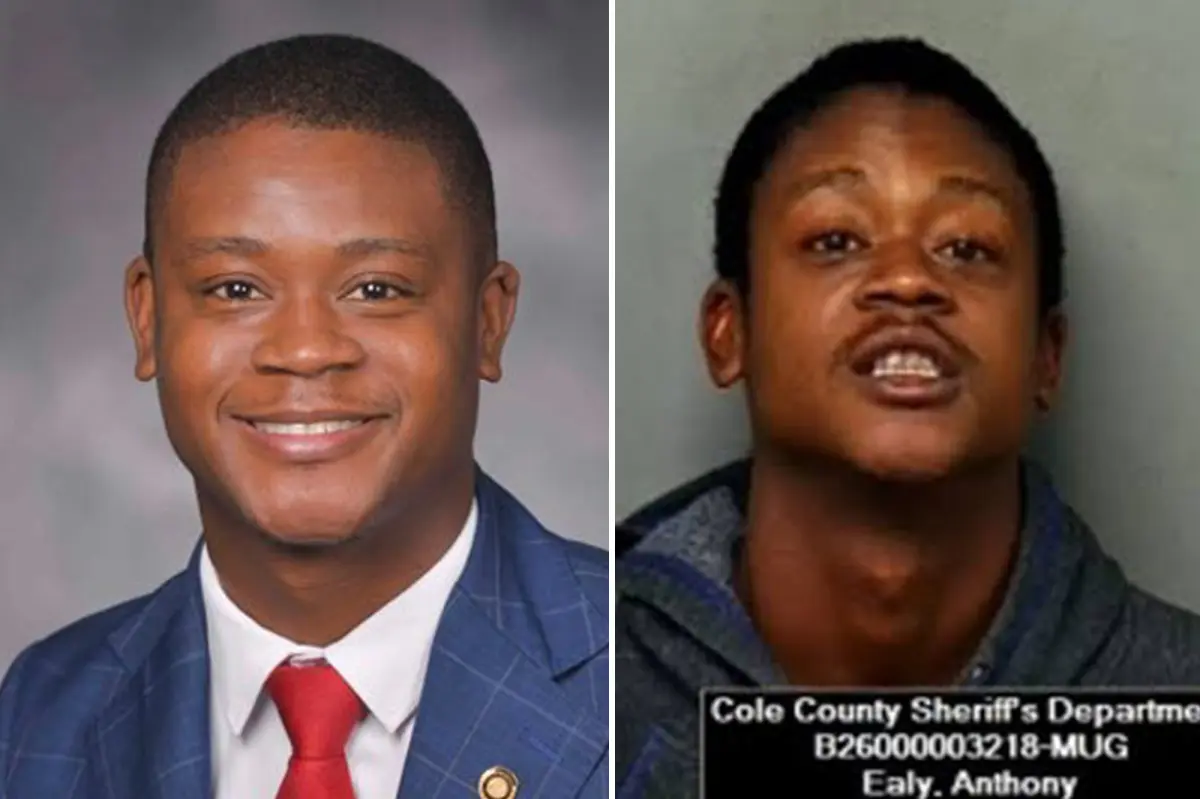
There are moments when a person’s private unraveling spills into public in the most unexpected place. For Missouri State Representative Anthony Ealy Jr., that moment came on a Wednesday morning in Jefferson City, outside a business where a family had gathered to make funeral arrangements. The 32-year-old Democrat from Grandview had won reelection just one day earlier, a decisive victory that should have felt like validation. Instead, he was at the center of a volatile scene that turned a day of mourning into a public spectacle. According to a probable cause statement cited by Fox 4, someone who was not involved in whatever had agitated Ealy decided to approach him and try to de-escalate the situation. What happened next was sudden and alarming: Ealy allegedly said he had a gun, lunged at that person, and threatened to kill him. “Call the police, I’m going to kill you,” he reportedly said. A witness described the episode as “definitely a scene” and “pretty chaotic,” and other witnesses corroborated the peacemaker’s account, giving police enough to act on quickly. Within about twenty minutes, officers were at Ealy’s home, placing him under arrest. The scene was a long way from the voting booths, celebrations, and handshakes that had marked his victory the day before. There was no political stage here—only a sidewalk, a grieving family, and a lawmaker whose behavior appeared to have spiraled into something law enforcement took seriously. The juxtaposition was painful: a man who had just been handed a mandate by voters was now handcuffed, his election-night glow replaced by the cold reality of a probable cause statement and a mugshot. Whatever was happening inside him that morning, it had little to do with politics and everything to do with human fragility.
When police read Ealy his Miranda rights at his home, he did not admit to the threats or even acknowledge mentioning a firearm. He denied the allegations entirely, a response that may reflect fear, confusion, shame, or simply a different understanding of what had happened. But witnesses had already told police a consistent story, and the probable cause statement painted a picture of a man who was yelling outside a business where a family was arranging a funeral—an already emotionally charged setting made worse by a stranger’s attempt to calm him down. Instead of cooling off, Ealy reportedly became more aggressive, using words that no public official should ever say no matter how difficult their day is. The following day, he was charged with misdemeanor assault and disturbing the peace, booked into the Cole County Jail, and released by Friday. The speed of the arrest and filing of charges suggested that investigators believed there was enough evidence to move forward, even if the charges were not felonies. For a sitting state representative, even a misdemeanor charge can have lasting consequences, especially when it involves allegations of threats and guns. The incident did not happen in a private home or behind closed doors; it happened in broad daylight, in front of witnesses, in the middle of a family’s grief. That made it both more serious and more difficult for Ealy to brush aside. And yet, he seemed determined to tell a very different story, one in which he was not the aggressor but the victim, not the source of chaos but the target of it. The gap between the witness accounts and Ealy’s own version of events is not just a legal problem—it is a human one, the kind of distance that forms when someone cannot bear to look at what they have done or when they genuinely believe that the world is conspiring against them.
In a bizarre statement to the New York Post, Ealy professed his innocence and offered a version of events that raised more questions than it answered. He claimed that while he was smoking a cigarette, he was “pushed and chased with a bat” by someone, though he did not provide details about who that person was or how that led to the charges against him. He then veered into a larger, almost mystical explanation: “I believe this has something to do with my Christian Faith, that I’m black and reelected. Something a prophecy.” He added, “I do not know anything else, I want peace and for this to be wrapped up but thats all I have to say. Something else bigger is going on.” The final line may be the most telling: “My record speaks for itself. True prophets live through this mess.” It is a statement that sounds less like a legal defense and more like the words of someone trying to make sense of a world that suddenly feels hostile and incomprehensible. Whether he is experiencing genuine persecution, mental strain, or the paranoid edges of a political identity under threat, his language reveals a deep sense of isolation. He does not seem to see himself as someone who caused a scene outside a funeral home; he sees himself as a prophetic figure being tested by forces greater than any single incident. That kind of narrative can be a way to survive shame, a way to transform an embarrassing moment into a spiritual trial. But it also risks separating him from the people who need him to take responsibility, including his constituents and the family who simply wanted to grieve without hearing a lawmaker threaten to kill a peacemaker.
Ealy’s political career had already been complex before this incident. He was first elected to the Missouri House of Representatives in 2022, becoming the first Black state representative for Grandview and, at the time, the youngest in the district. That was a meaningful achievement, the kind of milestone that carries hope for a community and pressure for the person holding it. He won reelection twice, including a commanding 68 percent of the vote on Tuesday, which suggested that his constituents believed in him despite whatever concerns had been floating around the statehouse. But behind the scenes, there were signs that all was not well. He had been removed from all committee assignments the previous spring so that he could focus on personal matters, according to the chief of staff for House Democratic minority leader Ashley Aune. That kind of removal is rare and significant; committee assignments are how legislators get work done, build relationships, and prepare for future leadership. Being stripped of them is a signal that party leaders are worried, not just about a member’s effectiveness, but about their stability and judgment. And the concern did not end there. House Democratic leadership reportedly asked Ealy to consider allowing someone else to run for his seat before he announced his reelection bid. That is an extraordinary request for an elected official, especially one who had already made history. It suggests that his party saw him as a liability even before the arrest, someone whose personal struggles might be hurting the district and the caucus. Yet Ealy ran anyway, and voters sent him back. Now his colleagues are facing the awkward and painful task of deciding what to do with a member who has been charged with a crime but who also still has a democratic mandate.
The institutional reaction to the arrest has been quiet but firm. There are currently no plans to reinstate Ealy’s committee assignments for the 2027 legislative session, which means he will likely enter the new term as a legislator without a formal role in the work that defines legislative life. He will still be a representative, able to vote and speak on the floor, but he will be sidelined from the committees where bills are shaped, budgets are negotiated, and alliances are formed. For a young lawmaker with a promising career, that is a harsh sentence. It also sends a message to the public that his own party is not willing to defend him or pretend that nothing happened. The request that he step aside before the election was already a sign of lost trust; the removal from committees was another. Together, they paint a portrait of a politician who has become isolated from his colleagues at a time when he needs support and accountability in equal measure. It is possible to feel compassion for Ealy—a person of faith, a Black man in a mostly white political system, a young father figure in his community—while also recognizing that his alleged behavior was unacceptable. Threatening to kill someone is not a normal response to being challenged, even if he felt provoked or threatened in some way. The fact that the incident occurred outside a funeral home makes it especially hard for supporters to spin it into something minor. The family inside was already dealing with death and grief; they should not have had to witness a public breakdown by an elected official. And yet, in a strange way, the setting may also remind us how close all human beings are to crisis, how quickly grief and pressure and stress can combine into something explosive.
As the news cycle moves on, the larger questions remain unanswered. What exactly pushed Ealy to that point? Was there a history of mental health struggles, personal turmoil, or untreated trauma? Did his faith give him comfort or fuel a sense that he was being persecuted? Why did he feel the need to mention his race and his reelection in the same breath as a threat accusation? These are not just legal questions; they are human ones. Ealy’s statement about “true prophets” living “through this mess” suggests a man who sees himself as a martyr, but even martyrs must answer for their actions. The Jefferson City Police Department did not immediately offer additional comment when reached by the Post, and the investigation may still evolve. For now, Ealy is free, but his reputation is fractured, his committee assignments are gone, and his colleagues are no longer quietly hoping he will do the right thing—they are preparing to move forward without him. This is a story about a promising political career derailed, but it is also a story about how fragile every human being is, regardless of title or election results. The voters in Grandview believed in Ealy enough to give him 68 percent of the vote, but no electoral victory can protect a person from themselves or from the consequences of their own actions. If there is any hope in this story, it is that Ealy may now have time to step back, away from the spotlight, and confront whatever has been haunting him. The path forward will not be easy, and it will require more than a prophetic defense. It will require humility, honesty, and a genuine effort to make amends—to the person he threatened, to the grieving family who witnessed it, to his constituents, and to himself. Until then, a newly elected legislator who once represented hope for his district is left staring at an uncertain future, with little more than a statement and a silence to explain the chaos of a Wednesday morning.