





First-time visitors often flock to the rolling hills and quiet riverbanks of southeast Missouri to escape the grind of daily life, but last Friday, nature transformed this peaceful sanctuary into a chaotic zone of survival. An unprecedented barrage of overnight thunderstorms dumped between 6 and 12 inches of rain across the region, triggering what meteorologists have classified as a historic, once-in-a-thousand-year deluge. As the Black River and its neighboring streams quickly broke their banks, quiet campgrounds and rural communities were swallowed by fast-rising, muddy torrents. The scale of the sudden disaster prompted Missouri Governor Mike Kehoe to swiftly declare a state of emergency, setting in motion one of the most extensive and urgent search-and-rescue mobilizations in the state’s modern history.
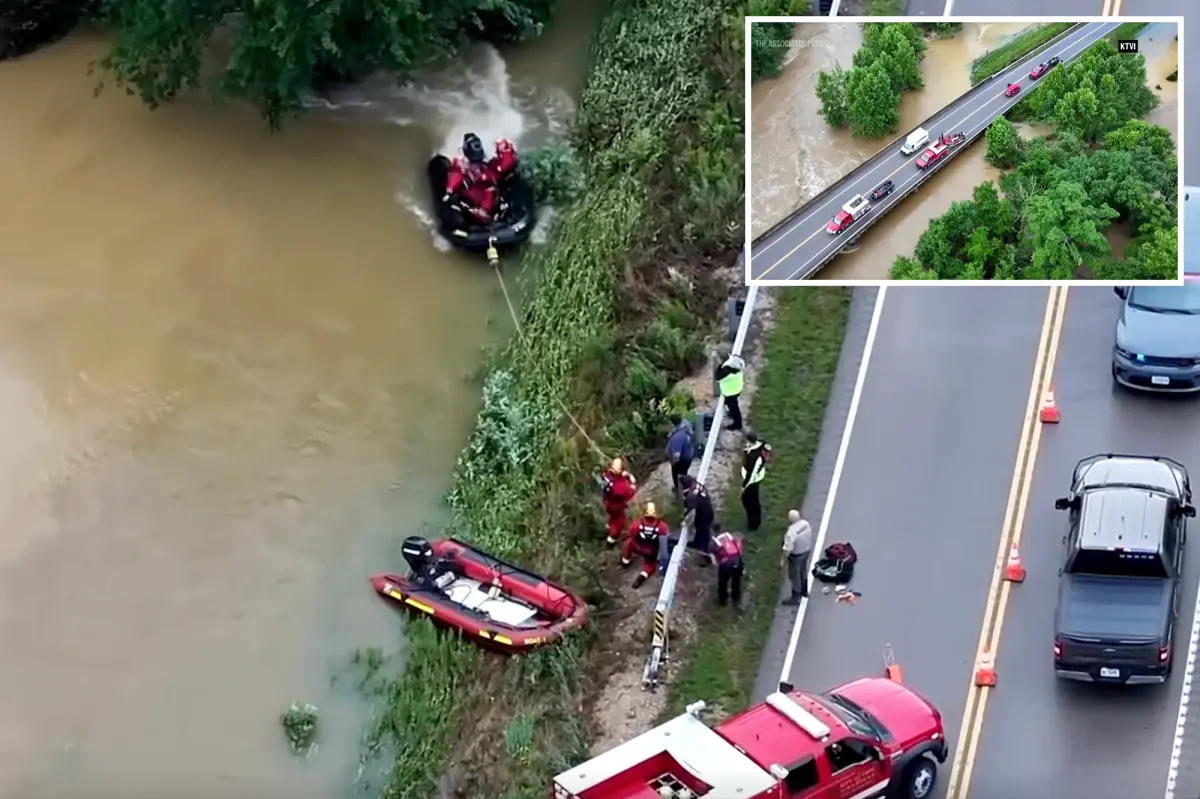
For hundreds of vacationers and local residents, Friday morning began not with the gentle sounds of the forest, but with the terrifying realization that they were completely trapped by a rising tide. With roads instantly washed out and pathways blocked, survival became a matter of minutes and inches. Frightened families and solo travelers found themselves stranded on car roofs, clinging desperately to the upper branches of trees, or huddled on the shaking rooftops of cabins as the water rushed beneath them. First responders from local, state, and federal agencies rushed into the disaster zone, braving treacherous currents to reach victims who had no other way out. In total, emergency teams executed more than 200 high-stakes water rescues, turning what could have been an unspeakable tragedy into a masterclass in bravery and quick coordination.
Nowhere was the tension felt more acutely than at Camp Taum Sauk, a beloved summer youth camp tucked away in the heavily impacted wilderness of Reynolds County, about 100 miles south of St. Louis. Approximately 200 campers and staff members found themselves completely cut off from safety as the waters rose around their cabins. Recognizing the extreme danger to the young campers, emergency officials called in the National Guard, who deployed helicopters to airlift the stranded children and their counselors to safety in a dramatic, hours-long rescue operation. Meanwhile, further downstream at the Bearcat Gateway Campground, another crisis unfolded when a building collapsed under the weight of desperate campers who had climbed onto its roof to escape the rising river, sweeping roughly 20 people into the current.
Miraculously, despite how quickly the situation deteriorated and the sheer volume of people caught in the water, the initial frantic search for the missing yielded incredibly fortunate results. By Friday evening, local authorities confirmed that all of the 20 to 30 people initially reported missing throughout Reynolds County—including those swept away during the campground building collapse and three individuals pulled from trees along the Black River—had been accounted for and brought to safety. As of Friday night, no fatalities or serious injuries had been reported in the hardest-hit zones, a outcome that officials attribute entirely to the relentless work of the rescue teams who risked their own lives to pull strangers from the mud and debris.
Despite the widespread successes of the emergency crews, the danger is far from over, and a somber cloud of worry still hangs over the state. In Crawford County, located about 71 miles southwest of St. Louis, a community remains on edge as search teams continue to look for a local woman who went missing after her entire home was violently ripped from its foundation and carried away by the floodwaters. Acknowledging both the triumph of the rescues and the ongoing danger, Governor Kehoe urged citizens to remain vigilant, praising the extraordinary bravery and compassion of the first responders while reminding residents that recovery is a long road and the ground remains incredibly unstable.
The threat of this massive weather system continues to stretch far beyond Missouri’s borders, reminding millions of the unpredictable power of nature. The National Weather Service has issued flood watches affecting over 21 million people across an eight-state corridor stretching from Missouri through Illinois, Indiana, Kentucky, Tennessee, West Virginia, Ohio, and Pennsylvania. With the ground already saturated to its absolute limit, meteorologists warned that even a minor additional shower could trigger immediate and severe flash flooding. As communities begin the long, exhausting process of cleaning up, drying out, and assessing the damage, residents across the heartland are keeping a watchful eye on the sky, hoping for a break in the weather and holding their loved ones a little closer.