



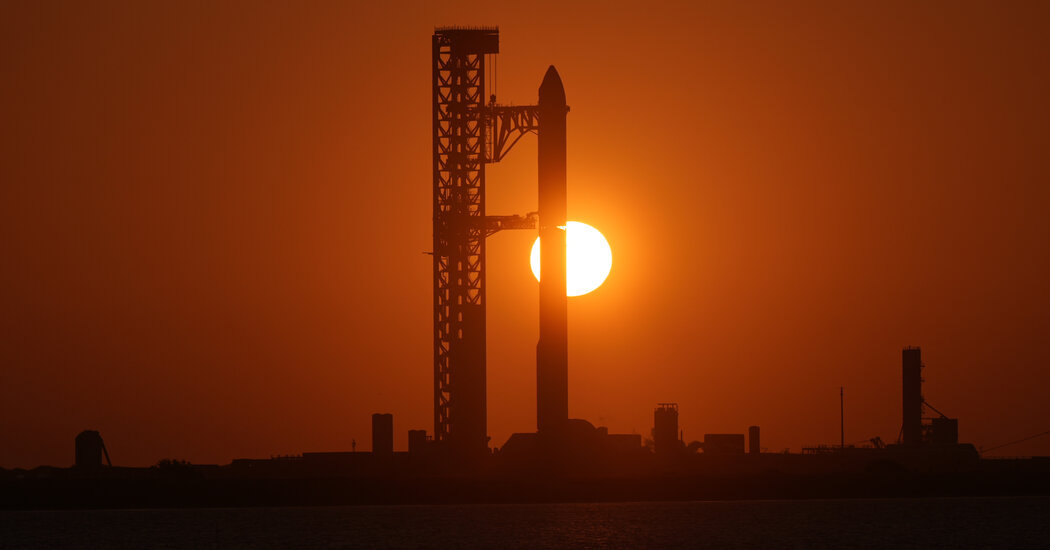
The salt-tinged air of the South Texas coastline was heavy with anticipation on Friday evening as SpaceX’s colossal Starship stood ready on its launchpad, shaking off a frustrating last-minute mechanical issue with its launch tower that had abruptly derailed the previous day’s attempt. At precisely 6:30 p.m. Eastern time, the quiet expanse outside Brownsville was shattered by a deafening, low-frequency roar as the world’s largest and most powerful rocket rose into the sky on a blinding pillar of fire. It was a breathtaking display of human ambition, yet the climb was immediately haunted by the unpredictable complexities of aerospace engineering. As the vehicle fought its way through the dense lower atmosphere, one of the thirty-three Raptor engines powering the massive Super Heavy booster failed, blinking out of existence during the grueling ascent. While the remaining engines brute-forced their way through this loss to successfully push the upper-stage spacecraft toward the vacuum of space, the booster’s journey back to Earth was plagued by more severe failures. The critical sequence of engine burns designed to bring the towering, school-bus-sized booster down for a gentle, controlled return did not execute as planned. Stunned onlookers and mission controllers watched live telemetry and video feeds that showed the booster plunging rapidly, culminating in a messy, high-velocity crash into the grey waters of the Gulf of Mexico. Meanwhile, the upper-stage spacecraft encountered its own crisis when one of its six engines failed to fire. Demonstrating the system’s built-in redundancies, the remaining engines burned significantly longer than their standard duration, successfully thrusting the ship into space. As the vehicle coasted silently above the blue curve of the Earth toward its final destination over the Indian Ocean, the mission stood as a stark reminder of the razor-thin margins of spaceflight, where triumph and destruction are separated by a fraction of a second.
This high-stakes journey marked the historic maiden voyage of “Version 3,” a radically overhauled iteration of the Starship vehicle that SpaceX engineers have described as almost an entirely different rocket than its predecessors. This flight was the culmination of relentless prototyping and design evolution, moving past the mixed legacy of the Version 2 vehicles that dominated the sky over the past year. While the earlier Version 1 test flights in late 2024 achieved milestones—such as the sixth flight where the upper stage survived the fiery trauma of atmospheric re-entry to hover gracefully over the ocean—the transition to the next iteration was fraught with setbacks. The seventh test flight in early 2025 ended in a catastrophic disintegration as it climbed toward orbit, and subsequent attempts either broke apart on re-entry or merely repeated earlier successes without breaking new ground. Eager to break this cycle of stagnation, SpaceX gambled on Version 3, introducing sweeping architectural and mechanical upgrades designed to maximize power and reliability. The legendary Raptor engines were stripped down to a lighter, streamlined configuration, purging complex external plumbing while simultaneously boosting thrust. On the booster stage, engineers took the bold step of replacing the traditional four-fin steering configuration with three larger, more aerodynamic grid fins to guide the giant booster during its high-speed fall through the atmosphere. Inside the upper stage, new hardware was integrated to test the mechanics of docking and propellant transfer—a highly complex process of moving thousands of gallons of super-cooled methane and oxygen between vehicles. Because Starship is so incredibly massive, it consumes nearly all its fuel just to escape the Earth’s gravity well; therefore, mastering the art of orbital refueling is the absolute key to unlocking destinations beyond Earth’s grasp.
While the mechanical anomalies of the launch occupied the analytical minds at mission control, the entire endeavor was deeply quieted by a tragic human cost that occurred just days earlier. On May 15, a 25-year-old Starbase worker named Jose Luis Bautista lost his life after falling eight feet from a scaffold at the Texas site, suffering fatal blunt force trauma that has triggered an ongoing investigation by the federal Occupational Safety and Health Administration. This heartbreaking loss served as a sobering reminder of the physical dangers endured by the ground crews building the future of space exploration, grounding the high-tech narrative in raw human reality. Despite the somber atmosphere and a brief delay, the launch proceeded, and once the upper stage made its way into the vacuum of space, it set to work on a series of critical technology demonstrations. It successfully deployed twenty dummy versions of SpaceX’s larger, next-generation Starlink satellites, which are crucial to the company’s global internet aspirations. Additionally, the mission launched two modified, camera-equipped Starlink units designed specifically to capture high-definition, close-up images of Starship navigating the vacuum of space. But this cosmic success was tempered by caution; because of the earlier engine failures during ascent, SpaceX flight controllers made the tactical decision to skip a scheduled engine relight test in space. This test was meant to fire one of the vehicle’s main engines to demonstrate how it will eventually de-orbit itself on future operational missions. Bypassing this maneuver was a necessary safety compromise, but it highlighted a glaring gap in the spacecraft’s current readiness, proving that the road to safe, routine orbital spaceflight is still littered with unexpected hurdles.
The stakes of these developmental struggles reverberate far beyond SpaceX’s corporate headquarters, directly impacting the strategic future of the United States space program. NASA has tied a significant portion of its cosmic reputation to Starship, having contractually selected a modified version of the giant craft to serve as the lunar lander that will ferry astronauts back to the surface of the Moon. However, as Starship’s development timeline has slipped and technical anomalies have persisted, anxiety within the space agency has mounted, prompting officials to publicly raise the possibility of leaning on a competing lunar lander designed by Jeff Bezos’s Blue Origin. This growing friction and realistic look at engineering timelines recently led to an overhaul of NASA’s flagship Artemis program. Rather than rushing a high-risk landing on the moon during the Artemis III mission, NASA redefined the mission to stay in Earth’s orbit so astronauts can safely practice docking procedures and test the transfer systems. The historic, boots-on-the-ground lunar landing has officially been pushed to the Artemis IV mission, which is target-dated for 2028. Even with this four-year runway, aerospace experts warn that the schedule is extraordinarily unforgiving. Developing a launch vehicle of this scale, proving its safety for human transport, and demonstrating the rapid-fire propellant transfers required to push it to the Moon is a monumental task. If Starship encounters more catastrophic failures or continues to struggle with basic booster retrieval and engine reliability, NASA’s return to the Moon could face devastating delays, leaving the door wide open for rival space-faring nations to claim the lunar south pole first.
For Elon Musk and his executive team, Starship is not just an instrument of ultimate scientific curiosity; it is the financial engine designed to power a gargantuan corporate empire currently valued at a dizzying $1.25 trillion. SpaceX is aggressively laying the groundwork for a historic initial public offering that could happen as soon as next month, seeking to raise between $50 billion and $75 billion in what would easily rank as the largest IPO of all time. However, the financial ledger behind this high-flying valuation reveals a company operating under immense financial strain, having suffered an overall loss of more than $4.9 billion last year alone. While a significant portion of this deficit can be attributed to heavy investments in artificial intelligence data centers, the company’s core space launch segment also lost $657 million, illustrating the eye-watering burn rate required to build, test, and occasionally vaporize experimental rocketry. The towering valuation of SpaceX is deeply predicated on Starship successfully transitioning from a prototype to a fully operational, highly profitable space truck. The company’s long-term business plan pitches the heavy-lift vehicle as a platform not only for massive satellite constellations but also for deploying orbital AI data centers and logistics hubs. Beyond Earth’s immediate neighborhood, Starship is the cornerstone of Musk’s ultimate goal to establish a permanent human colony on Mars. If SpaceX can achieve total, rapid reusability—where both the booster and the ship are launched, recovered, and re-flown within hours—it will completely dominate the global launch market. Conversely, if technical setbacks drag on, the financial pressure from investors and the massive overhead of Starbase could threaten to choke the very capital needed to keep the Martian dream alive.
Despite the violent splashdowns, missed burns, and lingering engineering hurdles of this twelfth flight, the path forward for Starship remains defined by the relentless, “fail fast, learn faster” philosophy that has become SpaceX’s signature. By design, every single Starship test flight conducted to date has adhered to a suborbital trajectory, utilizing elliptical flight paths that naturally decay back into Earth’s atmosphere; this ensures that if control is lost, the gargantuan vehicle will burn up safely over remote oceans rather than threatening populated areas. This structural safety measure means that while the rockets have repeatedly achieved orbital velocities, they have not yet entered a stable, continuous orbit around our planet. If the diagnostic data retrieved from this Version 3 test flight proves that the lighter Raptor engines and redesigned thermal protections are viable, the upcoming thirteenth flight may finally see the spacecraft break this barrier and establish actual orbit. Beyond that hurdle lies the daunting, almost science-fiction task of perfecting the launchpad recovery system, where the giant mechanical “chopstick” arms on the launch tower catch both the colossal booster and the returning upper-stage spacecraft mid-air. SpaceX has chosen to defer this spectacular recovery maneuver for now, simulating a Gulf landing instead, but mastering this catch is the ultimate key to achieving the rapid turnaround times vital for lowering launch costs. Ultimately, the story of Starship is an ongoing testament to the raw, imperfect nature of human exploration, reminding us that progress is not a clean, linear march, but a gritty process paved with immense financial risks, devastating setbacks, and hard-fought triumphs. Each launch from the Texas coast brings us closer to a future where traveling to the stars is no longer a fantasy, but a routine part of the human experience.