




The Polish Promise: How Trump’s Surprise Troop Pledge is Accelerating Europe’s Drive for Strategic Autonomy
A Sudden Turn on the Eastern Flank: Trump’s Unexpected Troop Pledge to Poland
By Jorge Mitssunaga
May 22, 2026
In a geopolitical landscape long accustomed to sudden shifts and rhetorical volatility, the announcement that President Donald J. Trump has promised to deploy 5,000 additional United States troops to Poland has sent profound shockwaves throughout the transatlantic alliance. This unexpected pledge represents a striking departure from the president’s historical skepticism toward the North Atlantic Treaty Organization (NATO) and his frequent, transactional criticisms of European allies who fail to meet defense spending targets. For years, the security of Europe’s eastern flank has been hostage to the shifting political winds in Washington, leaving frontline states in a state of perpetual anxiety over the durability of American security guarantees. By offering a concrete, substantial reinforcement of 5,000 military personnel to Warsaw, the administration appears to have reversed its isolationist trajectory, suddenly positioning itself as an active guardian of Eastern European sovereignty against regional adversaries. Yet, rather than eliciting uncritical celebration across continental capitals, this dramatic foreign policy pivot has been met with intensive scrutiny and meticulous diplomatic parsing. Observers are rushing to decipher whether this gesture signals a genuine, long-term commitment to collective defense and the preservation of the post-war international order, or if it is merely a transient, bilateral arrangement designed for immediate political theater rather than sustainable strategic stability.
Wary Whispers in Brussels: Why European Leaders Restrain Their Enthusiasm
“Our military commanders are working through all the details, but of course I welcome it. But let’s be clear: The trajectory we are on, which is a stronger Europe and a stronger NATO, making sure we will… be less reliant on one ally only.”
At a high-stakes security summit in Brussels, the atmosphere among European heads of state and defense ministers was characterized not by a sense of profound relief, but by a quiet, deeply calculated wariness that speaks to years of diplomatic exhaustion. When confronted with the news of the massive prospective deployment, allied representatives responded with calibrated, highly professional skepticism, refusing to let the headline-grabbing promise obscure the systemic instability of the current partnership. The prevailing sentiment was captured by a senior European diplomat who acknowledged the offer with polite reservation, noting that while military planners are actively working through the immense practical details, the broader strategic imperative must remain focused on internal resilience rather than external dependence. The general consensus in the room was that a security architecture subject to the erratic impulses of a single foreign leader is inherently fragile, leading one high-ranking official to privately describe the shifting declarations coming out of Washington as a confusing puzzle that is increasingly difficult to navigate. This collective hesitation highlights a profound evolution in the European mindset: no longer content to celebrate sudden windfalls of American military support, policymakers are recognizing that the unpredictability of their primary ally is itself a core strategic risk that requires a fundamental reassessment of continental security operations.
The Quest for Strategic Autonomy: Redefining Europe’s Dependence on Washington
“Well, it is confusing indeed, and not always easy to navigate. But we need to continue to focus on what we do, and not what everyone else says.”
This sudden American pivot, far from reassuring the continent, has instead acted as a powerful accelerant for the burgeoning movement toward European strategic autonomy and defense self-reliance. For more than three-quarters of a century, the nations of Western Europe have rested comfortably beneath the American nuclear umbrella, outsourced their heavy defense logistics to the Pentagon, and prioritized domestic welfare programs over robust national military budgets. However, the realization that an American administration can threaten to walk away from mutual defense treaties on one day and promise thousands of troops the next has made it clear that absolute reliance on a single partner is both strategically untenable and politically dangerous. Consequently, European leaders are increasingly championing a dual-track approach that seeks to bolster NATO’s collective capabilities while systematically building an independent European defense pillar that can function autonomously if necessary. This shift is driving a dramatic increase in domestic military production, the modernization of independent command structures, and a concerted push to standardize weapons systems across the European Union. By emphasizing that a stronger, self-sufficient Europe actually makes NATO more resilient, policymakers are attempting to redefine the transatlantic alliance as a partnership of equals, ensuring that the defense of the continent is never again entirely dependent on the variable political weather of a distant capital.
Poland’s Pivot Point: Balancing Bilateral Deals with Pan-European Security
The physical deployment of thousands of troops requires complex logistical negotiations, base infrastructure, and long-term political stability to proceed beyond mere political rhetoric.
The geographical reality of Poland places it at the very heart of this strategic drama, forcing Warsaw to walk a delicate diplomatic tightrope between its urgent bilateral dependency on Washington and its vital integration with its European neighbors. Situated directly on the eastern edge of the alliance and adjacent to the highly sensitive Suwałki Gap—the narrow, strategically vulnerable land corridor that connects the Baltic states with the rest of NATO—Poland views the threat landscape through a deeply existential lens. This acute vulnerability explains why successive Polish governments have historically courted direct bilateral security arrangements with the United States, occasionally preferring the immediate hard-power guarantees of American boots on the ground over the consensus-driven, often slow-moving diplomatic machinery of the European Union. However, this preference for bilateral arrangements has often created tension with partners in Paris and Berlin, who fear that independent deals with Washington weaken collective European cohesion and undermine efforts to build a unified European defense strategy. As Polish leaders work to finalize the terms of the promised 5,000-troop deployment, their diplomats face the formidable challenge of reassuring their European Union partners that this bilateral bolster is not designed to bypass continental alliances, but will instead serve as an integrated component of a broader, more cohesive regional defense framework.
The Rhetoric of Realpolitik: Deciphering the Confusing Contradictors of American Foreign Policy
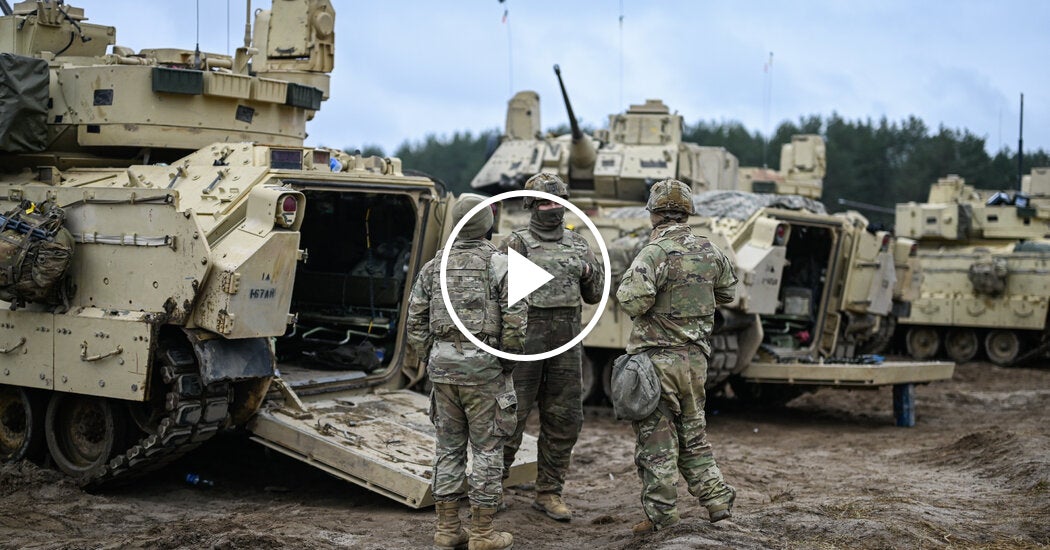
Military personnel near the open rear of an armored vehicle standing on mud in Poland, illustrating the practical realities of eastern flank security.
The friction points of this announcement become most visible in the vast gulf that separates enthusiastic political declarations from the grinding, complex realities of actual military logistics and operational planning. While an executive promise of 5,000 troops can be made in an instant at a press conference, the physical deployment of such a force requires months, if not years, of intricate planning by military commanders who must navigate base allocations, supply lines, search-and-rescue protocols, and complex Status of Forces Agreements (SOFA). European defense experts point out that without stable funding guarantees from the United States Congress and a clear, long-term strategic doctrine, such announcements run the risk of becoming hollow political symbols rather than credible deterrents. Furthermore, the confusion generated by mixed messaging—where the administration demands that Europe pay for its own defense while simultaneously offering to unilaterally subsidize Polish security—complicates the planning efforts of allied commanders who require stability and predictability to orchestrate collective defense maneuvers. This operational disconnect highlights the inherent dangers of transactional diplomacy, indicating that when military deployments are treated as currency for domestic political gains rather than elements of a unified coalition strategy, they can inadvertently signal division and weakness to watching adversaries.
The Road Ahead: Building a Resilient Transatlantic Security Framework for the 21st Century
The future of NATO relies on creating a dual-pillar alliance where European states are capable of defending their own borders independently of Washington’s shifting political winds.
Ultimately, this latest development serves as an irreversible turning point for the transatlantic security alliance, offering a stark wake-up call that will shape the defense policies of the Western world for decades to come. Whether the promised 5,000 American troops are successfully deployed to Poland or eventually stalled by political gridlock in Washington, the illusion of an uncomplicated, permanent American military guarantee has been permanently shattered. The future of global security in the twenty-first century demands a mature, balanced alliance where European nations transition from passive consumers of security to active, capable producers of their own defense. By embracing the current crisis as an opportunity to build robust, independent military capabilities, the European continent can ensure that its democratic institutions, sovereign borders, and collective values are protected by its own strength, rather than remaining subject to the shifting whims of foreign electorates. As military commanders working behind the scenes slowly piece together the operational details of this new deployment, the enduring lesson for European leadership remains absolute: welcome international partnerships, but hold the keys to your own house.