


The intersection of money, power, and modern media has always dictated the trajectory of American electoral politics, but the digital age has transformed this dynamic into something entirely unprecedented. Today, the traditional campaign trail of town halls, physical handshakes, and multimillion-dollar television advertising slots is slowly being eclipsed by a fast-paced, hyper-curated, and often bewildering landscape of social media algorithms, viral meme pages, and professional influencers. At the heart of this transition is billionaire hedge fund titan and political aspirant Tom Steyer, who is currently waging an incredibly expensive campaign to capture the governorship of California. Having already poured over $190 million of his immense personal fortune into his gubernatorial bid, Steyer’s campaign strategy represents a radical departure from conventional political playbook tactics. Rather than relying solely on standard political rhetoric or safe, mainstream media appearances, Steyer is sparing no expense to cast himself as a progressive, relatable billionaire capable of understanding the struggles of everyday citizens. His primary target is an incredibly elusive yet politically vital demographic: the social-media-addicted Gen Z and millennial voters who are notoriously cynical of wealthy elites and mainstream political structures. To break through this wall of youthful skepticism, Steyer’s campaign has recognized that cultural currency cannot simply be earned through legislation; it must be purchased in the digital marketplace where attention spans are measured in seconds. This has led to a highly coordinated, high-stakes experiment in political marketing, where hundreds of thousands of dollars are funneled directly into the pockets of internet creators, celebrity gossip accounts, and digital communities that dictate what is fashionable, what is relevant, and ultimately, what is politically acceptable to the younger generation. By treating his campaign not just as a civic endeavor but as a lifestyle brand, Steyer is testing the limits of how far personal wealth can go in buying authenticity in the digital age.
One of the most prominent examples of this unconventional strategy is Steyer’s financial partnership with “The Shade Room,” a veritable powerhouse in the realm of digital media and celebrity culture. Boasting an astounding 28 million followers on Instagram alone, The Shade Room acts as a primary news source, cultural touchstone, and community forum for a massive, highly active audience, particularly within Black and urban communities. Financial disclosures revealed that the Steyer campaign made a targeted $25,000 payment to the outlet, classified in campaign filings under the innocuous label of “online communications.” This payment resulted in two polished, highly strategic posts designed to present Steyer not as a detached billionaire financier, but as a champion of economic and racial justice. The first post spotlighted his aggressive regulatory stance, highlighting his ambitious proposal to block the massive, high-profile merger between media giants Warner Bros. and Paramount—a position calculated to appeal to young consumers increasingly wary of corporate monopolies and the consolidation of cultural media. The second post was even more politically calculated, focusing heavily on his endorsement by the Black Women’s Collective political action committee (PAC). This piece of content directly addressed deeply sensitive and vital issues such as reparations, substantial investment in Historically Black Colleges and Universities (HBCUs), and targeted economic empowerment initiatives for Black women. According to the sponsored post, the PAC praised Steyer for directly confronting complex socio-economic realities, speaking specifically and emphatically to the unique systemic vulnerabilities, educational gaps, and mental health barriers affecting Black women and girls in America today. By embedding these heavy, policy-driven messages within the colorful, high-engagement feed of a celebrity gossip giant, Steyer’s campaign successfully bypassed the defensive filters of young voters who normally ignore political advertisements, blending serious policy initiatives seamlessly into their daily entertainment feeds.
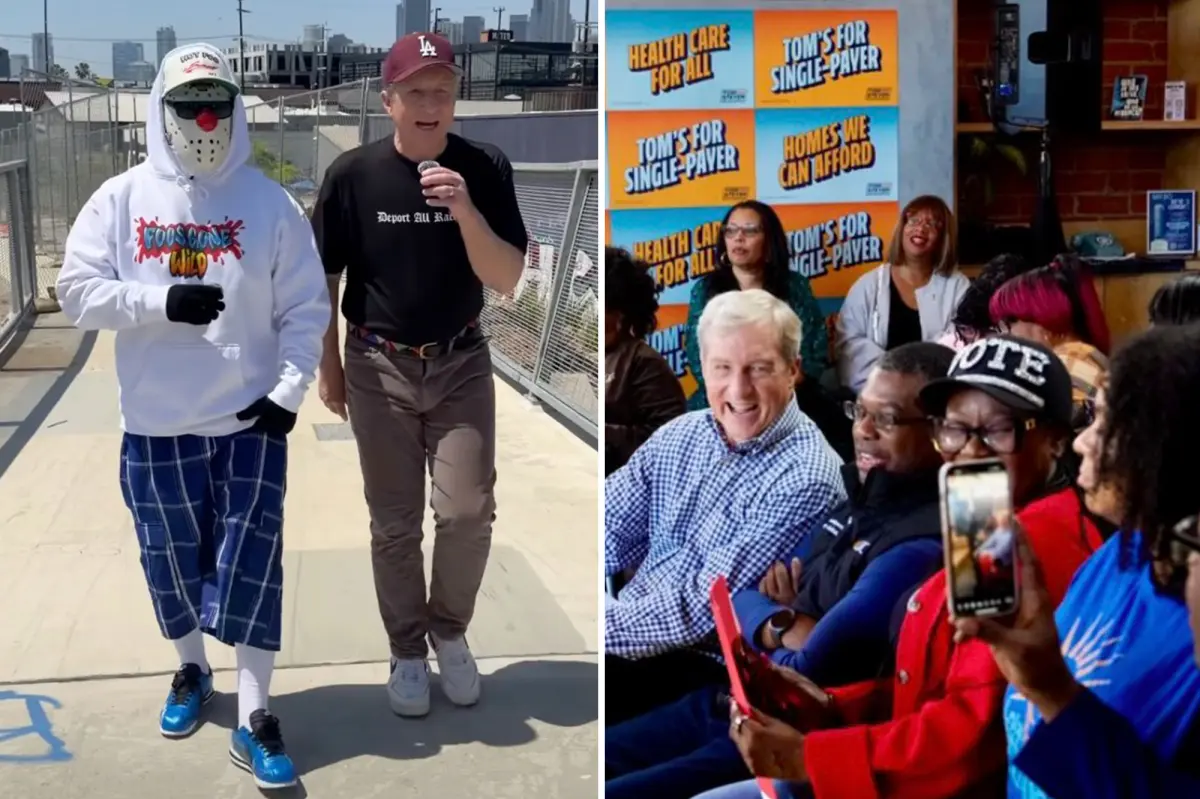
While the collaboration with The Shade Room aimed for a tone of progressive policy and social justice, Steyer’s campaign ventured into far more surreal territory with a $50,000 payment to the popular, irreverent meme account “Foos Gone Wild.” Rooted deeply in Chicano street culture, regional satire, and chaotic neighborhood comedy, Foos Gone Wild has accumulated a massive, deeply loyal following by celebrating and lampooning urban Southern California life. The paid partnership took the form of an incredibly awkward yet undeniably captivating video interview featuring Steyer alongside the account’s masked, anonymous host, known to fans as Mr. E. In the video, the billionaire hedge fund manager attempted to bridge the massive socioeconomic divide between himself and the account’s working-class audience by engaging in a casual chat about real-world issues. The conversation oscillated wildly between serious commitments to holding Immigration and Customs Enforcement (ICE) accountable for systemic abuses and relaxed banter about grabbing food at a local neighborhood taco truck. However, the defining moment of the video—and the one that generated the most viral traction—was the legendary “sock check.” This recurring gag on the channel functions as a playful cultural litmus test to evaluate whether an individual is cool and authentic, or “lame.” Under the guidance of Mr. E, Steyer self-consciously pulled up his pant leg to reveal thick, white tube socks hiked high up on his mid-calf, a gesture meant to demonstrate that he was “down” with the community. Despite the high production costs, the campaign ran into immediate ethical trouble when Foos Gone Wild initially failed to clearly disclose that the entire encounter was a paid political advertisement. It was only after intensive public calling-out by independent social media creators and digital watchdogs that the account quietly updated the post with the legally required disclosure. This payment, along with the one to The Shade Room, was routed through Flight House, a sophisticated media and communications agency specializing in matching corporate and political clients with high-impact internet influencers, illustrating the highly coordinated machinery operating behind these seemingly spontaneous viral interactions.
The revelation of these payments has shone a bright spotlight on the rapidly growing, highly lucrative, and largely unregulated world of political influencer marketing, where the boundary between organic advocacy and paid promotion is increasingly blurred. Steyer’s financial filings show a pattern of aggressive spending across a diverse spectrum of content creators, raising serious ethical and legal concerns among digital watchdogs. Among those compensated were well-known social media personalities such as Brandon Calvillo, also known as bjclavillo, who received a payment of $14,250, and other notable creators like Quentin Quarantino, who was paid $25,000, along with Thomas Marcus and Hari Tahov, who received $1,000. While the campaign insists these transactions are merely standard modern advertising expenses, this practice has previously landed Steyer in lukewarm water. Prior to these disclosures, two prominent online influencers publicly accused the billionaire’s campaign of seeking to illegally conceal the true financial nature of their paid collaborations, sparking conversations about the transparency and integrity of modern electioneering online. When traditional political ads run on television or radio, they are strictly bound by decades of Federal Election Commission (FEC) regulations requiring clear, voiceover disclaimers stating who paid for the message. In the fluid, rapidly shifting ecosystem of social media, however, regulations struggle to keep pace with innovation. Campaigns can easily employ intermediary agencies to pay young, popular creators to casually mention a candidate, slide policy points into comedy skits, or gently praise a politician’s character, creating a false impression of widespread, grassroots enthusiasm—a phenomenon political scientists refer to as digital “astroturfing.” For a generation already deeply skeptical of institutions, discovering that their favorite internet personalities are being quietly paid thousands of dollars to validate a billionaire can deeply fracture whatever trust remains in the democratic process.
This heavy financial investment in youth-focused internet culture is not just a lighthearted vanity project; it is a desperate, calculated survival tactic aimed at turning around a struggling campaign. As the crucial June 2 primary election rapidly approaches, Steyer finds himself in a tense uphill battle, trailing the Democratic frontrunner, Xavier Becerra, by several percentage points in recent, reputable public polls. In the high-stakes arena of California politics, where winning a statewide primary requires mobilizing millions of voters across highly diverse and sprawling metropolitan areas, a candidate trailing in the final stretch must take massive risks to change the narrative. Steyer’s campaign understands that traditional outreach methods, such as direct mailers, localized phone banking, and standard television commercials, often fail to reach younger, non-traditional voters who do not watch broadcast television or answer phone calls from unknown numbers. By funneling vast resources into the digital spaces where these disaffected and unaligned potential voters spend hours of their day, Steyer is attempting to engineer a late-stage surge. The strategy operates on the mathematical gamble that if even a tiny fraction of the millions of followers on accounts like The Shade Room or Foos Gone Wild can be coaxed into registering and actually casting a ballot, it could easily secure the razor-thin margin needed to overtake Becerra and secure a spot in the general election. Thus, the surreal sight of a billionaire doing a “sock check” or weighing in on hip-hop platforms is the direct byproduct of a political environment where traditional avenues of engagement are failing, and where candidates are forced to hunt for votes in the chaotic attention economy.
In response to the mounting public scrutiny over his campaign’s aggressive influencer strategy, Steyer’s camp has remained defiant, seeking to frame their actions as a progressive defense of digital labor while aggressively redirecting fire toward their main political opponent. The campaign’s spokesperson, Kevin Liao, issued a strong statement defending the financial disbursements, arguing that content creators are hard-working professionals who deserve to be fairly and transparently compensated for their time, creativity, and reach. “The Steyer campaign believes creators deserved to be compensated for their time and has fully disclosed all payments,” Liao stated, attempting to paint the campaign’s transactions as a model of labor justice and modern transparency. However, Liao quickly weaponized this defense to launch a stinging counter-attack against Xavier Becerra, accusing the frontrunner of benefiting from far more insidious and deceptive forms of digital manipulation. Liao stated, “The same can’t be said for Xavier Becerra, who’s benefiting from bot-driven political manipulation while refusing to condemn it.” This serious accusation refers directly to a striking report published by the cyber intelligence firm Cyabra, which claimed to have uncovered a highly sophisticated, mysterious network of social media bots actively working to artificially boost Becerra’s online popularity, manipulate public sentiment, and create a false perception of overwhelming momentum. As the primary race careens toward its conclusion, this bitter exchange exposes a dark, complex reality of modern American democracy: the battle for political power is no longer merely decided by public debates and policy proposals, but by a high-stakes, invisible war of information. Whether through high-paid celebrity influencer endorsements, awkward meme-page appearances, or covert networks of automated digital bots, the line between authentic public support and manufactured digital influence has been permanently shattered, leaving voters to navigate a political landscape where nothing is quite what it seems.