





For most travelers, boarding a commercial flight is a transition into a liminal space of forced relaxation, where the responsibilities of daily life are temporarily suspended between takeoff and landing. This was precisely the expectation for retired Minneapolis Police Chief Brian O’Hara and his wife, a lieutenant with the Newark Police Department, as they settled into their seats aboard United Airlines Flight 1364 from Newark to Fort Lauderdale. Yet, for those who have spent their lives in public service, the protective instinct is not a uniform that can be neatly folded and stored in an overhead bin; it is a permanent lens through which they view the world. As the Boeing 737-900 climbed to its cruising altitude of 35,000 feet, the quiet hum of the cabin was slowly punctured by the rising, discordant notes of human conflict. What began as a routine flight quickly devolved into a claustrophobic crisis when an increasingly belligerent passenger began to unravel, forcing a cabin full of strangers to confront the fragile boundary between orderly civilization and sudden chaos in the sky.
The unfolding drama was characterized not by a sudden explosion of violence, but by a agonizingly slow burn that tested the emotional endurance of everyone on board. For nearly forty-five minutes, the flight’s cabin crew demonstrated an extraordinary level of grace under pressure, employing every de-escalation technique in their arsenal to pacify a passenger whose behavior was becoming rapidly erratic and hostile. O’Hara watched with a mixture of professional admiration and growing concern as the flight attendants, whom he later described as absolute professionals, attempted to soothe the man’s escalating anger. The friction had ignited over a standard safety and service boundary: the crew’s refusal to serve the passenger any more alcohol. This boundary, meant to preserve the comfort and safety of the 174 passengers and six crew members on board, instead acted as a catalyst for the man’s entitlement and rage. He began to direct a barrage of vitriolic profanities and intimidating gestures at the female flight attendants, transforming the narrow aisles of the aircraft into a stage for verbal abuse and psychological terror.
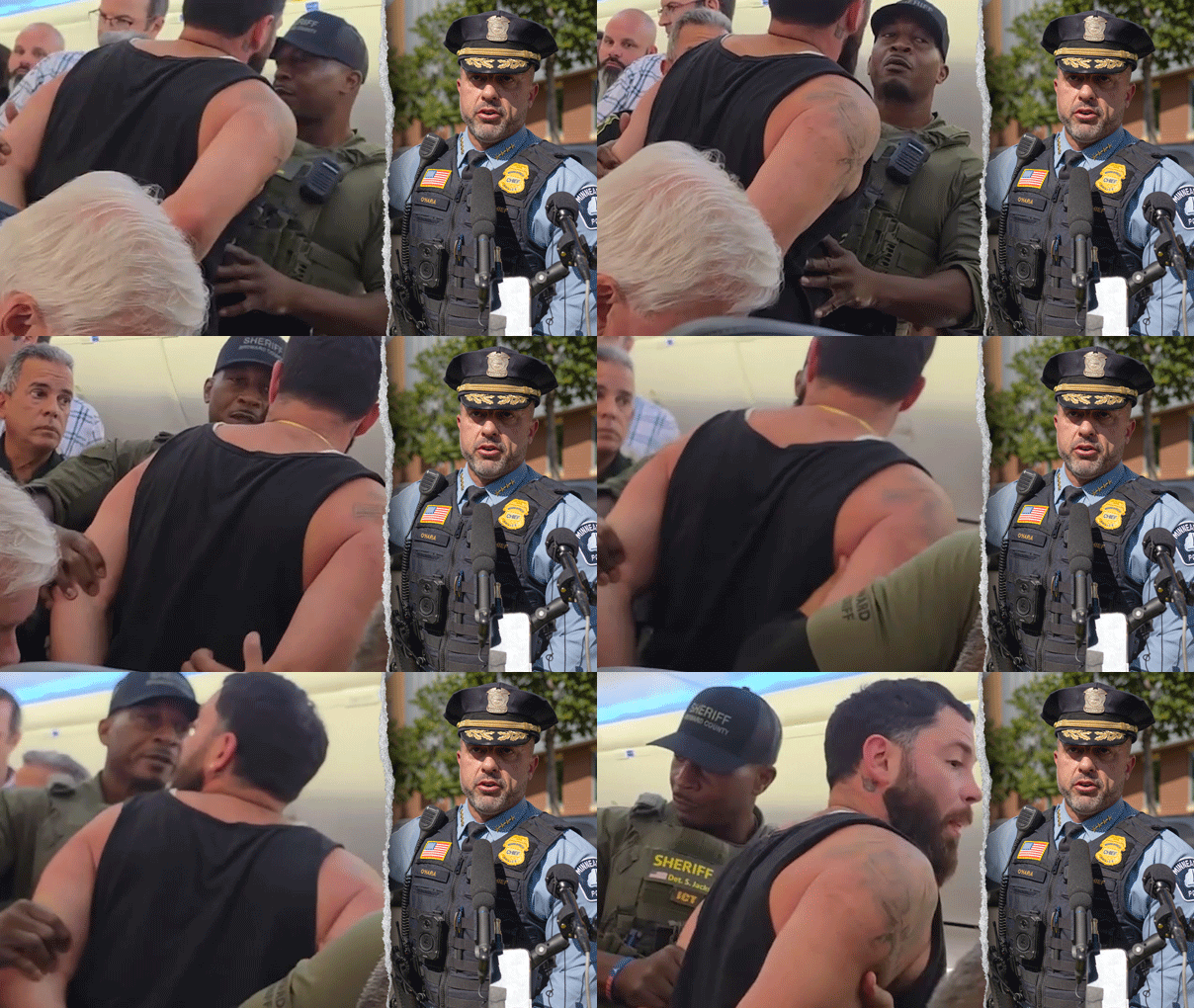
To be trapped in a metal cylinder miles above the earth while a fellow passenger loses control is a uniquely modern horror, evoking a deep sense of vulnerability among those who can only watch and hope the situation does not turn catastrophic. O’Hara sat in his seat, his law enforcement instincts finely tuned to the subtle shifts in the passenger’s body language, waiting for the inevitable moment when words would no longer suffice. That breaking point arrived with terrifying clarity when the passenger, entirely consumed by his grievances, stood up and lunged violently toward the flight attendants who had spent the last hour trying to protect him from himself. In that fraction of a second, the illusion of safety dissolved, but before the threat could materialize into tragedy, the collective defense mechanism of the cabin kicked in. Two alert passengers seated near the rear of the aircraft sprang from their seats, grabbing the disruptive man from behind, while O’Hara rushed forward from his row to join the fray, instinctively moving toward the danger to shield the defenseless crew.
The ensuing struggle in the cramped, unforgiving confines of the aircraft aisle was a testament to swift, coordinated action under intense pressure. Working in perfect unison, O’Hara and the two other men managed to overpower the thrashing passenger, neutralizing his physical threat and securing his wrists behind his back using plastic flex cuffs. It was only after the adrenaline began to subside and the passenger was safely secured back in his seat that O’Hara made a remarkable discovery: the two brave men who had answered the call to action alongside him were off-duty Bergen County Sheriff’s deputies from New Jersey. This serendipitous convergence of off-duty law enforcement officers prevented what could have been a disastrous escalation, allowing the relieved flight crew to finally take their seats and prepare the aircraft for a safe landing. Upon arrival in Fort Lauderdale, the plane was met by the Broward Sheriff’s Office, who took the unruly passenger into custody, bringing a dramatic and stressful journey to a secure conclusion.
Beyond the physical altercation, the incident illuminated the deep, unspoken bonds of partnership and mutual trust that define the lives of those in law enforcement, particularly within O’Hara’s own family. His wife, who sat nearby throughout the entire ordeal, watched her husband walk into the line of fire without hesitation, secure in the knowledge of his capabilities but undoubtedly feeling the quiet anxiety that accompanies loving a protector. Reflecting on the incident with a touch of lighthearted warmth, O’Hara joked that his only thought during the scuffle was knowing that if things went truly bad, his wife—a seasoned street cop—had his back. Later, she took to social media to express her profound pride in him, reminding her followers that true leadership is not defined by titles or retirement status, but by a persistent willingness to help others in moments of acute vulnerability. Her words painted a deeply human portrait of a couple whose commitment to public safety is not merely a career path, but a shared moral compass that governs their lives even when they are off the clock.
In the aftermath of the flight, O’Hara chose not to focus on his own heroism, but rather to use the platform to advocate for systemic changes in how airlines handle the rising epidemic of mid-air violence. He pointed out that while short cellphone videos of such confrontations often go viral, they rarely capture the exhausting, hour-long emotional abuse that flight crews endure before physical intervention occurs. O’Hara urged major airlines to ensure that robust physical restraints are readily accessible on all flights and that crew members receive specialized, practical training to deploy them safely when passengers become violent. Ultimately, as the nation approaches the solemn 25th anniversary of September 11, O’Hara issued a powerful reminder of our collective responsibility to one another, arguing that passive bystander culture is a luxury we can no longer afford when innocent people are threatened. His experience on Flight 1364 stands as a compelling testament to the power of community, proving that when ordinary citizens and off-duty heroes choose action over apathy, they can preserve the safety, dignity, and peace of our shared spaces, even high above the clouds.