




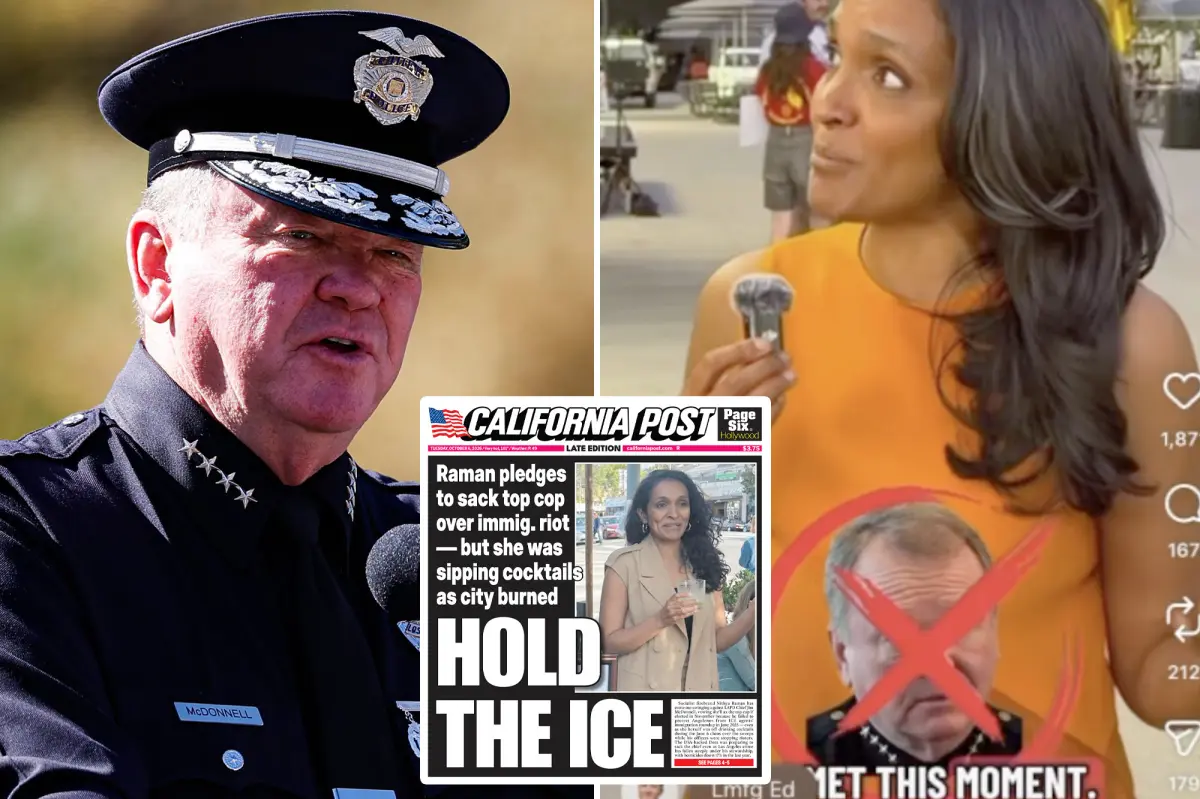
You could feel the fault line running through Los Angeles long before the words were ever spoken. On one side stood Nithya Raman, a city councilmember and self-described socialist who has built her political identity around challenging entrenched power, questioning police funding, and speaking for communities that feel overpoliced and underserved. On the other stood Jim McDonnell, the chief of the Los Angeles Police Department, a career law enforcement officer who has spent decades trying to hold the line between public safety and public trust. When Raman appeared in a since-deleted social media video alongside left-wing influencer Ed Choi, and the phrase “fascist liars” floated across the screen, the city suddenly had a new kind of battle on its hands. The video was raw, deliberately provocative, and visually unsparing. It showed Mayor Karen Bass’s face, then cut to Chief McDonnell’s face with a large red X slashed across it. To Raman’s supporters, it was a bold, necessary attack on a system that too often protects federal immigration agents over immigrant residents. To McDonnell and his officers, it felt like a declaration of war, a public branding of a sitting police chief as an enemy of the people. The political temperature in Los Angeles, already high after a summer of protests and violent confrontations, seemed to spike overnight. This wasn’t a policy debate about staffing or budgets. It was personal, visceral, and deeply human, with real consequences for the people who wear the badge and the people who feel threatened by it.
The video itself was the spark. In it, Raman and Choi opened with a phrase that would be parsed, condemned, and defended for days: “Only you can stop fascist liars.” As those words hung in the air, images of Mayor Karen Bass appeared on screen, followed later by McDonnell’s face with the unsettling red X. Choi, who has built a following as an unapologetic voice of left-wing frustration, accused Los Angeles of becoming “extremely fascist” because Bass had appointed McDonnell as police chief. Then he turned to Raman and asked how she would change the city if she were mayor. Raman did not flinch. She responded by accusing the LAPD of protecting ICE agents instead of protecting residents during the June 2025 immigration protests, and she made an explicit promise: if elected mayor, she would replace McDonnell. For anyone watching, the message was unmistakable. The LAPD was not a neutral institution in Raman’s eyes. It was a force aligned with federal immigration enforcement, and the chief who led it was part of the problem. But there was another layer to the video that made it feel even more dangerous to those in law enforcement. Crossing out McDonnell’s face with a red X was not just a metaphor. One LAPD member told The Post that the image effectively made the chief a target, describing the video as “extremely dangerous.” That reaction is not hard to understand. In a city where police officers have been shot, ambushed, and threatened, a public video that symbolically targets a police chief carries weight beyond political criticism. It becomes part of a broader narrative in which officers feel demonized, and in which the people who protect the city begin to wonder whether their own leaders see them as enemies or public servants.
Chief McDonnell did not stay silent for long. In an interview with NBC Los Angeles, he broke his silence and responded to Raman’s remarks with disappointment, not rage. “I saw that, and I was disappointed that she would be associated with anything like that,” he said. But then he went beyond the video itself and gave the public a stark picture of what his officers actually endured during the unrest Raman was referencing. He revealed that 52 LAPD officers were injured during the violent immigration protests in June 2025. The injuries were not minor scrapes or bruises. Officers suffered hearing damage from the relentless noise. They suffered concussive injuries from the force of explosions. McDonnell described officers being shot at directly with commercial-grade fireworks, which are far more dangerous than the sparklers most people think of. He described Molotov cocktails being thrown, all-terrain vehicles being driven toward officers, and cars set ablaze in front of them. His voice carried the weight of someone who had watched his people survive something close to combat. “The assaults on officers were like I’ve never seen before,” he said. And then, in the middle of that grim accounting, he offered a striking note of pride: “The officers were amazingly disciplined for what they were facing.” Those words were not just a defense of police tactics. They were a plea for the public to see the men and women behind the badges, to understand that the protests Raman was praising were not abstract exercises in political expression. They were chaotic, violent, and frightening events that left real people injured, some of them permanently. In McDonnell’s telling, the officers were not the villains of the story. They were the ones who stood in the middle of a storm, trying to protect the city while being attacked from all sides.
To understand why this conflict cuts so deep, it helps to remember the broader political moment in which it is taking place. Raman is not just any city councilmember. She is a rising figure on the left, a socialist mayoral hopeful who represents a growing movement that questions the very foundations of American policing. Her supporters see her as the rare politician willing to say uncomfortable things out loud, to call out what they believe is an increasingly authoritarian state, and to stand with immigrants, unhoused residents, and working-class communities who have been marginalized for generations. When she looks at the LAPD, she does not just see a police department. She sees an institution that has historically been used to enforce racial and economic boundaries, an institution that too often sides with federal power against local residents. For her, the video was not an attack on individual officers. It was an indictment of a system. That is why her campaign later clarified that the phrase “fascist liars” was never meant to describe Chief McDonnell, Mayor Bass, or LAPD officers. According to her campaign, the remark was aimed at ICE and the Trump administration, and the video was edited by its creator to place Mayor Bass on screen during that particular moment. “Nithya never used that phrase to describe Mayor Bass, Chief McDonnell or LAPD officers,” her campaign said. But by then, the damage had already been done. Politics does not always move on precise statements and careful clarifications. It moves on images, symbols, and the emotional reactions they create. A red X across a chief’s face is hard to unsee, and hard to explain away, no matter how many press releases follow.
The human dimension of this conflict is perhaps the most painful part. On one side, there are police officers who put on their uniforms every day not knowing whether they will come home. They walked into protests that turned violent, faced explosions that left them with lasting injuries, and had to stand their ground while cars burned and objects flew through the air. When they see a city councilmember crossing out their chief’s face and calling out “fascist liars,” they do not feel inspired. They feel betrayed. They feel as though the political leaders who are supposed to support public safety are actually willing to sacrifice their reputation and their safety for political gain. The red X feels like a target, not just for the chief, but for the entire department. On the other side, there are immigrant families and activists who have lived through raids, deportations, and the constant fear that a routine encounter with police could lead to a loved one being taken away. When they see local law enforcement cooperating with federal immigration agents, they do not feel protected. They feel hunted. For them, Raman is not a radical trying to tear down a good institution. She is a voice of resistance, someone willing to stand up and say that the city should not be helping ICE round up residents. Both sides carry real pain. Both sides believe they are fighting for the soul of Los Angeles. And because that pain is so deep, neither side seems able to hear the other. The language of politics has become a weapon, and the human beings caught in the middle, officers with concussions, residents with deportation orders, mayors trying to broker peace, are reduced to symbols and slogans.
In the end, the clash between Nithya Raman and Jim McDonnell is about more than one video or one protest. It is about what Los Angeles wants to become. It is about whether a city can protect its residents from crime and chaos while also protecting them from state violence and overreach. It is about whether police officers can be both guardians and targets, and whether activists can be both critical and patriotic. There is no easy answer, and perhaps that is the point. The rage on both sides is real, but so is the vulnerability. When McDonnell talks about his officers’ hearing loss and concussions, he is asking the public to see them as human beings. When Raman talks about ICE agents and fascism, she is asking the public to see immigrant communities as human beings. Both requests deserve more than a red X or a sound bite. The path forward does not lie in more attacks or more defensive rhetoric. It lies in the uncomfortable, unglamorous work of listening, of acknowledging that the other side has a story worth hearing, of understanding that public safety and civil rights do not have to be enemies. The war between the socialist mayoral hopeful and the city’s top cop is not going to end overnight. But if there is any hope for healing, it will begin when both sides realize that the person they oppose is not a monster, but a human being shaped by experience, fear, hope, and a deep desire to make Los Angeles a better place. That is the hardest truth of all, and the most necessary one.