




For airlines that call the Middle East home, the last twelve months have been a strange and often nerve-wracking ride. The skies, once taken for granted as reliable corridors for global travel, suddenly felt fragile, and every new headline about regional tensions sent a ripple through booking systems and flight plans across the industry. Yet amid all that uncertainty, Emirates has emerged with a story of resilience that is rare in any sector. The Dubai-based carrier is currently operating at around 93% of the capacity it maintained before the disruptions began, a number that might sound technical but actually represents something deeply human: the return of confidence. Hundreds of thousands of travelers are booking tickets again, boarding planes, reuniting with family, and taking those long-planned trips. Over July and August alone, a staggering 8.6 million passengers chose Emirates, and the airline admits that summer demand exceeded even its own optimistic expectations. That is not just a corporate milestone; it is proof that the urge to move through the world cannot be suppressed for long. Now, as the days shorten and the temperature begins to drop, Emirates says that momentum is continuing to build. Winter bookings, which cover the period starting in late October, are tracking positively. True, passengers are still making travel decisions much closer to departure than they used to, a habit they picked up during the pandemic and never fully lost. But that hesitation is no longer preventing people from flying; it just means the airline has to be nimble, flexible, and prepared for sudden waves of demand. And that, it appears, is exactly where Emirates feels most comfortable. There is something quietly reassuring about seeing an airline choose growth over caution when the world around it remains unpredictable.
One of the most encouraging signs for the winter season is not just how many people are booking, but where they are coming from. Emirates has identified several markets that are currently running ahead of last year’s figures, including South Africa, Brazil, India, Portugal, and Saudi Arabia. That geographic spread says a lot about the airline’s global reach and about how travel demand is no longer concentrated in a handful of familiar regions. South African travelers have long appreciated Emirates’ connections to Europe and Asia, while Brazilian passengers are drawn to Dubai as both a stopover and a final destination. India remains one of the most important aviation markets on earth, with a seemingly insatiable appetite for air travel, and Portugal’s growing popularity among Gulf investors and tourists has made it a valuable European gateway. Saudi Arabia, meanwhile, is undergoing a massive economic and cultural transformation, and its citizens are flying more than ever before for both business and leisure. The fact that these markets are all outperforming last year suggests that the winter ahead will not simply repeat previous patterns but may open up new ones. Emirates is also noticing that travelers are more spontaneous than they were before. People no longer plan their ski trips or winter getaways six months in advance. Instead, they wait to see how things are looking, check flight prices, and decide. That behavior is more difficult for airlines to manage because it makes forecasting harder. But Emirates seems to be embracing it, using data, flexible scheduling, and a broad route network to respond quickly. If a destination suddenly spikes in popularity, the airline has the ability to add capacity or adjust timing more quickly than many of its competitors. In a travel world that has learned to expect the unexpected, that kind of agility is not just a luxury; it is a survival skill, and Emirates appears to have mastered it.
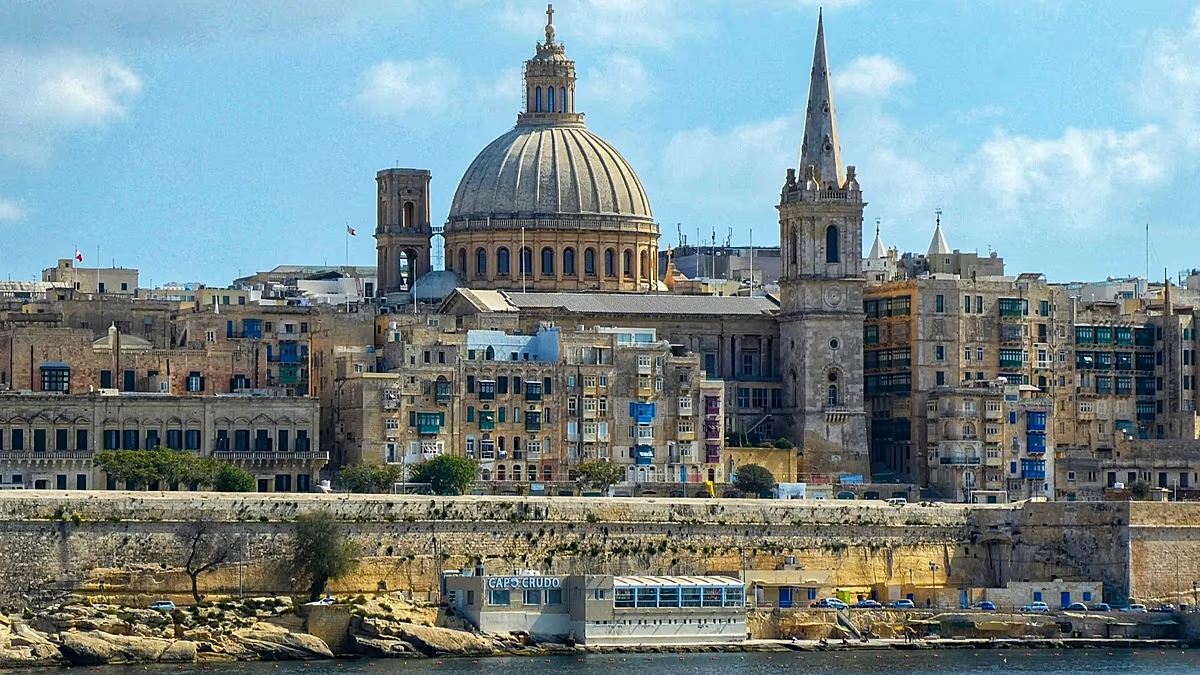
Emirates is turning that agility into action by expanding its network at a pace that suggests real confidence. Last week, it launched a daily route to Helsinki, a new gateway that adds Finland to its Nordic roster alongside Copenhagen, Oslo, and Stockholm. But the Helsinki launch is just one piece of a much larger growth puzzle. The airline has announced plans to add second daily services to Accra, Tokyo Narita, Ho Chi Minh City, and Hanoi—cities that span Africa, East Asia, and Southeast Asia. These are not timid additions; they are clear signals that Emirates sees sustained demand across a broad swath of the world. At the same time, the airline is deploying its Airbus A350 on an expanding list of routes. From late October, the A350 will serve Larnaca, Malta, Nairobi, and Hamburg, with Mauritius added in November. For frequent flyers, the A350 represents a step up in comfort and quietness, and for the airline it represents a more fuel-efficient way to operate long-haul routes. The most notable A350 development, however, comes on 1 November, when the aircraft will make its debut on scheduled US services, replacing the Boeing 777 on the existing daily Orlando route. Orlando, with its theme parks and warm climate, has become a favorite for families and leisure travelers, and putting the A350 there shows how seriously Emirates takes that market. Each of these moves on its own might be relatively routine for a major airline. Together, however, they paint a picture of a carrier that is moving forward with purpose. The capacity that was lost during the disruptions is not simply being restored; it is being reimagined, with newer aircraft and new destinations that better match the emerging patterns of global travel. It is a strategy that feels both grounded and optimistic, and it is exactly what a confident airline should look like after navigating a difficult period.
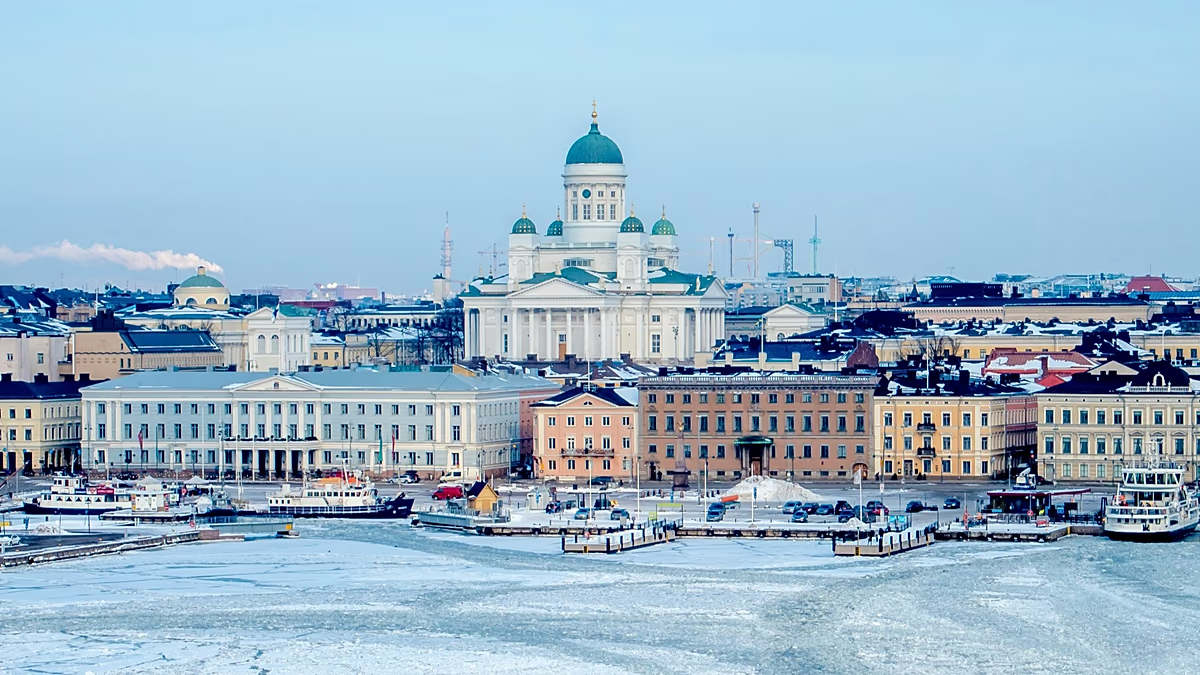
The decision to launch daily flights to Helsinki is significant for several reasons, not least because of the timing. Emirates touched down in the Finnish capital for the first time on 2 October, and from that moment it established a year-round connection that ensures travelers can fly between Dubai and Helsinki every single day. The route is operated with an Airbus A350, a journey that begins at 8:15 am from Dubai and arrives in Helsinki at 2:30 pm local time. That afternoon arrival is genuinely convenient for passengers, allowing them to continue their journey to other parts of Finland or simply settle into the city before evening. The return flight departs Helsinki at 4:20 pm and arrives back in Dubai at 12:20 am the following day, making it easy to connect onto Emirates’ extensive network of onward flights. The timing of the launch becomes even more interesting when you consider the actions of Finnair. Citing the unstable situation in the Middle East, Finnair has cancelled its own flights between Helsinki and Dubai from 25 October 2026 to 27 March 2027. That leaves a gap during the important winter months, and Emirates’ new service neatly fills it. Emirates had announced its Helsinki plans in January, months before Finnair confirmed its suspension in August, so there was no strategic opportunism here—just a solid business decision that turned out to be even more valuable than expected. In the words of Adnan Kazim, Emirates’ Deputy President and Chief Commercial Officer, Helsinki is “an exciting addition to our global network,” connecting Finland not only with Dubai but with the airline’s vast network beyond. He described Helsinki as a gateway offering “a unique blend of vibrant culture, beautiful nature and an abundance of opportunities for business and trade,” and noted that it also serves as a starting point for travelers who want to explore more of Finland. That last point matters because Finland is far more than its capital; it is a country of lakes, forests, and the remarkable magic of the Northern Lights.
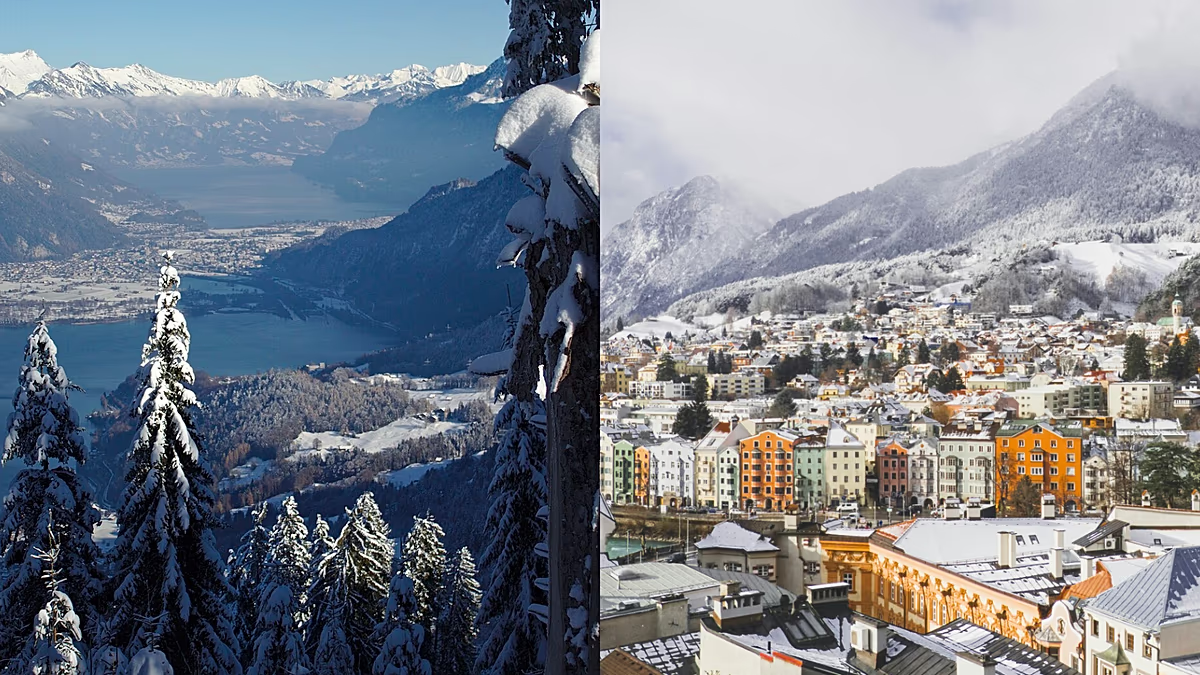
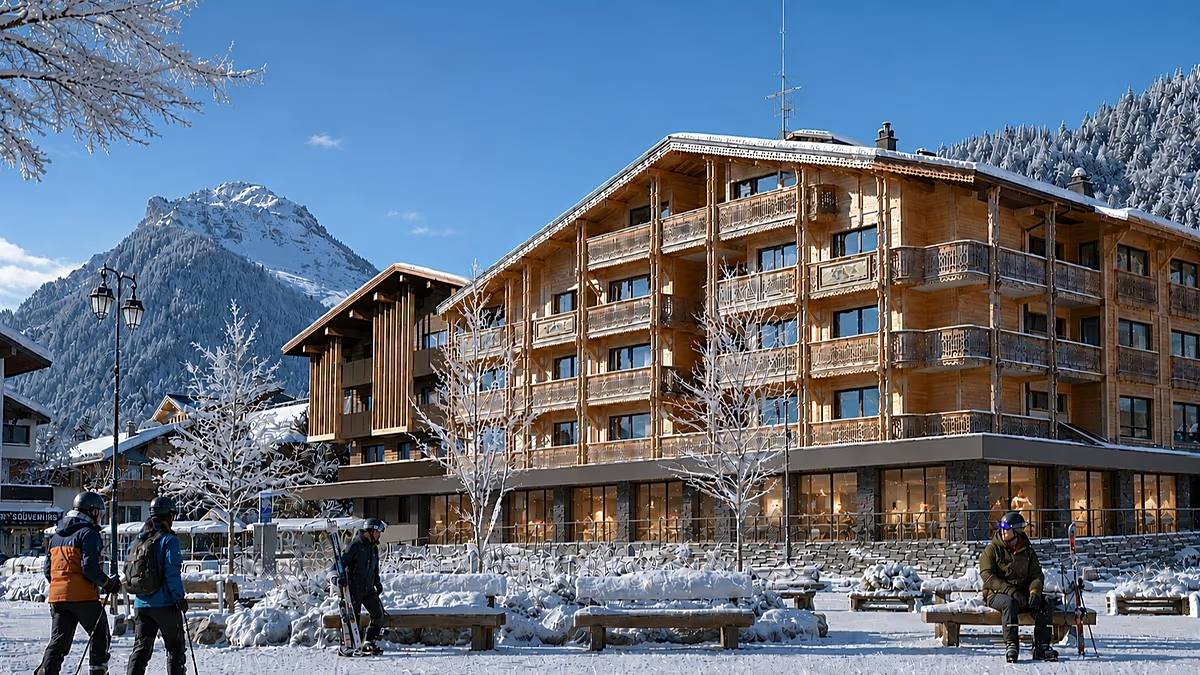
Beyond the routes and aircraft, there is a deeper story behind Emirates’ confidence this winter, and it involves the changing behavior of travelers in the Gulf region. dnata, the travel services company that belongs to the Emirates Group, has been paying close attention to what its customers want, and the answer is increasingly snow. Speaking at Arabian Travel Market in September, dnata Group CEO Nabil Sultan Al Murr noted a remarkable transformation in regional travel habits. “People going out for skiing, which was never the trend almost four to five years ago, is becoming such a huge trend,” he said. That one sentence captures a wider shift. For decades, travelers from the Gulf overwhelmingly looked for beach holidays and city breaks in warmer climates. But a new generation of travelers is curious about winter, about snow-covered landscapes, about the Northern Lights, and about the kind of cozy, cold-weather experiences that once seemed completely foreign. dnata has responded by launching a winter programme that includes around ten ski destinations, ranging from the Alps to lesser-known resorts in Northern Europe. The company is also going beyond conventional ski holidays, designing trips that showcase winter in all its forms. Seeing the Northern Lights has become an especially popular bucket-list item, and dnata wants to help travelers cross that dream off their list. Al Murr described these offerings as “new kinds of features and experiences” aimed at meeting the “emerging demand” that dnata continues to observe. It is not difficult to imagine the appeal. For someone living in the heat of Dubai, the idea of standing under a dark Arctic sky, wrapped in warm layers, watching ribbons of green and purple light dance overhead is almost impossibly romantic. The growth of winter tourism from the Gulf is not just an economic trend; it is a cultural one, reflecting how global travel is becoming more curious, more adventurous, and more diverse.
If there is a single takeaway from Emirates’ recent announcements, it is that the airline has learned to turn uncertainty into opportunity. The past year, with its airspace closures, shifting restrictions, and anxious travelers, could have been an excuse for caution. Instead, Emirates has chosen to grow. It is operating at 93% of pre-disruption capacity, it has carried millions of passengers through a surprisingly strong summer, and it is heading into winter with positive bookings and a network that keeps expanding. That is not luck; it is the result of strategic thinking, careful listening to customers, and a willingness to take calculated risks. For passengers, the benefits are obvious. More routes mean more options, and newer aircraft mean a more comfortable journey. But the deeper benefit is emotional. Travel is one of the most human activities there is—a way of satisfying curiosity, maintaining relationships, and discovering who we are through the places we see. After a period in which so much of that was suppressed, it is genuinely heartening to see an airline acting as if the future of travel is bright. Emirates’ expansion into Helsinki, its second daily services to four different cities, and its new A350 routes all reflect a belief that people will continue to fly, explore, and connect. The travel decisions may come later, and the plans may change more often, but the fundamental desire remains. As the winter season approaches, Emirates seems ready to meet that desire head-on. It has rebuilt capacity, added new destinations, and embraced a world where travelers are more spontaneous and more adventurous than ever before. In doing so, it has turned a turbulent chapter into a springboard for what looks like a very promising next act.