





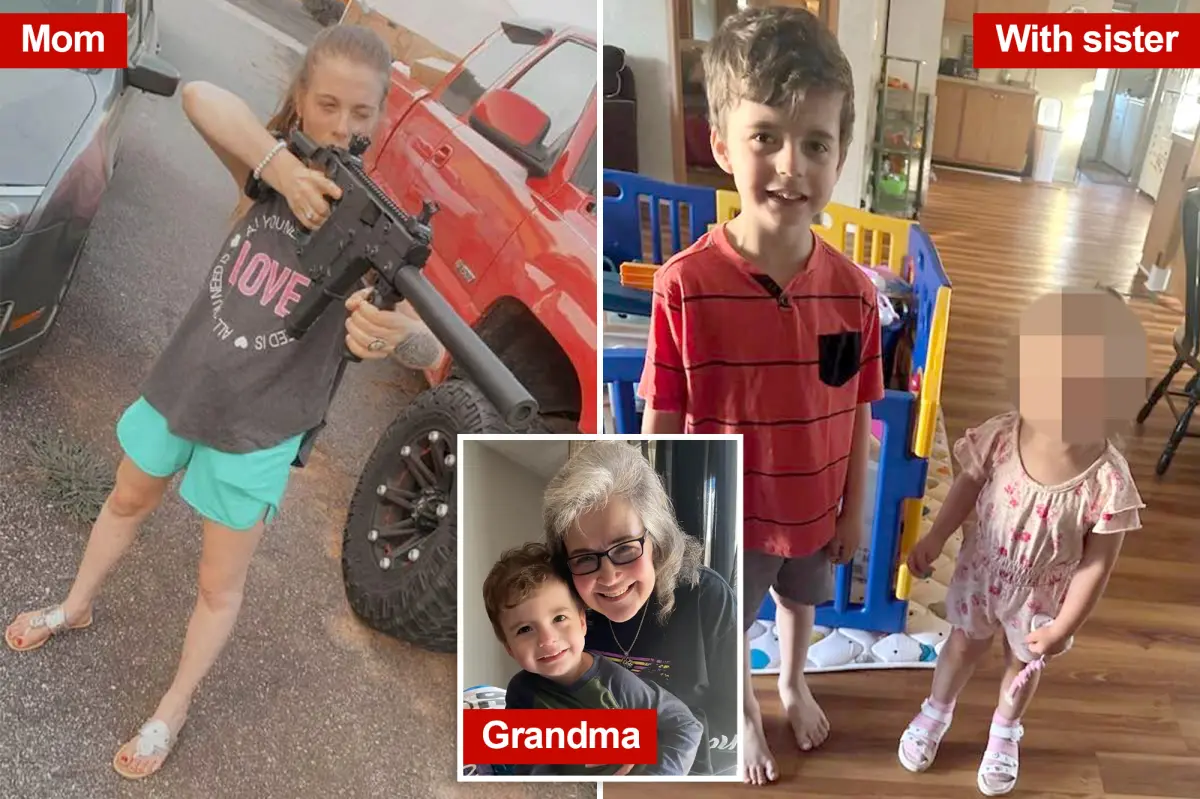
In the early hours of a late September morning, inside a small home in Spartanburg, South Carolina, a six-year-old boy did something that most adults would struggle to find the courage to do. Dawson, a first-grader with a gentle heart and a fierce love for his little sister, placed his own small body between his mother and his three-year-old sister Hazel during a violent knife attack. According to his grandmother, Jan Marie Mull, Dawson’s injuries were far worse than Hazel’s because he was trying to shield her. “The only thing I can visualize why Dawson had more injuries than Hazel was Dawson was trying to protect Hazel,” Mull told the US Sun. It is a sentence that no grandmother should ever have to speak, and yet it captures the pure, instinctive bravery of a child who did not think about his own safety when his sister needed him. The attack, allegedly carried out by their mother, 35-year-old Taylor Gosnell, left both children with nearly fifty stab wounds between them, wounds so deep that in some places the lacerations cut down to the bone. Yet despite the horror of what happened, Dawson’s act of love may well have saved his sister’s life.
The physical toll on these two young children is almost impossible to process. Authorities and medical experts confirmed that Dawson sustained the worst of the injuries, and his grandmother told reporters that doctors are now facing the grim possibility of amputation. “The medicine keeps him knocked out. They are looking at amputation,” Mull said. The words hang heavy with grief and uncertainty. Hazel, though also brutally wounded, is in stable condition, but stable is a relative term when a child has survived such an unthinkable assault. The solicitor’s office described lacerations so deep they exposed bone, and one can only imagine the terror of those moments when the children were alone with a parent who should have been their safest refuge. The fact that both children are still alive is, in itself, a kind of miracle, but the road ahead will be long and painful. There will be surgeries, rehabilitation, and emotional scars that no bandage can reach. Dawson may lose a limb, and even if he does not, he will carry the memory of this night in his body and mind for the rest of his life. His grandmother, still reeling from the news, said she was “floored” when she learned what had happened. “I couldn’t breathe. Honest to God, I could not breathe. I was freaking floored,” she said. It is the reaction of anyone who has ever loved a child, the visceral shock of realizing that the most innocent among us can be caught in the crossfire of a parent’s unraveling.
What makes this story even more heartbreaking is the way the children were discovered. Dawson, despite his injuries, somehow managed to call his grandmother to complain that he was hungry. It was a small, childlike request from a boy who had just endured something no human being should endure. That phone call led to a wellness check, and when authorities arrived at the home, they found the two children alone, covered in blood. The image is searing: a tiny boy and his even tinier sister, sitting in the wreckage of their home, waiting for someone to help them. Dawson’s ability to make that call, to reach out for help in the only way he knew how, is a testament to his resilience. Shortly after police arrived, Gosnell returned to the home and appeared distressed. She was taken to an ambulance for a mental health evaluation, but at some point she attempted to flee and had to be handcuffed to a stretcher. It is a detail that suggests a woman in the throes of a profound mental health crisis, but it does little to soften the reality of what her children endured. The authorities did their job that day, and the children were rushed to medical care, but the emotional and psychological damage will take years to untangle.
For Jan Marie Mull, the shock is compounded by the fact that she never saw this coming. Gosnell had, in the grandmother’s words, never been known to beat or abuse the children. “I’ve never known [Taylor] to beat or abuse these kids,” Mull said. “No bruises, nothing. I don’t know what happened.” That sense of bewilderment is common in horrific cases like this, but it does not make it any less painful. Mull’s own son Blake, Dawson’s father, has passed away, which means these children have already lost one parent and now face the potential loss of their mother to prison or psychiatric care. The family has been fractured in the most brutal way imaginable. Yet Mull says she was not surprised that Dawson would step in to protect his sister. “Dawson’s got that kind of love for everybody. He takes after my son in that department. I think he was just probably trying to protect her,” she said. Those words paint a portrait of a boy who learned love from his father, a boy who embodies the best of a family even in its darkest hour. Mull’s pride in her grandson is evident even through her tears, and it offers a small glimmer of light in a story otherwise full of shadows.
On the legal side, Taylor Gosnell is currently being held without bond, and she is scheduled to appear in court on November 12. The charges and the evidence are still being processed, but the case will likely hinge on her mental state at the time of the attack. The fact that she attempted to flee when taken for evaluation suggests a level of disorientation or fear that will be central to the proceedings. It is possible that the court will order a psychiatric evaluation, and it is equally possible that Gosnell will spend a long time in a treatment facility rather than a traditional prison. But for the two children, the legal outcome is almost secondary. What matters most is their physical recovery and the support system that will surround them in the months ahead. Their grandmother appears determined to be that support, even as she struggles to process the enormity of what has happened. The community, too, has likely rallied around the family, as it often does in the face of such inexplicable violence. There will be fundraisers, prayers, and offers of help, and all of it will be necessary. But the task of helping Dawson and Hazel heal will fall to those who love them, and they will need patience, strength, and an endless supply of gentleness.
In the end, this is a story about a child’s courage, a grandmother’s love, and the fragility of the human mind. Dawson is being hailed as a hero, and he is, but he is also just a little boy who wants to go home, who wants his mother to be okay, who wants to stop hurting. He may lose a limb, but he will not lose the love that made him throw himself in front of his sister. That love is the most powerful force in this story, and it is the only thing that can truly heal the wounds that cannot be seen. As the family waits for November 12, as Dawson fights through surgeries and Hazel learns to feel safe again, there is hope, fragile but real. There is hope in the grandmother who refuses to fall apart completely, hope in the medical teams working to save a little boy’s body, and hope in the bond between a brother and sister that no knife could sever. The road ahead is long and uncertain, but Dawson’s act of bravery has already proven that even in the darkest moments, love can be strong enough to protect us. And that is a truth worth holding onto.