






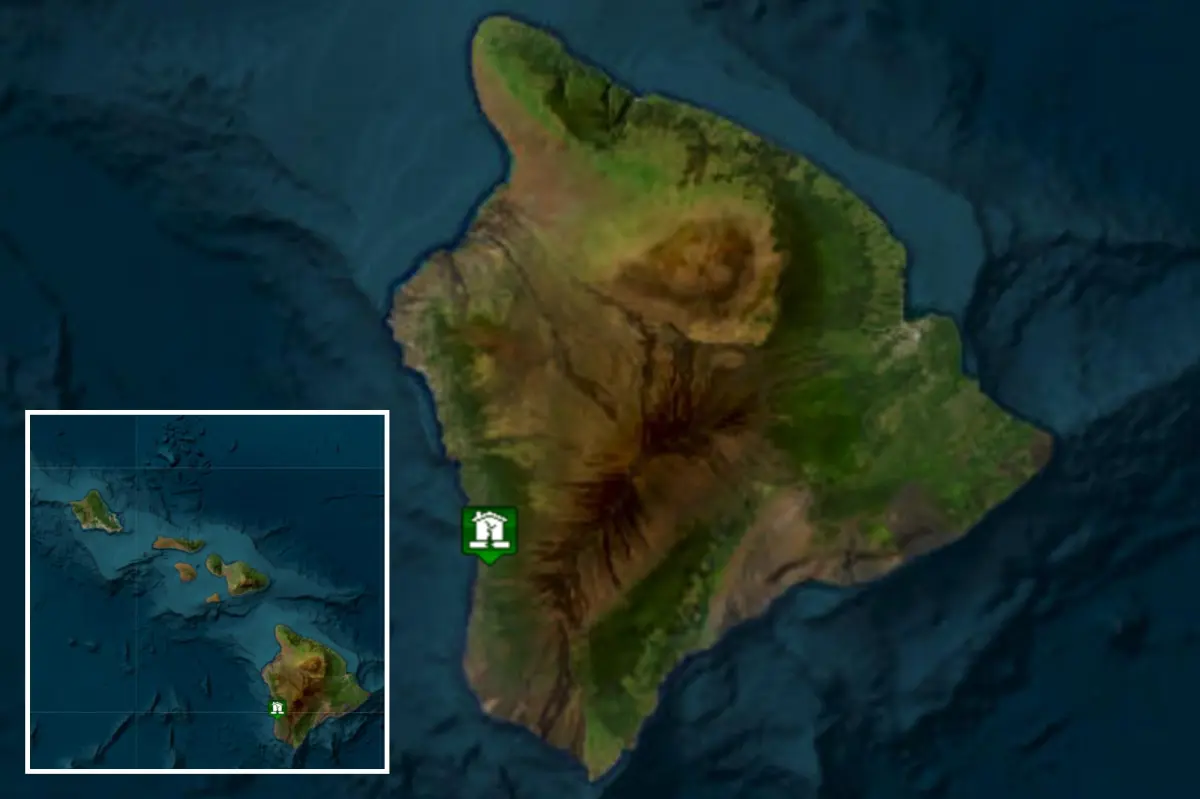
Late on a peaceful Friday evening, when the cool tropical breeze and the soft, rhythmic lull of the Pacific Ocean usually bring a sense of tranquil closure to the week, the Big Island of Hawaii was suddenly jolted by a powerful magnitude 6.0 earthquake. The epicenter of the deep tremor was located near the scenic and historic coastal community of Honaunau-Napoopoo, an area renowned for its lush coffee farms, ancient archaeological sites, and dramatic volcanic cliffs. Within moments, the sudden underground rupture sent violent shockwaves traveling rapidly across the ocean floor, expanding outward like ripples on a dark, watery canvas. The earth’s abrupt shuddering was felt widely across the entire Hawaiian archipelago, extending far beyond the Big Island to wake sleeping families on the beaches of Maui and rattle high-rise condominiums in the bustling streets of Honolulu on Oahu. For those who experienced it, those brief seconds of shaking felt agonizingly long; heavy wooden roof beams groaned, ceiling lamps swayed like pendulums, kitchenware clattered loudly inside cabinets, and a low, thunderous rumble echoed through the night. It was a stark, visceral reminder to the thousands of residents and tourists alike of the incredibly fragile and dynamic nature of life on these volcanic islands, which rise majestically but precariously from the deepest trenches of the vast Pacific Ocean, showing that paradise is always subject to the sudden shifts of the earth beneath.
Almost immediately, the conversation and thoughts of local residents turned to Kilauea, one of the world’s most active and awe-inspiring shield volcanoes, which dominates the southeastern landscape of the Big Island. Kilauea is not merely a mountain of stone; it is a living, breathing geological force that has been in a state of nearly constant episodic eruption since December 23, 2024, captivating onlookers with its glowing lava lakes, billowing steam plumes, and dramatic fountains of fire. For generations, the people of Hawaii have developed a profound, deeply personal relationship with this volcano, viewing its continuous activity not as a hostile threat to be feared, but as the natural and sacred process of physical creation itself. When a seismic event as large as a magnitude 6.0 earthquake occurs in such close proximity, it triggers an immediate wave of curiosity, respect, and quiet concern among the local population who know how closely linked seismic activity is to volcanic behavior. People instinctively stepped out onto their lanais to look toward the glowing night sky, wondering if the seismic energy would awaken a new phase of intense volcanic fury or alter the flow of the molten rock that constantly reshapes the island’s coastline. This connection between the community and the volcano is deeply spiritual, rooted in the ancient understanding that the earth under their feet is alive, constantly evolving, and demands a level of daily respect that few other places on the planet require.
In the wake of the initial shock, the dedicated scientific team at the United States Geological Survey’s Hawaiian Volcano Observatory (HVO) immediately sprang into action, monitoring their digital screens for updates. According to their rapid seismic analyses, the earthquake occurred at a substantial depth of approximately 14 miles beneath the Earth’s surface, a crucial geological detail that ultimately prevented widespread devastation and saved communities from disaster. In the complex science of seismology, deeper earthquakes possess a unique, somewhat merciful characteristic: while their energy is distributed over a much wider geographical area—explaining why it was felt with such clarity hundreds of miles away on Oahu—the localized shaking directly above the epicenter is significantly dampened by the miles of solid crust acting as a natural shock absorber. Had this 6.0 magnitude tremor struck at a shallow depth of just two or three miles, the shearing forces would have likely torn apart vital coastal highways, damaged fragile electrical grids, and destroyed residential homes. Knowing this crucial scientific context allowed HVO experts to quickly shift their focus to the intricate plumbing system of Kilauea, where they began meticulously analyzing real-time data from tiltmeters, GPS sensors, and sulfur dioxide gas detectors to determine whether this deep crustal shift would trigger a sudden migration of magma toward the surface or destabilize the volcano’s unstable south flank.
Adding a layer of dramatic timing to this natural event, the earthquake struck just as volcanologists were already on high alert due to a series of highly sophisticated predictive models. Earlier that very same Friday, the Hawaiian Volcano Observatory had released a routine scientific update forecasting that Kilauea’s next major eruptive episode was highly likely to manifest sometime between May 24 and May 27. For the residents of the Big Island, living alongside such precise volcanic forecasts is a fascinating exercise in balancing cutting-edge modern science with deeply rooted cultural traditions. To Native Hawaiians, these continuous geological changes are the physical manifestations of the goddess Pele, who is believed to reside within the fiery depths of Halemaʻumaʻu crater at the volcano’s summit. Rather than viewing the scientific predictions as cold, clinical data, many locals see them as a harmonious bridge between ancient indigenous wisdom and modern technology—a way to understand and prepare for the natural, fiery rhythms of an island that is still actively being born. Every tremor, earthquake, and lava flow is welcomed as a sign of renewal, rebirth, and a reminder that humans are simply visitors on land that belongs to the earth.
As the dust settled and the initial adrenaline subsided, the most immediate and terrifying concern for any coastal island community was the potential threat of a devastating tsunami. Mercifully, the Pacific Tsunami Warning Center was quick to analyze the seismic wave patterns and issue a reassuring public statement declaring that no destructive tsunami waves were expected to threaten the Hawaiian Islands, instantly lifting a heavy weight of anxiety off the shoulders of coastal residents. Furthermore, emergency response agencies reported that there were no immediate casualties or severe structural damages, a testament to both the reassuring depth of the earthquake and the resilient modern building codes designed to withstand such massive tectonic forces in Hawaii. In the quiet hours that followed, the true heart of the islands was on full display as communities rallied together, with neighbors reaching out via social media, families calming frightened household pets, and local hotlines filling with messages of mutual support. This spontaneous outpouring of care highlighted the powerful bond of aloha that unites the people of Hawaii, demonstrating that their greatest strength in times of natural uncertainty lies not in concrete and steel, but in their unwavering, compassionate commitment to looking out for one another.
In the final analysis, this magnitude 6.0 earthquake serves as a humbling yet powerful reminder of the delicate terms upon which humanity occupies this beautiful and volatile earth. For the people of the Big Island and the wider state of Hawaii, surviving such a powerful tremor without injury or major loss reinforces a profound sense of gratitude and resilience that is passed down through generations. As Kilauea goes through its restless cycles and approaches its predicted late-May eruption window, the island’s inhabitants will continue to go about their daily lives with an enhanced sense of awareness and respect for the ground they walk upon. Children will return to school, fishermen will head back out onto the deep blue waters, and life will quickly return to its usual, gentle cadence under the warm tropical sun. Yet, beneath that peaceful surface, there will remain an unspoken, shared understanding that they are merely temporary guests on a dynamic, living island, forever bound to the magnificent, primal forces of nature that continue to shape their past, present, and future, finding a unique peace within the wild, unpredictable heart of the Pacific.