





The Viral Phenomenon of Tasman Drive: How a Quiet Seaside Street Became Australia’s Prettiest Destination
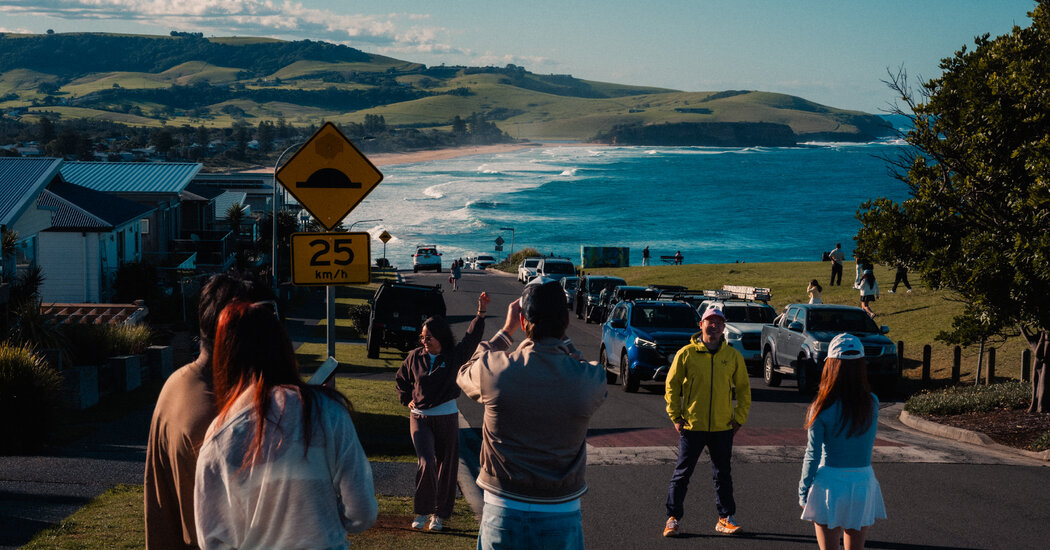
It is easy to spot the tourists on Tasman Drive. Their cars move at a glacial crawl down what was, until very recently, a quiet, unremarkable residential street overlooking the Pacific Ocean. From open car windows, hands dangle smartphones at precarious angles, desperate to capture the perfect, unobstructed perspective of the horizon, while on the asphalt below, visitors take up positions behind tripods set up directly in the middle of the active roadway. Others stand in small clusters, their eyes glued to their screens as they meticulously analyze, crop, and filter selfies they hope will capture the imagination of the digital world. This short stretch of road in the relaxed, historic coastal town of Gerringong—located in the Illawarra region of New South Wales, roughly 90 miles south of Sydney—has captured the internet’s collective imagination, earning the unofficial yet globally recognized moniker of “Australia’s prettiest street.” Over the past twelve months, this peaceful enclave has been thoroughly transformed by a relentless wave of social media tourism, with thousands of travel influencers and international sightseers descending upon the neighborhood to produce a continuous stream of viral videos for platforms like Instagram and TikTok.
The geography of Tasman Drive explains why it has become such a compelling visual magnet for digital creators. While sleek, multimillion-dollar modern coastal properties line the western side of the street, the eastern side offers a breathtaking, completely unobstructed panoramic view of the South Coast’s legendary natural landscape. A wide, sweeping reserve of vibrant green grass serves as a natural viewing platform, sloping dramatically down toward rolling emerald hills that frame the deep blue waters of the ocean below. When viewed from the crest of the hill, the street itself appears to perform a spectacular optical illusion: the asphalt dips so sharply that, to the human eye and the camera lens, the coastal bay seems to swallow the road entirely. This juxtaposition of manicured modern architecture, dramatic topography, and the infinite horizon creates an almost surreal, postcard-perfect backdrop that has proved irresistible to a generation of travelers who prioritize “Instagrammable” aesthetics above all else, turning a once-hidden local treasure into a global digital landmark.
The Eiffel Tower of Gerringong: Daily Life in the Shadow of Social Media Virality
                 _._ _..._ .-',     _.._._
                '-. `     '  .'    .'.'   `.
                   `-,_ _..-'_    / /
                   _.-'      `-._ | |       |
                 .'              `'      /
                /     Tasman         `._.'
               |       Drive         |  V
                     (Viral)       /
                 `._             _.'
                    `-.._____..-'
For the long-term residents of Tasman Drive, the sudden, overwhelming transformation of their neighborhood has required a massive shift in how they navigate their daily lives, forcing them to find a delicate balance between their privacy and the public’s curiosity. “Everyone who has traveled to Paris and seen the Eiffel Tower wants to get a photo in front of it,” explains Kevin Dale, a retired resident who has lived on the street for over a decade. “Well, this street has effectively become our Eiffel Tower; people travel from all over just to have their photograph taken on this exact stretch of road.” During peak holiday seasons, school vacations, and warm summer weekends, the resulting traffic congestion can become so severe that locals say they must plan their lives around the movements of the tourists.
Many residents now rush to complete basic domestic errands early in the morning before retreating inside their homes to hunker down during the busiest hours of the afternoon. At its worst, the narrow two-lane road is completely choked with vehicles parked haphazardly on both sides of the street, making it nearly impossible for local traffic, delivery trucks, or emergency services to pass through safely. The disruptions, however, extend far beyond parking issues and slow-moving cars. Some overzealous visitors have knocked on residents’ doors to ask if they can use their private bathrooms or kitchens, and local council meetings have noted disturbing reports of frustrated tourists relieving themselves on front lawns due to a lack of public facilities. Furthermore, the local council recently highlighted that some grieving residents have been physically blocked from accessing the peaceful cemetery located at the top of the adjacent hill because of the chaotic parking situation, showing how tourism can disrupt even the most solemn aspects of community life.
The High Toll of Overnight Fame: Balancing Economic Prosperity and Infrastructure Constraints
The ongoing crisis on Tasman Drive highlights a larger global dilemma: the delicate, often volatile balancing act between the economic benefits of viral tourism and the preservation of local community well-being. Like many picturesque, historical towns dotting the East Coast of Australia, Gerringong’s modern economy relies heavily on visitors to support its boutique shops, surf stores, cafes, and hospitality venues. This economic dependence is clearly reflected in recent municipal data, which shows that average monthly tourism spending in the Kiama municipal area rose to an impressive 2.4 million Australian dollars (approximately 1.7 million USD) over a recent six-month period. This represented a substantial 51.6 percent increase from the preceding six-month period, demonstrating the powerful role digital media plays in driving real-world economic growth to regional areas.
However, this rapid influx of capital highlights a major structural challenge: digital platforms can drive massive consumer demand in real time, while physical public infrastructure takes years of planning and funding to adapt. The sudden transition of Tasman Drive from a quiet residential street into a high-octane tourist destination has left the neighborhood struggling with issues like waste management, traffic control, and public sanitation. When a quiet neighborhood goes viral overnight, the traditional boundaries between public recreation areas and private residential spaces are erased, leaving municipalities with the difficult task of managing the negative impacts of tourism while protecting the local economy.
+———————————————————–+
| GERRIYONG’S TOURISM LANDSCAPE |
+—————————–+—————————–+
| ECONOMIC WINDFALL | CIVIC INFRASTRUCTURE |
+—————————–+—————————–+
| AU$2.4M monthly spend | Chronic gridlock |
| 51.6% growth half-on-half | Lack of public restrooms |
| High retail/cafe revenue | Restricted cemetery access|
| Boost to local employment | Residential disturbance |
+—————————–+—————————–+
Coexistence Over Exclusion: How Local Authorities Seek to Tame the Tourist Tide
In response to these mounting challenges, the Kiama Municipal Council and local community leaders are trying to address residents’ concerns without harming the tourism economy that keeps the region vibrant. Mayor Cameron McDonald admitted that the sudden popularity of Tasman Drive caught the council off guard, but he emphasized that they are working hard to put practical solutions in place. In the coming weeks, the council plans to launch a door-knocking campaign, visiting homes on Tasman Drive to gather feedback directly from residents and ensure their experiences guide future planning.
Rather than closing off the street or putting up unwelcoming barriers, the council is considering several infrastructure upgrades designed to help the area cope with its newfound fame. These proposed measures include:
- Strategic Parking Restrictions: Implementing timed parking and clear-way zones to prevent vehicles from blocking access to driveways and local streets.
- Multilingual Signage: Placing clear, accessible signs that direct visitors to existing public restrooms, parks, and legal parking areas.
- Enhanced Amenities: Installing extra high-capacity trash cans and picnic tables along the grassy reserve to encourage visitors to keep the area clean and orderly.
“Certainly, we won’t be turning anyone away,” Mayor McDonald noted, reaffirming the town’s welcoming spirit. However, he urged tourists to show consideration, asking that they “respect local residents and their property, and exercise good judgment and safety when taking pictures in the street.”
Generosity Amidst the Crowd: The Enduring Charm of Tasman Drive’s Longtime Residents
Despite the regular disruptions to their peace and quiet, many of the families who live on Tasman Drive continue to show remarkable generosity and warmth toward the steady stream of visitors. Kevin Dale and his wife, Leta, who have lived on the street for over twelve years, refuse to let the crowded road dampen their love for their coastal home. In fact, Ms. Dale notes that seeing the joy the view brings to visitors has actually renewed her own appreciation for the landscape. “It’s made me more aware of just how beautiful it is,” she says with a smile, adding philosophically, “after all, we’re all tourists at some point in our lives.” Their welcoming attitude is more than just talk; on several occasions, the couple has opened their own front door to let desperate tourists use their family bathroom.
This sense of hospitality is shared by their neighbor Cathy O’Connor, who bought her property on Tasman Drive in 2010. She harbors no resentment toward the crowds of selfie-seekers, noting that “everyone should be able to enjoy this view; I don’t own the ocean.”
           [ Tasman Drive Residence ]
                   /_________
                   |  _   _  |  <- (The Dales' Home)
                   | |.| |.| |
               ====|_|*|_|*|_|====
               |                 |  <- (Desperate tourists welcomed
               |    [WELCOME]    |     inside on busy days)
However, both the Dales and their neighbors admit that the situation has caused some genuinely difficult moments. On one occasion, the Dales’ specialized commercial van—which they rely on to transport their daughter, who uses a wheelchair—was completely boxed in by a visitor’s parked vehicle, leaving them temporarily stranded. While some neighbors feel more frustrated by the crowds, the general consensus on the street is a willingness to share their view, provided the local council installs the necessary infrastructure to manage the flow of visitors and protect residents’ safety.
The Digital Footprint of Modern Travel: Navigating the Viral Future of Coastal Communities
The transformation of Tasman Drive highlights the powerful role social media plays in shaping modern travel patterns, showing how digital platforms can redefine physical spaces overnight. Susan Grantham, a professor of social media at Griffith University, points out that the sudden virality of suburban areas can be highly stressful for residents who purchased their homes expecting a quiet, private life. “These people bought houses on a quiet street and now find themselves living in a highly popular destination, with crowds of travelers all searching for that perfect shot,” she explains. This shift has created an interesting dynamic, where visitors who discover the street online often arrive expecting crowds and local tension, yet are still captivated by the beauty of the landscape.
During a recent busy afternoon on Tasman Drive, young travelers Danica Lathanie and Rionart Prakarsa, who had driven down from Sydney after seeing the location on TikTok, reflected on this dynamic. “I actually expected to see massive crowds today,” Lathanie admitted, citing TikTok videos warning that the street was becoming overrun and that locals were growing tired of the noise and mess. “But it turns out it’s actually quite peaceful today,” she added, while Prakarsa described the panoramic view as “absolutely extraordinary” and well worth the drive.
As the sun sets over the ocean, casting a golden light across the grassy hills of Gerringong, the crowd of photographers gradually packs up their gear and heads home. Left with the quiet evening air, the Dales sit on their balcony to enjoy the view, feeling lucky to call this legendary stretch of coast their home. “We really are blessed,” Ms. Dale says, looking out over the water. “I wouldn’t want to live anywhere else.”