





Ashes in the Garden: How Distrust and a Rare Ebola Strain Sparked Chaos in Bunia
A Landscape of Fear: The Fiery Collapse of Trust in Bunia’s Isolation Wards
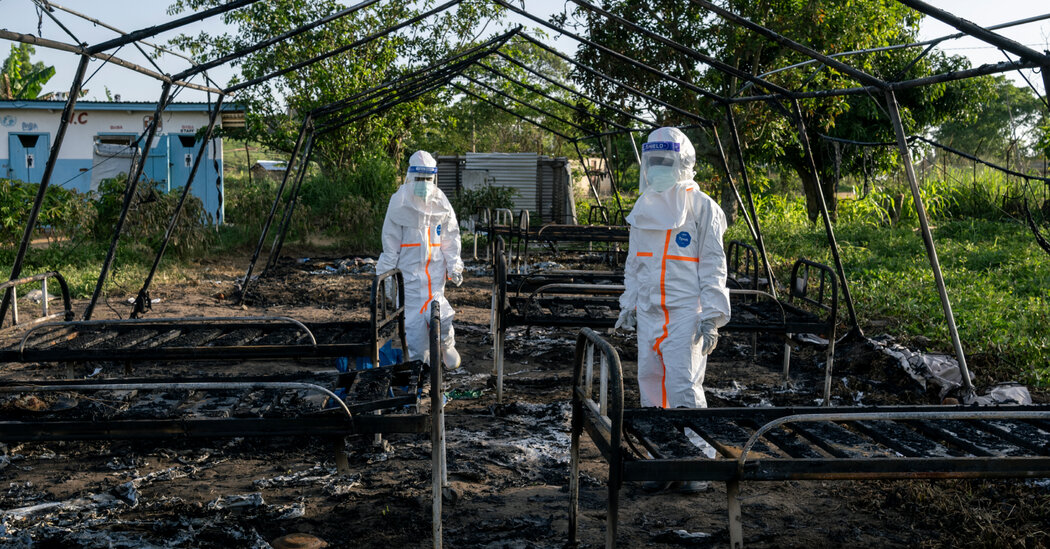
The scent of vaporized plastic and damp ash still hung heavy over the garden of the healthcare clinic on the outskirts of Bunia, a city poised at the jagged edge of the Democratic Republic of Congo’s latest humanitarian catastrophe. Nearby, four government soldiers carrying assault rifles stood sentinel by the rusted iron gates, their watchful eyes scanning a road that only hours earlier had been choked by a mob of hundreds of rioters. Behind them, where a state-of-the-art isolation ward had stood as a fragile bulwark against an invisible killer, lay nothing but a charred wasteland of skeletal tent poles, melted medical equipment, and the ruined foundations of a clinic designed to save the dying. This devastating flashpoint was sparked by the tragic demise of Elie Munungo, a beloved twenty-eight-year-old local icon whose roles as a soccer player, church choir vocalist, and motorcycle taxi driver made him a central figure in the social fabric of the community. When his sudden death—initially misdiagnosed by his family as a routine bout of malaria—led medical staff to quarantine his remains to prevent an epidemiological chain reaction, a wave of deep-seated suspicion swept through his peers. Refusing to allow a closed-coffin, sanitary burial that violated sacred ancestral funerary customs, an angry crowd stormed the gates, throwing heavy rocks at humanitarian vehicles and overwhelming the local security forces. As police officers fired warning shots into the equatorial sky, the two canvas isolation tents caught fire, forcing five terrified, highly infectious patients to flee for their lives into the dense urban sprawl of Bunia. This chaotic event laid bare the terrifying chasm of trust separating a traumatized population from the international medical teams trying to rescue them from the epicenter of an aggressive, deadly pathogen.
Unarmed Against an Invisible Enemy: The Unique Threat of the Bundibugyo Ebola Strain
                 EMERGENCY RESPONSE INFRASTRUCTURE
                 ┌──────────────────────────────┐
                 │     International Aid        │
                 │  (Supplies piled on runway)  │
                 └──────────────┬───────────────┘
                                │ (Severe logistical bottlenecks)
                                ▼
                 ┌──────────────────────────────┐
                 │   Local Isolation Centers    │
                 │  (Vulnerable to civil unrest)│
                 └──────────────┬───────────────┘
                                │ (Loss of trust / violence)
                                ▼
                 ┌──────────────────────────────┐
                 │      Active Outbreak         │
                 │ (Undetected spread in Bunia) │
                 └──────────────────────────────┘
Compounding this volatile social environment is a stark biological reality: the medical responders operating in Ituri province are fighting this epidemic with their hands effectively tied behind their backs. Unlike the more common Zaire variant of the virus, which has been successfully mitigated in recent years by the deployment of highly effective vaccines like Ervebo and targeted monoclonal antibody therapies, the current crisis is driven by the rare and elusive Bundibugyo species of Ebola. For this specific strain, there is no certified vaccine, no approved therapeutic cocktail, and no established protocol beyond basic supportive care, leaving clinicians with an empty arsenal and patients with a frighteningly high mortality rate. Making matters worse, global epidemiologists acknowledge that this outbreak went entirely undetected for at least two agonizing months after the initial infection occurred in a remote village near the Ugandan border. By the time genomic testing confirmed the presence of the pathogen, the chain of transmission had already wound its way through regional trade routes, traditional healing compounds, and crowded urban neighborhoods. This disastrously delayed detection meant that by the time international emergency teams arrived to set up field hospitals, they were already weeks behind the virus’s natural trajectory, trying to trace hundreds of secondary and tertiary contacts who had vanished into a population harboring a deep-seated resistance to Western medical intervention.
Echoes of Conflict: Why Medical Skepticism Runs Deep in Eastern Congo
To truly understand the visceral anger that culminated in the burning of the Bunia isolation ward, one must look closely at the scarred history of northeastern Congo, a region that has spent the better part of three decades abandoned by its central government and terrorized by shifting alliances of armed militias. For the generations of citizens who have grown up in Ituri province, the state has rarely manifested as an entity of protection or social welfare; instead, it has been experienced primarily through the lens of extraction, militarized violence, and systemic neglect. This history of profound state betrayal has fostered a pervasive community trauma, creating a fertile psychological ground for misinformation and conspiracy theories to take root with devastating efficiency. When international non-governmental organizations arrive in fleets of expensive white SUVs, wearing foreign biohazard suits that resemble science-fiction armor, locals do not see saviors—they see an invasive, well-funded apparatus that profits off their misery while ignoring their daily struggles with chronic poverty, malnutrition, and armed violence. Rumors quickly spread through the markets and backstreets of Bunia that the clinics are harvesting organs or that the medics are injecting patients with poisons to secure ongoing funding from foreign donors. As the hospital’s exhausted director, Dr. Isaac Mugenyi, lamented while surveying the smoking ruins of his ward, patients routinely delay seeking professional help until they are on the very brink of systemic organ failure, turning to traditional herbalists first. Consequently, when these patients inevitably pass away shortly after arriving at the clinic, it reinforces the community’s terrifying conviction that the hospital is a place of execution rather than a sanctuary of healing.
Shaky Alliances and Grounded Flights: The Geopolitical Hurdles of Containment
OUTBREAK TIMELINE & DISRUPTION[Month 1-2] [Month 3] [Current Phase]
┌──────────────────────────────┐ ┌────────────────────────────┐ ┌──────────────────────────────┐
│ Silent Transmission │ │ Outbreak Confirmed │ │ Logistical Gridlock │
│ │ │ │ │ │
│ • Mimics malaria symptoms │ │ • WHO sounds global alarm │ │ • Uganda suspends UN flights │
│ • Traditional cures sought │ │ • Isolation wards built │ │ • Aid stockpiled on runways │
│ • No early diagnostics used │ │ • Local riots erupt │ │ • Regional containment halts │
└──────────────────────────────┘ └────────────────────────────┘ └──────────────────────────────┘
While local resistance cripples the response on the ground, a parallel crisis of international logistics and fractured global health diplomacy is stalling the flow of life-saving materials from above. According to internal United Nations documents, the regional response suffered a crippling blow on Friday when the UN was forced to halt all humanitarian flights between Uganda and the Democratic Republic of Congo following a sudden, unilateral directive from the Ugandan government. This aerial suspension has essentially severed the primary logistical pipeline for transport, leaving massive piles of personal protective equipment, laboratory reagents, and field hospital components abandoned on the tarmac at Bunia’s small domestic airport. The World Health Organization estimates that the death toll has already climbed to 177 lives out of more than 750 confirmed cases, a figure that health administrators admit is almost certainly an underestimate due to unregistered domestic burials and cases hidden in remote villages. This bureaucratic paralysis is further exacerbated by a shifting global health landscape, characterized by the United States’ highly controversial withdrawal from the WHO earlier this year, which severely disrupted long-term funding models and fractured the coordinated command structures necessary to manage trans-border pathogens. Without a united geopolitical front, the emergency response has degenerated into a patchwork of underfunded agencies competing for scarce resources, leaving local administrators to face a highly infectious, incurable pathogen with dwindling supplies and compromised communication channels.
A City Divided Against Itself: The Chilling Contrast of Daily Life in Bunia
Despite the looming threat of an uncontrolled epidemic, the city of Bunia on Friday presented a surreal facade of bustling, everyday normality that masked a deep undercurrent of psychological dread. In the central market, women balanced heavy baskets of cassava roots and bright purple eggplants on their heads, navigating narrow pathways where laughing school children dodged sputtering motorcycle taxis. Yet, this superficial vitality was betrayed by subtle shifts in the community’s behavioral patterns: hand sanitizer bottles had completely vanished from pharmacy shelves, and simple paper face masks were retailing at ten times their standard price, transforming basic hygiene into a luxury reserved only for the wealthy. At a sprawling funeral service held in a residential compound nearby, the traditional, high-touch rites of grieving were conspicuously absent; instead, stoic youth leaders stood at the entrance checking mourners’ temperatures with digital infrared guns, offering plastic cups of cold soda as a substitute for the communal meals that usually cement community ties in times of loss. This behavioral schism reflects the profound anxiety of residents like thirty-two-year-old Elizabeth Kombi, a mother of six who has made the painful decision to pull her children out of school and lock them within the confines of her modest home. Clutching her last unsold bottle of medical disinfectant, Kombi expressed her deep skepticism regarding the timeline of global intervention, noting that while families pray every day for the arrival of clinical therapies, the harsh administrative reality of the WHO means that a validated treatment for the Bundibugyo strain may be more than half a year away.
The Human Toll on the Frontline: Fighting a War with No Weapons
                ┌────────────────────────────────────────┐
                │  EPIDEMIOLOGICAL PRESSURE POINTS       │
                ├────────────────────────────────────────┤
                │ • Pathogen: Bundibugyo Ebola Strain    │
                │ • Clinical Vulnerability: No Vaccine   │
                │ • Environmental Risk: Armed Conflict   │
                │ • Social Barrier: Pervasive Distrust    │
                │ • Logistical Halt: Border Closures     │
                └────────────────────────────────────────┘
The tragedy of the Bunia crisis is ultimately borne by the low-wage healthcare workers who choose to return to these volatile wards day after day, operating at the dangerous intersection of infectious disease and public fury. Among them is Elekane Bugasaki, a local head hygiene worker whose daily responsibilities include spraying down contaminated wards with highly corrosive chlorine solution and ensuring that highly infectious biological waste is safely incinerated. As he peeled off his heavy rubber boots at the conclusion of an exhausting, tension-filled shift, Bugasaki confessed that his primary motivation for continuing this high-stakes work is the survival of his own seven children, who live in a neighborhood directly downwind from the hospital. His quiet dedication stands in stark contrast to the institutional chaos around him: the body of Elie Munungo was eventually retrieved and buried in secret by his relatives, but the remains of another suspected Ebola patient were accidentally cremated during the riot, further inflaming local rumors of medical desecration. When asked how he finds the emotional resilience to step back into his protective suit each morning, knowing that five active Ebola patients are now missing in the community and that the clinic lacks any curative drugs, Bugasaki offered a weary smile and held up his chlorine-stained hands. “I am deeply afraid, and I spend my nights praying to God for protection,” he whispered, reflecting the existential dread of a frontline workforce abandoned by the global community. “But when there is no treatment, when there is no vaccine, and when our own neighbors are burning down the tents, how can any of us truly be safe?”
Key Takeaways of the Bunia Outbreak
- Rare Viral Strain: The epidemic is driven by the Bundibugyo species, which lacks the established vaccines and therapeutic options available for the Zaire strain.
- Delayed Intervention: Epidemiologists estimate that the virus spread unchecked for two months prior to official detection, severely undermining early contact tracing efforts.
- Armed Conflict and Distrust: Decades of institutional neglect and militant violence in Eastern Congo have left the population highly suspicious of foreign medical actors.
- Logistical Instability: The suspension of UN humanitarian flights from Uganda has blocked critical supply chains, leaving vital emergency gear stranded at domestic airports.
- Frontline Vulnerability: Local healthcare workers face the double threat of accidental exposure to an incurable virus and physical violence from an angry, misinformed populace.