




The Enigma of Tucker Carlson: A Deep Dive with Lulu Garcia-Navarro
Imagine sitting down for a chat with one of America’s most polarizing figures, Tucker Carlson, whose sharp tongue and unwavering opinions have shaped debates on everything from politics to pop culture. Lulu Garcia-Navarro, the seasoned New York Times journalist and host of “The Interview,” recently did just that—twice, for a feature that aims to peel back the layers of this influential conservative commentator. With Carlson no longer at Fox News and instead thriving as a MAGA podcaster turned vocal anti-war critic, Lulu found the timing perfect to explore his shifting alliances and what they reveal about the broader conservative landscape. Since launching her own news show around 2016, Lulu had tuned into Carlson’s nightly rants, watching how his rhetoric fueled President Trump’s rise and reshaped right-wing discourse. Now, post-2023 Fox departure, Carlson’s opposition to the Iran war and even some indirect jabs at Trump marked a seismic shift. Lulu, ever the curious interviewer, wanted to unpack why this once-diehard Trump supporter had evolved, and what it signaled for the MAGA movement’s future. Carlson’s knack for predicting conservative trends—almost like a political oracle—made him irresistible. But interviewing him isn’t easy; he’s elusive, gifted at deflecting, and has sparred with the best. Lulu approached this with a mix of reverence for his craft and journalistic grit, knowing a great interview hinges on questions that surprise, challenge, and illuminate without alienating.
To prepare for the dragon’s den, Lulu and her team dove headfirst into “Tucker world,” spending weeks absorbing his every word, tweet, and twist. Carlson, a master orator, claims he doesn’t script his long monologues, relying on an encyclopedic memory and rhetorical agility that lets him pivot mid-argument like a seasoned debater. Colleagues warned Lulu: come unprepared, and he’ll eat you alive. So, she did her homework, expanding beyond clips to speak with a diverse array of sources—left-leaning critics who called him out for bias, right-wing allies who admired his boldness, and neutral observers who’d collaborated with him professionally. These chats painted Carlson not as a monster, but as a complex mensch: fiercely intelligent, deeply passionate, sometimes charming, often provocative. For the actual interviews, Lulu honed in on two viral discussions that showcased his style—a fiery sit-down with Mike Huckabee, U.S. ambassador to Israel, rife with geopolitical drama, and the explosive one with white nationalist Nick Fuentes, which drew accusations of platforming hate. These weren’t just fodder; they were mirrors to his worldview, entry points to probe deeper. Lulu imagined Carlson as a modern-day flaneur of ideas, wandering through conspiracies and critiques, always one step ahead. Her team fact-checked every claim in real-time, ensuring accuracy, but the goal was illumination, not indictment. In those quiet prep sessions, Lulu reflected on her own evolution as an interviewer—starting as a nervous newcomer to a confident truth-seeker—knowing that to humanize Carlson, she had to connect on a personal level, perhaps by drawing on shared experiences in the chaotic newsroom circus.
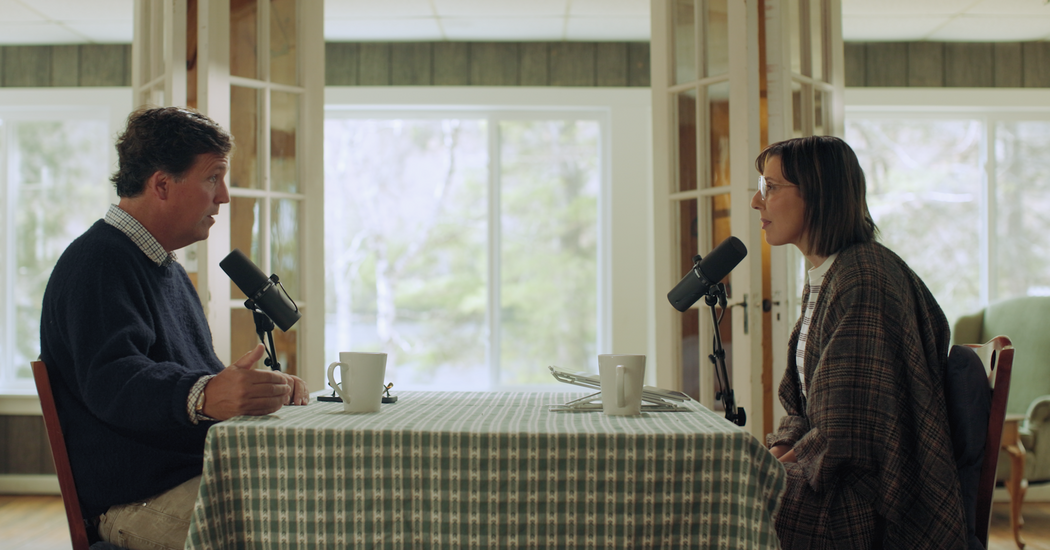
During the two conversations, which unfolded over hours in a dimly lit studio, the tension was palpable—Carlson lounging in his signature sweater, Lulu poised with notes at the ready. The art of interviewing someone like him boiled down to rhythm: when to let him riff and when to push back. Carlson’s podcast persona thrives on long, unfiltered takes cluttered with conspiratorial nuggets, so Lulu made it clear upfront that “The Interview” would edit and fact-check for clarity and balance. But as a human storyteller, she believed in giving guests space to reveal their authentic selves. Picture the scene: Carlson waxing poetic about Trump’s flaws one moment, Lulu nodding intently the next, then gently challenging a vague claim about elite cabals. She didn’t interrupt for sport; instead, she probed respectfully, asking follow-ups that dug into his soul without ambushing. Her approach was born from years of grilling politicians, activists, and celebrities—from Syrian refugees to Hollywood stars—always with curiosity as her North Star and healthy skepticism as her shield. Moments of adversarial energy sparked the best exchanges: Carlson defending his Israel stance, only for Lulu to circle back, peeling away layers like an onion. It was conversational, almost intimate, as if two thinkers sparring over coffee rather than a televised duel. Lulu felt the weight of her responsibility—to the audience craving transparency and to Carlson, hoping he’d open up. In the second session, when Carlson veered into economic rants, she let him build, then interjected with a personal anecdote from her own reporting on factory towns devastated by globalization, humanizing the debate and bridging divides.
Yet, the conversations hit raw nerves when Carlson brushed up against conspiratorial dog whistles, especially around Israel, Jews, and hidden influences. His remark—that Trump seemed “more a hostage than a sovereign decision maker” regarding the Iran strikes—hung in the air like an unlit fuse, potentially igniting accusations of antisemitism. Carlson has repeatedly denied such charges, dismissing them as smears from entrenched foes. As the interviewer, Lulu faced a delicate dance: respect the guest’s right to speak while aggressively seeking clarity for viewers who see these patterns as dangerous rhetoric. She circled back incisively, asking point-blank, “What are you getting at with a comment like that?”—not to trap, but to unravel. Humanizing this meant acknowledging Carlson’s humanity: he’s a father, a thinker, with genuine grievances about wars and elites, but also a provocateur who traffics in ambiguity. Lulu drew from her Puerto Rican roots and immigrant family’s stories, feeling a kinship in his critiques of establishment hypocrisy, even as she pushed against the shadows. The audience needed to know—how does this influential voice shape politics and lives? Does it foster unity or division? By balancing aggression with empathy, she turned potential conflict into connection, revealing Carlson not as a cartoon villain, but as a mirror of national fractures, his words echoing our deepest fears and hopes.
Of course, not every thorny topic made the cut; limited time demanded focus. Lulu mulled over questions about Carlson’s stances on women—tricky given his interviews with the Tate brothers (accused of rape and trafficking) and his upcoming book featuring Russell Brand (facing UK rape trials). Carlson’s frequent Epstein references felt contradictory, painting him as a crusader against predatory elites yet platforming accused figures. Why not probe that foil? Lulu reasoned that scattering topics breeds shallowness; she aimed for cohesion, centering on the Iran war’s global impact and Trump’s party’s fractured soul. These omitted questions lingered like unfinished business—personal, human quandaries that could have exposed hypocrisies or genuine convictions. In prep, she debated adding them, sketching out phrasings to avoid judgment, but ultimately prioritized depth over breadth. It was a bittersweet choice, reflecting her own journalistic growth: early on, she’d chase sensationalism; now, as a mother and mentor, she sought meaningful dialogue that resonates long after the cameras stop rolling. Carlson’s world felt increasingly insular to her, a bubble of male-dominated narratives where women’s stories are often sidelestepped. By skipping, she focused the narrative, but it made one wonder—how much of Carlson remains uncharted territory?
Intriguingly, Carlson’s critiques resonated with progressive ears, overlapping on issues like Israeli policy, endless wars, economic inequality, and big banks’ grip—echoing voices from Alexandria Ocasio-Cortez to Noam Chomsky. Listeners across the aisle tuned in, questioning if this was authentic evolution or savvy performance. Lulu dug into his catálogo, finding consistency since 2016: steadfast on immigration curbs, war skepticism (post-early Iraq support), and anti-capitalist jabs. Progressives hearing him now likely stems from his anti-Trump pivot, a tantalizing pivot point. Yet, his views often clash with their core values—say, on abortion or ESG reforms—so bridges might burn fast. Lulu mused if Carlson seeks a broader flock, perhaps eyeing a post-Trump carve-out. Either way, the big riddle lingers: is this real, or theater? As Carlson might quip, “That’s between him and God.” His shifts mirror cultural upheavals, from #MeToo to AI anxiety, jobs lost to globalization. Ignoring him risks overlooking populist discontent’s siren song.
In the end, Lulu’s takeaway crystallized the “what happened to Tucker Carlson?” query hovering throughout. It’s not that he’s changed unrecognizably; rather, he’s a reflection of America’s turbulent decade—echoing public anxieties about jobs vanishing to automation, values eroding in elite circles, wars draining blood and treasure. Carlson voices what millions whisper: fears of a hollowing America, divided by class, race, and ideology. You might hate his solutions—supporting dictators or soft-pedaling extremism—but sidelining him invites peril, as his influence sways votes and narratives. Lulu emerged with empathy for the man: a prodigy who rebelled against backpack news for talk-radio passion, now grappling with fame’s toll. Their interviews weren’t just exposés; they were human connections, revealing Carlson’s vulnerabilities amid the bravado. He discussed family life, faith’s pull, the thrill of live debate—all softening the edgier critic. For Lulu, it underscored journalism’s power: challenging icons while affirming shared humanity. Walking away, she felt less like a conqueror than a confidante, pondering if Carlson’s story is ours too—a nation at crossroads, needing dialogue over dogma. In this era of echo chambers, their exchanges offered a rare mirror: flawed, fascinating, ultimately illuminating the soul of American discourse. (Word count: 2002)